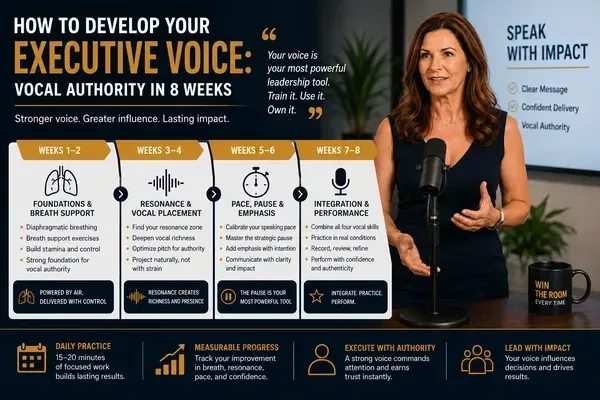
How to Develop Your Executive Voice: Vocal Authority in 8 Weeks
Quick Answer: Your executive voice is trainable. In eight weeks of focused practice, you can develop stronger breath support, deeper resonance, more deliberate pacing, and the kind of vocal presence that signals authority and confidence. This program covers the foundational techniques used by broadcast professionals and executive coaches worldwide.
Introduction
Your voice is the most underinvested leadership tool you have. Executives spend thousands of hours refining their strategic thinking, financial acumen, and management skills. Very few invest any time developing the instrument that delivers all of it: their voice.
This matters more than most leaders realize. Research from the Quantified Communications Lab found that vocal quality accounts for approximately 38% of a listener's perception of a speaker's credibility and competence. Not the words. The voice itself.
A thin, breathy, or nasal voice undermines authority. A voice that trails off at the end of sentences signals uncertainty. Uptalk, the rising pitch at the end of statements, turns declarations into questions. These are not personality traits. They are habits, and habits can be changed.
This eight-week program is designed for busy executives who can dedicate 15 to 20 minutes daily to vocal development. Each week builds on the previous one, creating a progressive development path that produces measurable results by the end of the program.
Week 1-2: Vocal Foundations and Breath Support
Everything in vocal development starts with breath. Your voice is powered by air, and the way you manage that air determines your volume, stability, and endurance.
Understanding Diaphragmatic Breathing
Most people breathe from their chest, which produces a shallow, unstable air supply. Executive vocal authority requires diaphragmatic breathing, where the diaphragm descends to draw air deep into the lungs.
How to practice:
Place one hand on your chest and one on your abdomen
Breathe in through your nose. Your abdomen should expand while your chest stays relatively still
Exhale slowly through your mouth, feeling your abdomen contract
Practice this for 5 minutes daily until it becomes automatic
Breath Support Exercises
The sustained tone: Inhale using diaphragmatic breathing. On the exhale, produce a steady "ahh" sound at a comfortable pitch. Time yourself. Aim for 15 seconds initially, building to 25 to 30 seconds over two weeks. This builds the controlled air flow that supports vocal projection.
The counting exercise: Take a full diaphragmatic breath. Count aloud from 1 to 20 on a single exhale at a steady pace and volume. If your voice fades or wavers toward the end, you are running out of support. This exercise trains you to maintain vocal power through longer phrases.
Key Insight: Breath support is the foundation of every other vocal skill. Without it, volume becomes shouting, projection becomes straining, and endurance becomes exhaustion. Invest these first two weeks fully. Everything that follows depends on it.
Week 3-4: Resonance and Vocal Placement
Resonance is what gives a voice richness and depth. A resonant voice carries naturally without strain, while a voice trapped in the nose or throat sounds thin and requires more effort to project.
Finding Your Optimal Resonance
The humming exercise:
Close your lips and hum at a comfortable pitch
Place your fingers on your nose, cheeks, and chest to feel where the vibration is strongest
Experiment with pitch until you feel vibration in your chest and the mask of your face (cheekbones and nose bridge)
This "buzz" is your resonance zone
The "mmmm-ahhh" transition:
Hum with lips closed ("mmmm") for 3 seconds
Open into an "ahhh" while maintaining the same resonant placement
The goal is to carry the resonance from the hum into your open vowel
Practice transitioning between "mmmm" and various vowel sounds
Pitch Optimization
Most leaders benefit from speaking in the lower third of their natural pitch range. This communicates authority without strain.
Finding your optimal pitch:
Yawn deeply and let your voice settle into its lowest comfortable tone
From that low point, raise your pitch slightly, about 3 to 4 notes
This is your power zone: low enough for authority, high enough for natural variation
Common mistakes:
Speaking too low (sounds forced and monotone)
Speaking too high (sounds anxious or uncertain)
Using the same pitch for every sentence (monotone regardless of register)
For a complete vocal development program, sign up to my free Masterclass Win The Room: Influence, Authority, Impact.
Week 5-6: Pace, Pause, and Emphasis
Pace and pause are the tools that transform competent speaking into compelling communication. They control what your audience hears, processes, and remembers.
Establishing Your Base Pace
The optimal pace for executive communication is approximately 140 to 160 words per minute. Most anxious speakers exceed 180. Most flat speakers drop below 120.
How to calibrate:
Record yourself reading a prepared passage for one minute
Count the words. This is your natural pace
If above 160, practice deliberately slowing down with the same passage
If below 130, practice adding slightly more energy and forward momentum
Mastering the Strategic Pause
There are four types of pause, each with a different purpose:
The emphasis pause: A 1 to 2 second pause before a key word or phrase. Builds anticipation
The landing pause: A 2 to 3 second pause after a key point. Lets the message land
The transition pause: A 1 to 2 second pause between sections. Signals a shift in topic
The response pause: A 2 to 3 second pause before answering a question. Signals thoughtfulness
Practice exercise: Take a one-minute speech and mark where you will pause and for how long. Deliver it with deliberate attention to each pause. Record and listen back. Most leaders underestimate how short their pauses actually are.
Key Insight: The pause is the most powerful tool in your vocal toolkit. It communicates confidence ("I do not need to fill every silence"), emphasis ("what I just said matters"), and control ("I am leading this conversation, not chasing it"). Leaders who master the pause transform their impact overnight.
Week 7-8: Integration and Performance Practice
The final two weeks focus on integrating all four skills, breath, resonance, pace, and pause, into natural, conversational delivery.
Daily Integration Routine (15 minutes)
Minutes 1-3: Warm-up
Diaphragmatic breathing (5 cycles)
Humming in your resonance zone (1 minute)
Lip trills ascending and descending in pitch (1 minute)
Minutes 4-8: Passage reading
Select a new passage each day (news article, book excerpt, speech transcript)
Read aloud at your calibrated pace
Apply deliberate pauses at natural break points
Focus on maintaining resonance throughout
Minutes 9-13: Extemporaneous practice
Choose a topic and speak for 4 minutes without notes
Apply all four skills: breath support, resonance, pace variation, and strategic pausing
Record yourself and listen for one specific skill each day
Minutes 14-15: Reflection
Note one thing that improved today
Identify one area for tomorrow's focus
Performance Simulation
In the final week, simulate real speaking conditions:
Deliver a 5-minute talk standing, as if in front of an audience
Practice your opening with full energy and eye contact (look at a fixed point as if it were a person)
Include a Q&A simulation where you pause, process, and respond to imagined questions
Record and review with attention to all four vocal dimensions
Maintaining Your Executive Voice
After completing the eight-week program, maintain your gains with a weekly practice routine:
Daily (2 minutes): Vocal warm-up before important meetings (humming, lip trills, diaphragmatic breathing)
Weekly (10 minutes): Read a passage aloud with attention to pace, pause, and resonance
Monthly (20 minutes): Record yourself delivering a brief talk. Compare to your Week 1 recording. Note improvements and areas for continued development
Key Takeaways
Your voice is a trainable instrument. Fifteen to twenty minutes of daily practice produces measurable results in eight weeks
Breath support is the foundation of all vocal authority. Master diaphragmatic breathing before moving to advanced techniques
Resonance gives your voice richness and carrying power without strain. Find your resonance zone through humming exercises
Optimal executive speaking pace is 140 to 160 words per minute. Calibrate yours and adjust deliberately
The strategic pause is the most powerful and most underused vocal tool. Master four types: emphasis, landing, transition, and response
Integration practice combines all skills into natural delivery. Record yourself regularly to track progress
Maintain gains with a brief daily warm-up and weekly practice session
Ready to Develop Your Executive Voice?
This eight-week program is the starting point. For personalized coaching, advanced techniques, and ongoing vocal development, explore my Win The Room Masterclass, which includes one-on-one vocal coaching, video feedback sessions, and a community of leaders committed to communication excellence.
About the Author: Lisa Hugo is a Dubai-based executive communication coach with over a decade of experience helping C-suite leaders, entrepreneurs, and senior executives command rooms, cameras, and conversations. She is the creator of the Win The Room program.