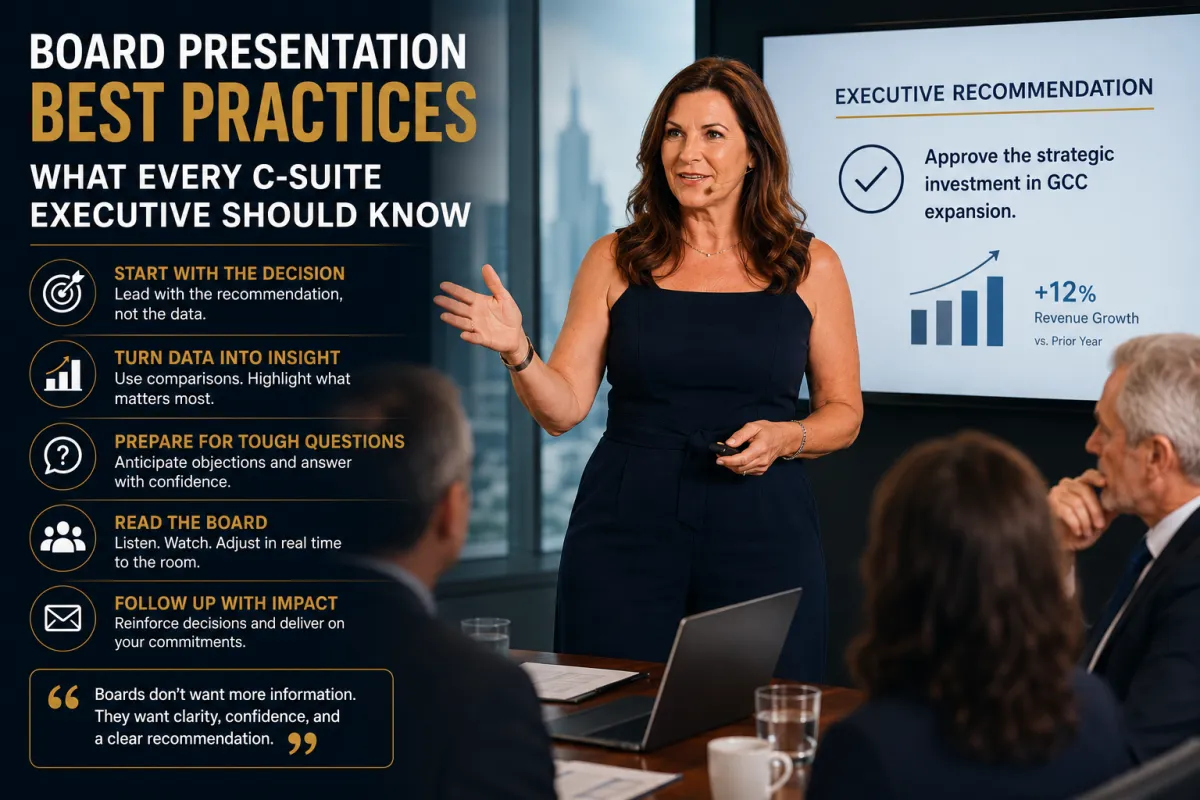
Board Presentation Best Practices: What Every C-Suite Executive Should Know?
Quick Answer: The best board presentations are concise, decision-focused, and structured around what the board needs to act on, not what you want to share. Lead with the recommendation, support it with data, anticipate objections, and close with a clear ask. Preparation for questions matters more than slide design.
Introduction
Board presentations are unlike any other speaking situation a leader faces. The audience is small, highly experienced, time-constrained, and focused on governance and risk. They are not there to be impressed by your slides. They are there to make decisions.
Yet many executives prepare for board presentations the same way they prepare for team meetings or client pitches. They build dense slide decks, walk through every data point, and treat the session as an information dump rather than a strategic conversation.
This approach fails. Board members do not want more information. They want clarity, confidence, and a clear recommendation they can evaluate efficiently.
After coaching dozens of executives through high-stakes board presentations across industries and regions, I have distilled the practices that consistently produce strong outcomes. These are the fundamentals every C-suite leader should master.
Preparation: Start with the Decision, Not the Data
The most critical shift in board presentation preparation is moving from "what do I want to present?" to "what does the board need to decide?"
The decision-first framework:
Identify the specific decision or action you need from the board
Determine the three to four key data points that support your recommendation
Anticipate the two or three objections most likely to arise
Prepare clear, evidence-based responses to each objection
Build your materials around this structure, not around your department's activities
Key Insight: Board members routinely report that the presentations they value most are those that respect their time and intelligence. Lead with the conclusion. Let them drill into the details as needed.
Pre-meeting preparation checklist:
Review the board pack and identify connections between your agenda item and others
Speak with the board chair or a trusted board member before the meeting to gauge the room's priorities
Prepare a one-page executive summary that could stand alone without your slides
Rehearse your opening 60 seconds until it is crisp and confident
Data vs. Story: Finding the Right Balance
Boards need data. But data without context is noise. The executives who present most effectively to boards translate numbers into narrative without oversimplifying.
How to structure data for a board audience:
Lead with the insight, not the chart: "Revenue grew 12% this quarter, driven primarily by our expansion into the GCC market" is better than walking through a revenue chart line by line
Use comparisons: Show performance relative to plan, prior year, competitors, or industry benchmarks
Highlight exceptions: Boards care most about what is different. What beat expectations? What missed? Why?
Be honest about unknowns: Boards respect leaders who distinguish between what the data confirms and what it suggests
The 3-slide rule for data sections:
The headline slide: your key finding in one sentence with the supporting metric
The context slide: comparisons, trends, and benchmarks that frame the number
The implication slide: what this means for strategy and what you recommend
Key Insight: The biggest mistake executives make with data is presenting too much of it. A board presentation is not a data review. It is a strategic conversation informed by data. Curate ruthlessly.
For a complete framework on structuring high-stakes presentations, see the High-Stakes Presentation Mastery Guide.
Handling Tough Questions with Confidence
The question-and-answer portion of a board presentation is where credibility is built or lost. Board members ask difficult questions not to test you, but to fulfill their governance responsibilities. How you respond matters as much as what you say.
Techniques for handling board questions:
Pause before answering. A two-second pause signals that you are thinking, not reacting. It demonstrates confidence
Acknowledge the question directly. "That is a critical question" or "You are right to push on that" shows respect for the questioner
Answer the question that was asked. Do not pivot to a more comfortable topic. If you do not know the answer, say so clearly and commit to a timeline for follow-up
Keep answers concise. Aim for 30 to 60 seconds per response. Board members will ask follow-ups if they want more detail
Watch for body language cues. If the questioner is nodding, you have addressed their concern. If they are leaning forward with a furrowed brow, you need to go deeper or clarify
Preparation strategy: Before every board presentation, list the 10 toughest questions you could be asked. Prepare a 30-second answer for each. Have a trusted colleague challenge you with them in a rehearsal.
Reading the Board: Adjusting in Real Time
Every board has its own dynamics, priorities, and unspoken concerns. The executives who present most effectively are those who read the room and adjust accordingly.
How to read a board during your presentation:
Before you begin: Note who is engaged, who seems distracted, and who is reviewing your materials
During your opening: Gauge reactions to your recommendation. Nodding signals alignment. Silence may signal skepticism or the need for more context
When you lose the room: If side conversations start or devices come out, pause. Ask a direct question: "Before I continue, is there a specific concern I should address?"
When you face pushback: Distinguish between substantive disagreement and clarifying questions. Respond to disagreement with data and reasoning, not defensiveness
Key Insight: The ability to read a board in real time and adjust your approach is what separates competent presenters from trusted advisors. It requires emotional intelligence, not just technical preparation.
Power dynamics awareness:
Identify the informal influencers on the board, not just the chair
Pay attention to who other board members look at when a tough question is asked
Respect the board's time boundaries. If you are running long, ask: "I have two more points. Would the board prefer I cover them now or send a follow-up memo?"
Follow-Up: What Happens After the Presentation Matters
The presentation does not end when you leave the room. Your follow-up reinforces your credibility and keeps momentum on decisions.
Follow-up best practices:
Send a brief email within 24 hours summarizing the key decisions made and any action items assigned to you
Deliver on any commitments you made during the Q&A within the promised timeline
If a question went unanswered, provide the answer in writing before the next board meeting
Share relevant updates between meetings if material developments occur
The follow-up email structure:
Thank the board for their time and engagement
Summarize the decision or direction agreed upon
List your committed follow-up items with deadlines
Offer availability for any additional questions
Key Takeaways
Start every board presentation with the decision you need, not the data you have
Translate data into narrative. Lead with the insight, use comparisons, and be honest about unknowns
Prepare for 10 tough questions and rehearse 30-second answers for each
Read the room in real time and adjust your pace, depth, and approach based on board signals
Follow up within 24 hours with a summary of decisions and your committed action items
Keep presentations concise and decision-focused. Boards value clarity over comprehensiveness
Build relationships with board members outside of formal presentations to understand their priorities
Ready to Master High-Stakes Board Presentations?
Board presentations are among the highest-leverage communication moments in any executive's career. See the High-Stakes Presentation Mastery Guide for a complete preparation framework, including templates, rehearsal protocols, and question-handling strategies designed specifically for board-level communication.
About the Author: Lisa Hugo is a Dubai-based executive communication coach with over a decade of experience helping C-suite leaders, entrepreneurs, and senior executives command rooms, cameras, and conversations. She is the creator of the Win The Room program.