
Table of Contents
Executive Summary
Introduction: When the Stakes Are High, Mastery Is Not Optional
Chapter 1: Anatomy of a High-Stakes Presentation
Chapter 2: Strategic Preparation
Chapter 3: Structuring for Impact
Chapter 4: Delivery Excellence
Chapter 5: Visual Design for Executives
Chapter 6: Handling Q&A Like a Pro
Chapter 7: Industry-Specific Presentation Strategies
Chapter 8: Presentation Mastery Framework
Conclusion: From Competent to Commanding
Key Takeaways
About the Author
Executive Summary
High-stakes presentations are defining moments in executive careers. A single board presentation, investor pitch, or keynote address can accelerate a career, secure funding, or shift an organization's direction. Yet despite the enormous consequences attached to these moments, most executives prepare for high-stakes presentations the same way they prepare for routine meetings, and it shows.
This comprehensive guide is designed for senior leaders, C-suite executives, entrepreneurs, and professionals who face presentations where the outcome truly matters. It covers every dimension of high-stakes presentation mastery, from strategic preparation and message architecture to delivery techniques, visual design, and the art of handling tough questions under pressure.
Drawing on more than 20 years of coaching executives through career-defining presentations, Lisa Hugo provides a proven, systematic approach that removes guesswork and replaces it with confidence. You will learn how to analyze your audience at a strategic level, structure your content for maximum impact with time-constrained executives, deliver with vocal authority and physical presence, and navigate the unpredictable Q&A sessions that often determine whether a presentation is perceived as successful.
The guide includes practical frameworks, preparation checklists, industry-specific strategies, and real-world insights from coaching leaders across financial services, technology, energy, and government sectors. Whether you are presenting quarterly results to your board, pitching to investors, delivering a keynote at an industry conference, or briefing government officials, this guide will help you perform at your highest level when the stakes are at their peak.
Introduction: When the Stakes Are High, Mastery Is Not Optional
There is a moment in every executive's career when a single presentation carries outsized consequences. Perhaps it is the board meeting where you are seeking approval for a transformational acquisition. Perhaps it is the investor pitch that will determine whether your startup receives the funding it needs to survive. Perhaps it is the keynote address that will establish you as a thought leader in your industry, or the crisis briefing where thousands of employees are looking to you for direction and reassurance.
These are high-stakes presentations, and they operate by different rules than everyday business communication. The audience is more discerning. The scrutiny is more intense. The margin for error is smaller. And the impact, both positive and negative, is amplified far beyond the moment itself.
The cost of a poor high-stakes presentation is significant and measurable. Failed investor pitches cost companies millions in unrealized funding. Weak board presentations lead to rejected strategies and stalled careers. Unconvincing keynotes result in lost deals, diminished credibility, and missed opportunities that may never return.
Yet most executives approach these pivotal moments with the same preparation habits they use for routine meetings. They compile slides until late the night before. They rehearse in their heads rather than out loud. They focus on covering every data point rather than crafting a compelling narrative. And then they wonder why the presentation did not land as they intended.
Presentation mastery at the highest level is not about natural talent. It is about systematic preparation, deliberate skill development, and a deep understanding of what moves sophisticated audiences. In my more than 20 years of coaching C-suite executives, board members, government leaders, and entrepreneurs, I have seen ordinary speakers become extraordinary presenters through the right methodology applied with commitment.
This guide provides that methodology. Every chapter is built on real-world experience coaching executives through the presentations that matter most. Read it before your next high-stakes moment, apply its principles, and experience the difference that mastery makes.
Chapter 1: Anatomy of a High-Stakes Presentation
What Makes a Presentation "High-Stakes"
Not every presentation qualifies as high-stakes, and understanding the distinction matters because it determines how you prepare. A high-stakes presentation is one where the outcome has significant consequences for you, your organization, or your stakeholders. The defining characteristic is not the size of the audience or the formality of the setting. It is the magnitude of the consequences.
A presentation is high-stakes when it involves significant financial decisions, such as budget approvals, investment requests, or major contract negotiations. It is high-stakes when career advancement depends on the outcome, such as a promotion review or a leadership assessment. It is high-stakes when organizational direction will be influenced, such as a strategic plan presentation or a merger recommendation. And it is high-stakes when reputation is on the line, such as a keynote address, a media briefing, or a crisis communication.
Key Insight: The defining feature of a high-stakes presentation is asymmetry. The potential downside of a poor performance is much larger than the potential upside of a good one. A strong presentation meets expectations. A weak one creates damage that requires significant effort to repair.
Board Presentations, Investor Pitches, and Keynotes
Each type of high-stakes presentation has its own dynamics. Board presentations require extreme conciseness, data credibility, and the ability to defend recommendations under questioning. Board members are experienced evaluators who appreciate directness and despise wasted time. A twenty-minute board presentation may influence decisions worth hundreds of millions of dollars.
Investor pitches require a compelling narrative combined with credible data. Investors are evaluating not only your business model and financials but also your ability to lead, your credibility, and your composure under pressure. They have seen thousands of pitches, and they can detect rehearsed enthusiasm, inflated projections, and evaded questions within minutes.
Keynotes require the ability to inspire, educate, and entertain simultaneously, often for audiences numbering in the hundreds or thousands. The challenge is maintaining energy, authenticity, and connection at scale while delivering content that feels both substantial and accessible.
Stakes vs. Stress Management
It is natural to feel stress before a high-stakes presentation, but it is essential to distinguish between productive and counterproductive stress. Productive stress sharpens focus, elevates energy, and enhances performance. Counterproductive stress overwhelms cognitive function, creates physical tension, and impairs delivery.
Quick Tip: The goal is not to eliminate stress. It is to manage it so that it enhances rather than undermines your performance. The techniques in this guide, particularly in the preparation and delivery chapters, are specifically designed to channel stress into performance energy.
Success Factors
Through coaching hundreds of high-stakes presentations, I have identified five consistent success factors. First, clarity of purpose: the presenter knows exactly what they want the audience to think, feel, or do after the presentation. Second, audience insight: the presenter understands their audience's priorities, concerns, and decision-making criteria. Third, narrative structure: the content follows a logical, compelling arc rather than a data dump. Fourth, delivery confidence: the presenter speaks with authority, makes eye contact, and projects calm control. Fifth, Q&A readiness: the presenter can handle tough questions without becoming defensive or evasive.
Common Failure Points
The most common reasons high-stakes presentations fail are predictable and preventable. Information overload, attempting to cover everything rather than focusing on what matters most, is the number one failure. Second is lack of rehearsal, relying on knowledge of the content rather than practicing the actual delivery. Third is poor time management, running long and having to rush through the most important material. Fourth is defensive Q&A responses, treating questions as attacks rather than opportunities. Fifth is misreading the audience, delivering a presentation suited for a different group.
Each of these failures stems from inadequate preparation, and each can be systematically prevented through the methods outlined in this guide.
Chapter 2: Strategic Preparation
Audience Analysis for Executives
Preparation for a high-stakes presentation begins not with your content but with your audience. Who will be in the room? What are their priorities? What concerns keep them up at night? What is their preferred communication style? What decisions are they empowered to make? And critically, what is their current disposition toward your topic, are they supportive, skeptical, neutral, or opposed?
For board presentations, research each board member's background, areas of expertise, and known concerns. A board member with a finance background will scrutinize your financial projections differently than one with an operations background. Tailoring your emphasis, and your anticipation of questions, to the specific composition of your audience demonstrates strategic thinking and preparation.
Quick Tip: Never present to an audience you have not analyzed. Even five minutes of research into who will be in the room and what they care about dramatically improves your relevance and impact.
Objective Setting
Every high-stakes presentation must have a single, clear objective. Not three objectives. Not five objectives. One. What is the one thing you want your audience to do, decide, or believe as a result of your presentation?
This objective becomes your North Star. Every slide, every data point, every story, and every argument must serve this objective. If a piece of content does not advance your objective, remove it, regardless of how interesting or impressive it may be. Discipline in objective setting is what separates strategic presenters from data dumpers.
Message Architecture
Once your objective is clear, build your message architecture: the three to five key messages that support your objective. Think of these as the pillars of your argument. Each key message should be supported by evidence, whether that is data, examples, case studies, or expert testimony.
A strong message architecture follows this pattern: State the key message clearly and concisely. Provide supporting evidence. Explain the implications. Connect back to your objective. This pattern, repeated for each key message, creates a presentation that is both logical and persuasive.
Data Selection and Visualization
In high-stakes presentations, data must be carefully curated rather than comprehensively presented. The mistake most executives make is including every data point that supports their argument. This creates cognitive overload and dilutes the impact of your strongest evidence.
Key Insight: Select only the data points that directly support your key messages and that your audience will find most compelling. For a board of directors, this means focusing on financial impact, risk analysis, and competitive positioning. For investors, this means highlighting market size, growth trajectory, and unit economics. For technical audiences, this means emphasizing performance metrics, scalability data, and innovation benchmarks.
Present data visually whenever possible. A well-designed chart communicates more effectively than a table of numbers. Use visualization to reveal patterns, comparisons, and trends rather than to decorate slides.
Anticipating Questions and Objections
The most critical preparation activity for high-stakes presentations is anticipating questions and objections. For every recommendation you make, ask yourself: what would a skeptical, intelligent audience member challenge? What assumptions might they question? What data might they want to see that you have not included? What alternative approaches might they propose?
Prepare concise, evidence-based responses to the ten most likely questions. Practice delivering these responses until they feel natural rather than rehearsed. The ability to answer tough questions with calm authority is often the single most important factor in a high-stakes presentation's success.
Rehearsal Strategies
Rehearsal is where preparation becomes performance. Yet many executives skip rehearsal entirely, relying on their familiarity with the content. This is a critical mistake. Knowing your content is not the same as being able to deliver it effectively under pressure.
Rehearse your full presentation at least three times out loud, on your feet, at full volume. Time yourself to ensure you stay within your allotted time. Practice with a colleague who can ask challenging questions. Record yourself on video and review your delivery critically. If possible, rehearse in the actual room where you will present to familiarize yourself with the space, acoustics, and technology.
Chapter 3: Structuring for Impact
The Executive Attention Span
Senior executives are among the most time-pressured audiences you will ever address. Research from Microsoft suggests that the average attention span has decreased to approximately eight seconds for initial engagement, but this figure is misleading for executive audiences. Executive attention is not short. It is selective. Executives will give their full attention to content they perceive as relevant, strategic, and valuable. They will disengage instantly from content they perceive as redundant, unfocused, or already known.
This means your structure must front-load value, signal relevance immediately, and maintain a relentless pace of insight delivery. Every minute of your presentation must earn its place.
Opening Hooks That Command Attention
The first 60 seconds of your presentation determine whether your audience leans in or checks out. An executive audience has no patience for lengthy introductions, agenda reviews, or throat-clearing preambles. You must capture attention immediately.
Quick Tip: Start with a provocative insight, a surprising data point, a bold statement, or a compelling question. "Our industry will look fundamentally different in three years, and the companies that adapt now will capture 80 percent of the growth" is far more effective than "Good morning, today I would like to walk you through our strategic plan."
Effective opening strategies include starting with the conclusion (telling the audience your recommendation or finding upfront, then using the rest of the presentation to support it), starting with a startling statistic, starting with a brief but vivid story that illustrates your core message, or starting with a provocative question that frames the challenge you are addressing.
The Middle: Logical Flow and Evidence
The body of your presentation should follow one of these proven structures. The situation-complication-resolution structure presents the current reality, identifies the challenge or threat, and proposes your solution. The problem-cause-solution structure defines the problem, explains its root causes, and presents your recommended solution with evidence. The timeline structure moves chronologically from past (how we got here) through present (where we are) to future (where we need to go and how).
Regardless of structure, each section should follow a clear pattern: make a point, support it with evidence, explain the significance, and transition smoothly to the next point.
Powerful Closings and Calls to Action
Your closing is your last impression and your most important call to action. Never end with "any questions?" or "that is all I have." Instead, close with a clear, compelling summary of your key message and a specific call to action. What do you want the audience to do? Approve a budget? Invest? Change direction? Endorse a strategy?
Key Insight: A powerful closing echoes your opening, creating a sense of completeness and reinforcing your core message. If you opened with a statistic, return to it with new context. If you opened with a question, answer it definitively. This structural bookend creates a satisfying narrative arc that audiences remember.
Transition Techniques
Smooth transitions between sections maintain momentum and help your audience follow your argument. Use explicit transitions that signal where you are in your structure: "That covers the market opportunity. Now let me address how we plan to capture it." Use questions to create bridges: "So the market is growing at 15 percent annually. The critical question is, how do we position ourselves to capture our share?"
Avoid transitions that signal a new section without connecting it to what came before. "Moving on to the next slide" or "Now I would like to talk about..." are weak transitions that fragment your narrative.
Time Management
Time management in high-stakes presentations is non-negotiable. Running over time signals poor preparation and disrespects your audience. Running significantly under time suggests insufficient substance. Aim to finish with five to ten percent of your allotted time remaining, leaving space for Q&A and unexpected interruptions.
The most effective time management technique is to identify your "must cover" content (the material essential to your objective) and your "nice to have" content (supporting material that adds depth but is not essential). If you run short on time, you can cut the "nice to have" content without compromising your core message.
Chapter 4: Delivery Excellence
Voice and Vocal Variety
In high-stakes settings, your voice must project authority, warmth, and confidence simultaneously. Speak in the lower third of your natural range for authority. Vary your pitch to maintain engagement. Slow down for key points and speed up slightly for supporting details.
The most common vocal mistake in high-stakes presentations is speaking too quickly. Adrenaline accelerates speech, and rapid delivery signals nervousness to a discerning audience. Consciously slow your pace. Insert pauses. Let important points land before moving on.
Quick Tip: Record your rehearsal and listen specifically for pace. If you are speaking faster than 150 words per minute, consciously slow down. If you cannot comfortably pause for two full seconds between key points, you are rushing.
Body Language and Movement
Your physical delivery should project confidence and composure. Stand with your weight evenly distributed, shoulders back, and chin level. Use purposeful gestures to emphasize key points, keeping them within the gesture box between your shoulders and waist.
Movement should be deliberate. Step toward the audience when making an important point, which creates emphasis and connection. Step to the side when transitioning to a new topic, which physically signals a shift. Avoid pacing, rocking, or repetitive movements that signal nervousness.
Eye Contact Strategies
Eye contact is your primary tool for connecting with your audience and projecting confidence. In a boardroom, make sustained eye contact with each person, holding for three to five seconds before moving to the next. In a large audience, use the lighthouse technique, slowly scanning sections of the room and making eye contact with individuals in each section.
When answering questions, maintain primary eye contact with the questioner for the first few seconds, then include the broader audience, and return to the questioner to conclude your answer. This approach respects the questioner while engaging the group.
Managing Nerves and Adrenaline
Adrenaline is a certainty before high-stakes presentations. Rather than fighting it, channel it. Arrive early and familiarize yourself with the room and technology. Practice diaphragmatic breathing for three to five minutes before presenting. Engage in brief, friendly conversations with attendees as they arrive, which shifts your nervous system from fight-or-flight to social engagement.
Key Insight: Physical movement before presenting helps metabolize excess adrenaline. Walk briskly, do gentle stretches, or squeeze and release your fists repeatedly. This channels nervous energy into physical action, leaving you calmer and more centered when you begin.
Using Pauses Effectively
The strategic pause is the single most underutilized technique in executive presentations. Pausing before a key point creates anticipation. Pausing after a key point allows absorption. Pausing before answering a question signals thoughtfulness rather than reactivity.
Most speakers fear silence, interpreting any pause as a sign of losing control. In reality, the ability to pause confidently is a hallmark of mastery. Practice pausing for a full two to three seconds at key moments in your presentation. It will feel uncomfortably long at first. To your audience, it will feel commanding.
Handling Technical Difficulties
Technology failures during high-stakes presentations are not a matter of if, but when. Projectors malfunction, slides fail to advance, microphones cut out, and video connections drop. The way you handle these moments defines your presence more than your polished slides ever could.
When technology fails, maintain your composure. Do not apologize repeatedly or show frustration. Calmly acknowledge the issue, continue your presentation from memory if possible, or engage the audience in conversation while the problem is resolved. Always have a backup plan: printed copies of critical slides, a USB drive with your presentation, and the ability to present without any visual support at all.
Chapter 5: Visual Design for Executives
Less Is More: Minimalist Slides
Executive audiences despise cluttered slides. A slide filled with text or complex diagrams forces the audience to choose between reading the slide and listening to you, and they cannot do both effectively. The result is they do neither well.
The principle of executive slide design is simplicity. Each slide should communicate one idea. Text should be minimal, ideally no more than six words per line and no more than three lines per slide. Images, charts, and diagrams should be clean and immediately comprehensible.
Quick Tip: Apply the "glance test." If your audience cannot understand the key message of a slide within three seconds of seeing it, the slide is too complex. Simplify ruthlessly.
Data Visualization Best Practices
When presenting data to executives, choose the visualization that most clearly communicates your message. Use bar charts for comparisons, line charts for trends over time, pie charts for proportions (rarely, and only for three to four categories), and single bold numbers for dramatic statistics.
Avoid three-dimensional charts, excessive gridlines, unnecessary legends, and decorative elements that add visual complexity without informational value. Label data directly rather than relying on legends. Highlight the key data point you want the audience to notice by using color, size, or annotation.
Typography and Readability
Use no more than two fonts in your entire presentation: one for headlines and one for body text. Both should be clean, sans-serif fonts that are easy to read from a distance. Minimum font size should be 24 points for body text and 36 points for headlines.
Avoid all caps for anything other than very short labels. Avoid elaborate fonts, shadow effects, or text animations. Professional, clean typography signals competence and attention to detail.
Color Psychology
Color choice affects how your audience perceives your message. Blue conveys trust and stability, making it ideal for financial presentations. Green suggests growth and sustainability. Red signals urgency or danger and should be used sparingly and intentionally. Black and dark gray convey authority and sophistication.
Use a limited color palette, no more than three to four colors, and use them consistently throughout your presentation. Use contrasting colors to highlight key data or messages.
Animation and Transitions
In executive presentations, animation and transitions should be minimal and purposeful. A subtle fade or appear animation can be useful for revealing data points sequentially. Elaborate transitions, flying text, spinning charts, and other effects are distracting and signal poor judgment in professional settings.
Key Insight: If in doubt, use no animation at all. Your content and delivery should carry the presentation, not your slide effects.
When to Use No Slides
Sometimes the most powerful choice is to present without slides at all. One-on-one executive conversations, small group discussions, and emotionally charged topics often benefit from direct, unmediated communication. When you present without slides, you command full attention, demonstrate deep mastery of your material, and create a more intimate, conversational dynamic.
If you choose to present without slides, ensure you have a clear structure that you can navigate verbally, using phrases like "I want to cover three key areas today" and "Let me now turn to the second point." Structure replaces slides as your audience's navigational guide.
Chapter 6: Handling Q&A Like a Pro
Preparing for Tough Questions
Q&A is where high-stakes presentations are won or lost. A brilliant 20-minute presentation can be undermined by a fumbled response to a single challenging question. Conversely, a solid but unremarkable presentation can be elevated by confident, insightful Q&A handling.
Preparation is the foundation of Q&A confidence. Before any high-stakes presentation, brainstorm the 15 to 20 most likely questions, including the ones you hope nobody asks. Prepare concise, evidence-based responses for each. Practice delivering these responses until they feel natural and unrehearsed.
Quick Tip: Organize your anticipated questions into categories: supportive questions (easy to answer), clarifying questions (require more detail), challenging questions (test your assumptions), and hostile questions (attempt to undermine your position). Prepare different strategies for each category.
Bridging Techniques
Bridging is the technique of redirecting a question toward your key message without ignoring the question itself. It is essential for media interviews and useful in any Q&A setting. The bridge follows a simple pattern: acknowledge the question, provide a brief response, and then pivot to your message.
For example: "That is an important consideration. The data we have seen indicates that the risk is manageable, and what is most compelling about this opportunity is..." This technique allows you to address the question respectfully while steering the conversation toward your strengths.
Handling Hostile Questions
Hostile questions, those designed to challenge, embarrass, or provoke, require a specific approach. First, do not take the bait. Maintain your composure regardless of the questioner's tone. Second, acknowledge the underlying concern, which demonstrates emotional intelligence. Third, respond with facts, not emotion. Fourth, redirect to your key message.
Never match hostility with hostility. The audience is watching not just what you say but how you handle pressure. A calm, confident response to a hostile question dramatically enhances your credibility.
Admitting What You Do Not Know
One of the most powerful things you can do in Q&A is honestly admit when you do not have the answer. A response such as "I do not have that specific data point with me today, but I will ensure you have it by end of business tomorrow" is far more credible than a vague or evasive response. Executives who pretend to know everything lose credibility. Executives who acknowledge gaps with confidence and follow through with answers gain trust.
Managing Multiple Questioners
When multiple audience members want to ask questions, manage the process actively. Acknowledge each person with eye contact and a brief nod. If necessary, say, "I see several hands. Let me take your question first, then yours, and then yours." This creates order and demonstrates control.
If one questioner dominates, politely redirect: "Thank you for your thorough questions. In the interest of hearing from others, let me take one more question from the group and then I am happy to continue our discussion afterward."
Closing After Q&A
Never let Q&A be the final note of your presentation. After the last question, reclaim the floor with a brief closing statement that reinforces your key message and call to action. "Thank you for these excellent questions. I hope this discussion has reinforced why this initiative deserves your support. The opportunity is significant, the plan is sound, and the time to act is now."
This technique ensures your presentation ends on your terms, with your message, rather than trailing off after an unrelated question.
Chapter 7: Industry-Specific Presentation Strategies
Financial Services Presentations
Presentations in financial services demand precision, credibility, and measured authority. Your audience, whether regulators, investors, or board members, expects rigorous data, transparent risk disclosure, and confident but never overconfident projections. Avoid hyperbole. Use conservative language and let the numbers speak for themselves. Visual design should be clean and professional, reflecting the industry's emphasis on trust and stability.
Quick Tip: In financial services, credibility is built through what you acknowledge as risk, not just what you promote as opportunity. Proactively addressing potential downsides demonstrates sophisticated understanding and builds trust.
Technology and Innovation Pitches
Technology presentations require a balance of vision and pragmatism. Investors and executives expect to see big thinking, but they also demand a credible path from concept to execution. Start with the problem you are solving and why it matters. Demonstrate your solution with clarity, avoiding technical jargon that excludes non-technical stakeholders. Show traction with real data, even if early stage.
Energy and enthusiasm are valued in technology presentations, but they must be grounded in substance. Passion without evidence is dismissed as naivety. Evidence without passion fails to inspire.
Government and Public Sector
Government presentations require diplomatic precision and careful awareness of political dynamics. Decision-makers may be evaluating not just your proposal but its political viability, public perception, and regulatory implications. Use measured, formal language. Provide clear cost-benefit analysis. Anticipate objections based on policy constraints and public accountability requirements.
Transparency and thoroughness are valued above all in government settings. Be prepared with extensive supporting documentation, even if you only present a summary. The ability to answer detailed follow-up questions signals competence and preparation.
Energy Sector Presentations
The energy sector demands presentations that balance complex technical content with strategic business implications. Audiences in this sector are often deeply knowledgeable and will challenge superficial analysis. Focus on data integrity, safety considerations, regulatory compliance, and long-term sustainability. Use technical specificity when appropriate but always connect technical details to business outcomes.
Cultural Considerations by Region
Presentation expectations vary significantly across regions. In the Middle East, relationship building and personal connection are valued alongside professional content. Building rapport before diving into business substance shows respect and cultural awareness. In Northern Europe, directness and efficiency are prized, with minimal small talk expected. In East Asia, hierarchy and formality shape both content and delivery expectations.
Key Insight: Global executives must develop a repertoire of presentation styles and the cultural fluency to deploy the right approach for each context. A presentation that succeeds in Dubai may not land in Stockholm, and vice versa. The content may be the same, but the framing, pacing, and interpersonal dynamics must be adapted.
Chapter 8: Presentation Mastery Framework
Preparation Checklist
Use this checklist before every high-stakes presentation:
Have I identified my single clear objective?
Have I analyzed my specific audience and their priorities?
Have I structured my content around three to five key messages?
Have I prepared supporting evidence for each key message?
Have I anticipated the fifteen most likely questions and prepared responses?
Have I rehearsed at full volume, on my feet, at least three times?
Have I tested all technology in the actual presentation environment?
Have I prepared a backup plan in case of technology failure?
Have I timed my presentation to ensure I finish within the allotted time?
Have I prepared a powerful opening and a compelling closing?
Delivery Checklist
Review these principles immediately before presenting:
Breathe deeply and center yourself before entering the room.
Begin with confidence, not apology.
Maintain eye contact with your audience throughout.
Speak at a measured pace, using pauses for emphasis.
Use purposeful gestures within your gesture box.
Watch your audience for engagement cues and adapt accordingly.
Handle questions with calm authority.
Close on your key message and call to action.
Post-Presentation Analysis
After every high-stakes presentation, conduct a structured debrief:
Did I achieve my objective?
What moments landed most effectively?
Where did I lose the audience's attention?
Which questions surprised me?
What would I do differently next time?
What feedback did I receive?
Record these insights and use them to improve your next presentation. Continuous improvement is the path from competence to mastery.
Quick Tip: Ask a trusted colleague to observe your presentation and provide specific, candid feedback. Their perspective will reveal blind spots that self-assessment misses.
Continuous Improvement
Presentation mastery is not a destination. It is a practice. Even the most accomplished speakers continue to refine their skills throughout their careers. Seek opportunities to present in low-stakes environments to practice new techniques. Join speaking organizations where you can experiment and receive feedback. Work with a coach who can provide expert, objective assessment and accelerate your development.
Record your presentations whenever possible and review them critically. Compare recordings from six months apart to observe your progress. Celebrate improvements and identify areas for continued development. The executives who commit to continuous improvement in their presentation skills are the ones who consistently outperform their peers when the stakes are highest.
Conclusion: From Competent to Commanding
High-stakes presentations are the moments that define executive careers. They are the opportunities to demonstrate strategic vision, inspire confidence, and drive the decisions that shape organizations. No amount of technical expertise or operational competence can compensate for the inability to communicate compellingly when the stakes are highest.
This guide has provided you with a comprehensive, proven methodology for mastering these defining moments. You now understand how to analyze your audience strategically, structure your content for maximum impact, deliver with vocal authority and physical presence, design visuals that enhance rather than distract, handle tough questions with composure, and adapt your approach to different industries and cultures.
The difference between a competent presenter and a commanding one is not talent. It is preparation, practice, and the willingness to invest in continuous improvement. Every presentation is an opportunity to learn, and every high-stakes moment is an opportunity to distinguish yourself as a leader who communicates at the highest level.
If you are ready to transform your high-stakes presentation performance with expert, personalized guidance, I invite you to explore my Influential Voice Accelerator program. Together, we can ensure that your next career-defining presentation is the one that propels you forward.
The stage is set. The audience is waiting. It is time to command the room.
Key Takeaways
High-stakes presentations are defined by the magnitude of their consequences, not the size of the audience.
Every high-stakes presentation must have a single, clear objective that drives all content decisions.
Audience analysis is the most important preparation step and should precede content development.
Front-load value in your presentation because executive attention is selective, not short.
Your opening must capture attention within the first 60 seconds with a compelling hook.
Rehearse at full volume, on your feet, at least three times before any high-stakes presentation.
Strategic pauses project confidence and allow key points to land with your audience.
Slide design should follow the three-second glance test: if the audience cannot grasp the slide in three seconds, it is too complex.
Q&A preparation, including anticipating and practicing responses to tough questions, is as important as preparing the presentation itself.
Never let Q&A be the final note. Always reclaim the floor with a closing that reinforces your key message.
Technology failures are opportunities to demonstrate composure. Always have a backup plan.
Continuous improvement through post-presentation analysis and feedback is the path from competence to mastery.
About the Author
Lisa Hugo is an internationally recognized executive communication coach and presentation strategist with more than 20 years of experience helping C-suite leaders, entrepreneurs, and government officials deliver career-defining presentations. Based in Dubai, Lisa works with Fortune 500 executives, senior government leaders, and high-profile entrepreneurs across the Middle East and globally.
Her proprietary Influential Voice Accelerator program has helped hundreds of leaders transform their presentation performance, turning high-stakes moments from sources of anxiety into opportunities for distinction. Lisa's approach combines strategic preparation methodology with delivery coaching that produces measurable, lasting results.
Lisa is a sought-after keynote speaker, workshop facilitator, and trusted advisor to leaders who understand that their ability to present compellingly is inseparable from their ability to lead effectively.
Copyright © 2026 Lisa Hugo/Audacia Marketing Management LLC, All rights reserved.
Ready to master your next high-stakes presentation?



She’s helped 1000s of clients around the world to develop their speaking skill with her 1 : 1 coaching and powerful programs, each centered on a different aspect of speaking, including confidence, voice, presentation, and body language.
COMPANY
LEGAL
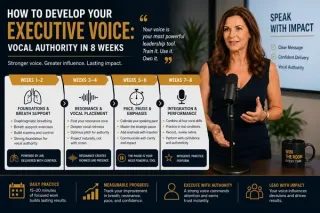
How to Develop Your Executive Voice: Vocal Authority in 8 Weeks
Develop your executive voice with this 8-week vocal authority program. Learn breath support, resonance, pace, pause, and practice routines for senior leaders. ...more
Improve Public Speaking Skills: Expert Tips by Lisa Hugo ,Corporate Communication Tips for CxOs & Executives
July 14, 2026•7 min read
Looking for webinar funnels, digital marketing or a client acquisition system for your coaching or consulting business?
Copyright © 2026 Audacia Marketing Management LLC, All rights reserved.