
Table of Contents
Executive Summary
Introduction: Why Voice and Presence Define Leadership
Chapter 1: Understanding Executive Presence
Chapter 2: The Science of Voice
Chapter 3: Developing Your Executive Voice
Chapter 4: Physical Presence and Body Language
Chapter 5: Commanding Attention in Any Room
Chapter 6: Voice and Presence in Different Contexts
Chapter 7: Common Voice and Presence Challenges
Chapter 8: The Influential Voice Framework
Conclusion: Your Path to Executive Presence Mastery
Key Takeaways
About the Author
Executive Summary
Executive voice and presence are the invisible forces that separate competent leaders from truly influential ones. While technical expertise may earn you a seat at the table, it is your voice, your physical presence, and your ability to command a room that determine whether people listen, trust, and follow you.
This comprehensive guide explores every dimension of executive voice and presence, from the neuroscience of how voice impacts perception to practical exercises you can practice daily. Whether you are a newly appointed C-suite executive, a senior leader preparing for board presentations, or an entrepreneur seeking to inspire investors, this guide provides the strategies, frameworks, and techniques you need to project authority and authenticity simultaneously.
Drawing on more than 20 years of coaching Fortune 500 executives, government leaders, and entrepreneurs across the Middle East and globally, Lisa Hugo distills her proven methodologies into a clear, actionable roadmap. You will learn how your vocal quality shapes your credibility, how body language amplifies or undermines your message, and how to adapt your presence across diverse settings, from intimate boardrooms to international stages.
The guide introduces Lisa's proprietary Influential Voice Framework, a structured approach to developing lasting executive presence that feels natural rather than performed. Each chapter includes practical exercises, quick tips, and real-world insights drawn from decades of coaching at the highest levels of business and government. By the time you finish reading, you will have a concrete development plan to transform how others perceive you, and more importantly, how you perceive yourself as a leader.
Introduction: Why Voice and Presence Define Leadership
Every leader has experienced that moment. You walk into a room and someone commands attention without raising their voice. They speak, and the conversation shifts. They pause, and everyone waits. They are not louder than anyone else. They are not taller, older, or more decorated with titles. Yet something about them signals authority, credibility, and calm confidence.
That "something" is executive presence, and it is one of the most misunderstood and undervalued leadership competencies in professional life today.
Research consistently shows that executive presence accounts for approximately 26 percent of what it takes to get promoted to senior leadership. Yet most leadership development programs focus almost exclusively on strategic thinking, financial acumen, and operational management. These skills are essential, but they are not sufficient. A leader who cannot project confidence, articulate a vision with conviction, or hold a room's attention will struggle to influence stakeholders, inspire teams, or drive organizational change.
The challenge is that executive presence is rarely taught. Most leaders are told they either "have it" or they do not, as though it were a genetic trait rather than a learnable skill. This is simply not true. Executive presence, like any other professional competency, can be developed, refined, and mastered through deliberate practice and expert guidance.
In my more than 20 years of coaching C-suite executives, entrepreneurs, and government leaders, I have seen quiet introverts transform into commanding communicators. I have watched technical experts learn to translate complex ideas into compelling narratives. I have helped leaders from every cultural background find their authentic voice and use it to lead with greater impact.
This guide is designed to be your comprehensive resource for developing executive voice and presence. Each chapter builds on the previous one, creating a progressive development path from understanding the fundamentals to mastering advanced techniques for specific situations. Whether you read it cover to cover or focus on the chapters most relevant to your current challenges, you will find practical strategies you can implement immediately.
Your voice and your presence are your most powerful leadership tools. Let us make sure you are using them to their full potential.
Chapter 1: Understanding Executive Presence
What Is Executive Presence?
Executive presence is the ability to project confidence, credibility, and composure in a way that inspires trust and commands respect. It is not about being the loudest person in the room or having the most impressive title. It is about how you carry yourself, how you communicate, and how you make others feel when you speak.
Quick Tip: Executive presence is not a single skill. It is a combination of behaviors, habits, and qualities that together create an impression of leadership competence.
The Center for Talent Innovation identifies three core pillars of executive presence: gravitas, communication, and appearance. Understanding each pillar is essential for targeted development.
The Three Pillars of Executive Presence
Gravitas accounts for approximately 67 percent of executive presence. It encompasses your ability to project confidence under pressure, demonstrate decisiveness, show emotional intelligence, and maintain composure in challenging situations. Leaders with gravitas are seen as substantial and credible. They do not waver when challenged, and they do not overreact when surprised.
Communication accounts for roughly 28 percent. This includes your speaking skills, your ability to command a room, your capacity to read an audience and adapt accordingly, and your talent for making complex ideas accessible. Communication is the vehicle through which gravitas becomes visible to others.
Appearance makes up about 5 percent, but it matters more than that small number suggests. Appearance is not about attractiveness. It is about looking polished, professional, and appropriate for your context. An executive who shows up underdressed for a board meeting or overdressed for a factory visit sends a signal about judgment and awareness.
Why Executive Presence Matters for Career Advancement
Senior leaders consistently report that executive presence is a deciding factor in promotion decisions, particularly at the vice president level and above. When two candidates have equivalent technical skills and track records, executive presence becomes the differentiator.
Consider this scenario. Two senior directors are presenting quarterly results to the board. Both have identical data and similar recommendations. The first speaks quickly, avoids eye contact with board members, and reads directly from slides filled with bullet points. The second speaks with measured confidence, makes eye contact with each board member, pauses for emphasis, and uses slides only to reinforce key points. Both are equally competent. But the board perceives the second leader as more credible, more strategic, and more ready for the next level.
Key Insight: Executive presence does not replace competence. It amplifies it. Without substance, presence is empty performance. Without presence, substance goes unnoticed.
How Presence Is Perceived vs. Possessed
One of the most important concepts in executive presence development is the gap between how you feel and how you are perceived. Many executives I coach are surprised to learn that their internal experience does not match their external impression. A leader who feels nervous may actually appear calm to the audience. Conversely, a leader who feels confident may come across as arrogant or dismissive.
This perception gap is why feedback is essential. Without external input, you are operating blindly. Video recording your presentations, seeking honest feedback from trusted colleagues, and working with a coach are all ways to close the perception gap.
Self-Assessment Framework
To begin your development journey, honestly assess yourself across these dimensions:
Do people listen attentively when you speak in meetings?
Are you frequently asked to present to senior stakeholders?
Do you receive feedback about speaking too quickly or too softly?
Can you hold your ground in disagreements without becoming aggressive?
Do you feel confident entering a room of strangers?
Can you adapt your communication style to different audiences?
Do you project calm during crises?
If you answered "no" to three or more of these questions, focused development in executive presence will significantly accelerate your leadership effectiveness.
Real-World Examples
In my coaching practice, I worked with a Chief Technology Officer at a multinational firm who was brilliant technically but consistently overlooked for the CEO track. His challenge was not intelligence or strategy. It was that he spoke in technical jargon, avoided eye contact during board presentations, and physically retreated when challenged. After six months of focused development on voice projection, strategic storytelling, and physical presence, he was perceived entirely differently by the board, and he received the promotion he had been passed over for twice before.
Executive presence is not about changing who you are. It is about ensuring that who you are comes through clearly, powerfully, and authentically.
Chapter 2: The Science of Voice
How Voice Impacts Perception
Your voice is the single most powerful instrument you possess as a communicator. Research from the University of Glasgow demonstrates that listeners form judgments about a speaker's trustworthiness, dominance, and competence within the first 500 milliseconds of hearing their voice. That is before they have processed a single word of content.
A study published in the Journal of Experimental Psychology found that speakers with lower-pitched voices are perceived as more authoritative, more competent, and more trustworthy. Importantly, this effect holds across cultures, industries, and gender. While we cannot fundamentally change our vocal anatomy, we can learn to use our natural range more effectively to project authority and warmth.
Quick Tip: Your voice communicates emotion and intent even more powerfully than your words. People remember how your voice made them feel long after they forget what you said.
Vocal Anatomy and Mechanics
Understanding the basics of how your voice works empowers you to use it more intentionally. Voice production involves three systems working together.
The respiratory system provides the power. Your lungs push air upward through the trachea. The amount of air and the pressure behind it directly affect your volume, stamina, and vocal quality.
The phonatory system creates the sound. Air passes through the larynx, causing the vocal folds to vibrate. The speed and tension of this vibration determine your pitch. Faster vibration produces higher pitch. Slower vibration produces lower pitch.
The resonatory system shapes the quality. The vibrations from the vocal folds are amplified and shaped by the throat, mouth, nasal passages, and sinuses. This is where your unique vocal quality, your "vocal fingerprint," is created. By adjusting the shape and openness of these resonating spaces, you can dramatically alter the richness and warmth of your voice.
Pitch, Tone, and Resonance
Pitch refers to how high or low your voice sounds. Most executives benefit from speaking in the lower third of their natural range, which conveys authority and calm. However, using your full range strategically, rising in pitch to convey enthusiasm, dropping to signal seriousness, creates vocal variety that keeps listeners engaged.
Tone is the emotional quality of your voice. A warm tone builds connection. A firm tone establishes boundaries. A measured tone projects competence. The best executive communicators shift tones fluidly within a single conversation, matching their vocal quality to the emotional content of their message.
Resonance is the richness and depth of your voice. A well-resonated voice sounds full, warm, and effortless. A poorly resonated voice sounds thin, strained, or nasal. Resonance is developed by learning to engage the chest, throat, and facial resonators together, creating a sound that projects without strain.
Breathing and Support
Breath is the foundation of vocal power. Most people breathe shallowly, using only the upper chest. This produces a thin, unsupported sound that fatigues quickly and lacks projection.
Key Insight: Diaphragmatic breathing, where you engage the diaphragm to draw air deeply into the lower lungs, is the single most impactful change most executives can make to improve their vocal quality.
When you breathe diaphragmatically, your belly expands on the inhale and contracts on the exhale. This creates a steady, controlled airflow that supports a richer, more resonant sound. It also has the added benefit of activating the parasympathetic nervous system, which reduces stress and promotes calm, exactly what you need before a high-stakes presentation.
Projection and Volume
Projection is not the same as volume. Volume is simply how loud you are. Projection is the ability to be heard clearly at the back of a room without shouting. Effective projection relies on breath support, resonance, and articulation working together.
Many executives make the mistake of pushing their voice when they need to be louder. This creates tension, raises pitch, and actually reduces clarity. Instead, focus on deepening your breath, opening your resonating spaces, and directing your voice outward with intention. Think of projecting as aiming your voice to a specific point in the room rather than simply turning up the volume.
Regional Considerations
In an increasingly global business environment, executives often present to audiences across different regions and cultures. Vocal expectations vary significantly. In the Middle East, a commanding, resonant voice is highly valued in business settings. In some East Asian cultures, a softer, more measured delivery may be preferred. Understanding these nuances allows you to adapt your vocal delivery without losing your authentic sound.
Accents deserve special mention. Every person speaks with an accent, and no accent is inherently better or worse for executive communication. What matters is clarity, articulation, and confidence. I have coached executives from dozens of linguistic backgrounds, and the goal is never to eliminate an accent. It is to ensure that the accent enhances rather than obscures the message.
Examples of Powerful Voices
Consider the voices of leaders who command global attention. Their vocal styles differ dramatically, but they share common traits: controlled pacing, deliberate pauses, pitch variation for emphasis, and a sense of ease rather than strain. These qualities are not innate. They are practiced, refined, and maintained through consistent effort.
Chapter 3: Developing Your Executive Voice
Finding Your Authentic Voice
Developing your executive voice is not about imitating someone else. It is about discovering and strengthening the most effective version of your natural voice. Every person has a unique vocal quality shaped by anatomy, culture, and habit. Your authentic voice is the one that feels natural, projects your personality, and communicates your message with clarity and conviction.
To find your authentic voice, start by recording yourself in different contexts: a casual conversation, a meeting, a presentation, and a phone call. Listen to the recordings and notice the differences. Where do you sound most confident? Where do you sound strained or uncertain? Where does your personality come through most clearly? The version of your voice that sounds most natural and confident is your authentic baseline.
Quick Tip: Your authentic voice is not your habitual voice. Many people develop vocal habits, speaking too high, too fast, or too softly, that obscure their natural vocal quality. Developing your executive voice means stripping away unhelpful habits to reveal the voice underneath.
Vocal Exercises and Warm-Ups
Just as athletes warm up before performing, executives should warm up their voice before important communications. A five-minute warm-up can dramatically improve your vocal quality, clarity, and stamina.
Start with humming. Close your lips gently and hum at a comfortable pitch, feeling the vibrations in your lips, nose, and chest. This activates your resonators and warms up the vocal folds without strain. Next, practice lip trills (blowing air through loosely closed lips to create a buzzing sound) while sliding up and down your pitch range. This releases tension and improves flexibility.
Then move to articulation exercises. Repeat tongue twisters slowly, focusing on precise consonant production. "Red leather, yellow leather" and "unique New York" are excellent choices. Finally, practice a few sentences from your upcoming presentation at full voice, focusing on clear articulation and natural pacing.
Building Resonance and Depth
Resonance gives your voice its authority and warmth. To build resonance, practice speaking with an open, relaxed throat. Imagine the feeling of the beginning of a yawn, that open, spacious sensation in the back of your throat. Maintaining this openness while speaking creates a richer, more resonant sound.
Place your hand on your chest while speaking. You should feel vibrations when you use your chest resonance effectively. Practice reading aloud, focusing on directing sound down into your chest rather than up into your nose or throat. Over time, this will become your natural speaking pattern.
Eliminating Vocal Fry and Uptalk
Vocal fry, that creaky, gravelly sound at the end of sentences, and uptalk, the habit of raising pitch at the end of statements so they sound like questions, are two patterns that significantly undermine executive presence.
Vocal fry signals low energy, disengagement, or lack of conviction. It typically occurs when breath support runs out before the sentence ends. The solution is to take a breath before you run out of air, allowing your voice to maintain its full quality through the end of each sentence.
Uptalk signals uncertainty and seeks approval. It converts statements into questions, which reduces your perceived authority. To eliminate uptalk, practice ending declarative sentences with a downward inflection. Record yourself and listen specifically for upward inflections on statements. With awareness and practice, this pattern resolves quickly.
Pace and Rhythm
The ideal speaking pace for executive communication is approximately 140 to 160 words per minute. Most nervous speakers accelerate well beyond this, sometimes reaching 200 words per minute or more. Rapid speech signals anxiety and makes it difficult for listeners to process your message.
Key Insight: Strategic pauses are more powerful than any word you will ever speak. A pause before a key point creates anticipation. A pause after a key point allows absorption. The most commanding speakers are those who are comfortable with silence.
Practice speaking with deliberate variation in pace. Speed up slightly when delivering supporting details. Slow down significantly when making key points. Pause fully between major ideas. This rhythm creates a musical quality that holds attention naturally.
Emphasis and Inflection
Emphasis is how you highlight the most important words in a sentence. Consider the difference between "We need to change our strategy" and "We need to change our STRATEGY." Same words, different emphasis, different meaning.
Practice identifying the one or two most important words in each sentence of your presentation. Mark them in your notes and practice delivering them with slightly more volume, slightly lower pitch, and slightly slower pace. This simple technique dramatically increases the impact and memorability of your message.
Practice Techniques
Consistent practice is the key to lasting vocal development. Record yourself daily, even if only for five minutes. Listen back with a critical ear, noting improvements and areas for continued development. Practice in front of a mirror to observe how your facial expressions align with your vocal delivery.
Work with a partner when possible. Have them sit at the back of a large room while you practice projecting clearly without shouting. Practice in the actual rooms where you will be presenting whenever feasible. The more familiar you are with the acoustic environment, the more confident you will feel.
Chapter 4: Physical Presence and Body Language
Posture and Stance
Your body communicates before you open your mouth. Research consistently shows that physical posture affects both how others perceive you and how you feel internally. Standing tall with your shoulders back, chest open, and weight evenly distributed signals confidence and authority.
The executive stance, feet shoulder-width apart, arms relaxed at your sides, chin parallel to the floor, is your default power position. This stance grounds you physically and psychologically. When you feel nervous, returning to this stance activates a feedback loop that calms your nervous system and projects composure.
Quick Tip: Avoid the "fig leaf" position (hands clasped in front of your body) and the "parade rest" position (hands clasped behind your back). Both signal discomfort. Keep your hands at your sides or use them purposefully for gestures.
Gestures and Movement
Effective gestures amplify your message. Research from the University of Chicago found that speakers who use purposeful gestures are rated as more dynamic, more competent, and more engaging than those who keep their hands still.
The key word is "purposeful." Random, repetitive, or nervous gestures, such as fidgeting, touching your face, or playing with a pen, distract from your message. Instead, use open, outward gestures to emphasize key points. Use the "gesture box," the space between your shoulders and your waist, for most gestures. Extend beyond this box only for dramatic emphasis.
Movement should also be purposeful. When presenting, move to different parts of the stage to connect with different sections of the audience. Plant your feet when making an important point. Walk slowly and deliberately rather than pacing nervously. Every movement should serve a communicative purpose.
Eye Contact Strategies
Eye contact is the most powerful non-verbal tool for establishing connection and projecting confidence. In executive settings, sustained eye contact of three to five seconds per person creates a sense of personal connection without becoming uncomfortable.
Key Insight: In large audiences, use the "lighthouse" technique: slowly scan the room, making eye contact with individuals in different sections. In smaller meetings, distribute your eye contact evenly, ensuring each participant feels seen and included.
When addressing a board or a small executive group, make eye contact with the person asking a question for the first few seconds of your answer, then briefly include others before returning to the questioner to conclude. This demonstrates respect for the questioner while including the broader group.
Facial Expressions
Your face is your most expressive communication tool. Research shows that audiences rely heavily on facial expressions to assess a speaker's credibility and emotional state. A neutral or "resting" expression often reads as disengagement, disapproval, or hostility, even when you feel perfectly calm inside.
Practice "attentive listening face," a slight smile with engaged eyes and a gently lifted brow. This signals openness, interest, and warmth. When speaking, allow your facial expressions to match your content. Show genuine concern when discussing challenges, enthusiasm when sharing wins, and calm confidence when addressing uncertainties.
Personal Space and Proxemics
Understanding personal space is critical for executive presence, particularly in multicultural environments. In the Middle East, closer conversational distances are common and signal trust and warmth. In Northern European and East Asian cultures, more physical space is expected.
As a leader, learn to read spatial cues from your audience. If someone steps back during a conversation, respect that boundary. If someone leans in, match their engagement. Spatial awareness demonstrates emotional intelligence, a core component of executive presence.
Dress and Appearance
While appearance accounts for only a small percentage of executive presence, it functions as a gatekeeper. Inappropriate dress can distract from your message and undermine your credibility before you speak a single word.
The principle is simple: dress for the context and slightly above. In a business formal environment, be impeccably formal. In a business casual setting, be polished casual. Consistency in grooming, fit, and appropriateness signals attention to detail and respect for your audience.
Cultural Considerations
Body language norms vary significantly across cultures. Gestures that signal confidence in one culture may signal arrogance in another. Eye contact norms, handshake expectations, and personal space preferences all differ. Global executives must develop cultural fluency in non-verbal communication, adapting their physical presence to resonate with diverse audiences while maintaining authenticity.
Chapter 5: Commanding Attention in Any Room
Making Powerful Entrances
The first 30 seconds of your presence in a room create an impression that is extraordinarily difficult to change. Enter with purpose. Walk at a measured pace. Make eye contact with people as you enter. If appropriate, greet individuals by name. Avoid looking at your phone, shuffling papers, or rushing to your seat. Your entrance sets the tone for everything that follows.
Quick Tip: Arrive early enough to settle in, test any technology, and greet attendees as they arrive. This transforms you from a guest in the room to a host, a subtle but powerful shift in perceived authority.
Owning Your Space
Whether you are standing at a podium, sitting at a conference table, or speaking from a virtual background, claim your space with confidence. Spread your materials comfortably. Place your hands on the table with open palms. If standing, use the full space available to you rather than shrinking into one corner.
Owning your space is a physical expression of psychological confidence. When you expand your physical presence appropriately, you signal that you belong, that you are comfortable, and that you have something valuable to contribute.
Handling Interruptions
Interruptions are inevitable in executive settings, and how you handle them defines your presence. When interrupted, maintain your composure. Do not raise your voice or show irritation. Instead, pause, make eye contact with the interrupter, and calmly say, "I appreciate that thought. Let me finish this point, and then I would like to hear your perspective."
This response accomplishes three things: it acknowledges the other person, it reclaims your floor, and it demonstrates grace under pressure. Over time, consistent handling of interruptions this way trains others to respect your speaking time.
Managing Energy
Every room has an energy level, and executive presence requires the ability to read and influence that energy. In a low-energy room, you may need to increase your own energy slightly, speaking with more animation and moving more dynamically, to elevate the group. In a high-energy, tense room, you may need to lower your energy, speaking more slowly and calmly, to provide a stabilizing influence.
Key Insight: Leaders with strong executive presence do not merely respond to the energy in a room. They set it. Your calm lowers anxiety. Your enthusiasm elevates engagement. Your focus sharpens attention.
Reading the Room
Reading the room is the art of observing non-verbal cues from your audience and adapting in real time. Are people leaning in or leaning back? Are they making eye contact or looking at their phones? Are they nodding or frowning?
Develop a practice of scanning the room every few minutes during your presentation or meeting. If you notice attention drifting, shift your approach. Ask a question, change your vocal pace, share a story, or move to a different part of the room. The ability to adapt in real time distinguishes good communicators from exceptional ones.
Adapting to Different Settings
Commanding attention at an intimate dinner with six executives requires a different approach than commanding a stage in front of five hundred attendees. In small settings, presence is about depth: deep eye contact, active listening, thoughtful pauses, and measured responses. In large settings, presence is about projection: bigger gestures, stronger vocal projection, more dynamic movement, and more dramatic pauses.
The underlying principles remain the same, but the scale changes. Practice adapting your presence to rooms of different sizes and you will develop the versatility that marks a truly skilled executive communicator.
Recovery from Mistakes
Every speaker makes mistakes. You will forget a point, stumble over a word, or lose your train of thought. What matters is not the mistake itself but how you recover. The most powerful recovery technique is the confident pause. When you make a mistake, simply pause. Take a breath. Collect your thoughts. Then continue. Most audiences will not even register the error if your recovery is calm and unhurried.
Never apologize for minor mistakes. Saying "sorry" or "I messed that up" draws attention to errors that would otherwise go unnoticed. Instead, pause, reset, and move forward with the same confidence you had before the mistake occurred.
Chapter 6: Voice and Presence in Different Contexts
Board Meetings
Board presentations require the highest level of executive presence. Board members are experienced evaluators of leadership capability, and they are assessing you as much as your content. Speak with measured authority. Be concise, as boards value efficiency. Present data confidently and be prepared to defend your recommendations without becoming defensive.
Quick Tip: In board settings, less is more. Speak only when you have something substantive to add. When you do speak, make every word count.
Media Interviews
Media interactions present unique presence challenges. You must project confidence and authenticity while staying on message, often in adversarial or fast-paced environments. Key strategies include maintaining a warm but professional tone, using bridging phrases to redirect to your key messages, and resisting the impulse to fill silence.
Virtual Presentations
Virtual communication strips away many of the physical cues that contribute to presence. Compensate by increasing your vocal variety, maintaining steady eye contact with the camera lens, and using deliberate facial expressions. Your energy needs to be slightly higher than in person because the screen flattens your dynamic range.
One-on-One Conversations
Executive presence in one-on-one settings is about attentive listening, thoughtful questioning, and genuine engagement. Give the other person your full attention. Put away devices. Lean in slightly. Respond to what they say rather than waiting for your turn to speak. The most powerful leaders are those who make each individual feel like the most important person in the room.
Large Conferences
When speaking to large audiences, amplify every element of your presence. Use bigger gestures, stronger projection, more dramatic pauses, and more dynamic movement. Connect with the audience by addressing different sections of the room and using inclusive language. Tell stories that create emotional connection at scale.
Crisis Communication
In crisis situations, executive presence is defined by calm, clarity, and compassion. Speak slowly and deliberately. Use simple, direct language. Acknowledge the situation honestly without speculation. Project composed confidence, not casual dismissiveness. Your presence during a crisis will be remembered far longer than your presence during routine communications.
Industry-Specific Considerations
Different industries have different norms for executive presence. Financial services value precision and understated authority. Technology favors dynamic energy and visionary thinking. Government requires diplomatic composure and measured gravitas. Understanding and adapting to industry expectations while maintaining your authentic voice is a hallmark of advanced executive presence.
Chapter 7: Common Voice and Presence Challenges
Nervousness and Shaking Voice
A shaking or unsteady voice is one of the most common challenges executives face, and one of the most solvable. The tremor typically results from shallow breathing, tension in the throat, and an activated fight-or-flight response. The solution is physical: deep diaphragmatic breaths before speaking, a deliberate warm-up routine, and grounding exercises that connect you to your body.
Key Insight: Nervousness is not visible to others nearly as much as you think it is. Studies show that audiences perceive speakers as significantly calmer than the speakers feel. Your perceived nervousness is usually a fraction of your actual nervousness.
Being Talked Over
Being consistently talked over in meetings is a presence challenge, not a personality flaw. To counter this, lower your pitch slightly (lower voices command more attention), increase your volume by ten to fifteen percent, and use the "verbal placeholder" technique: begin your point with a clear, assertive opening such as "The key issue here is..." or "What the data shows us is..." These openings signal authority and reduce interruptions.
Not Being Taken Seriously
If you feel you are not taken seriously, examine your vocal habits and body language. Uptalk, vocal fry, excessive qualifiers ("I think," "maybe," "sort of"), fidgeting, and poor eye contact all undermine perceived credibility. Eliminate one habit at a time, starting with the one that is most visible.
Sounding Too Aggressive or Too Soft
Finding the right balance between authority and approachability is a nuance that many executives struggle with. If you are perceived as too aggressive, focus on warmth: softer eye contact, more smiling, warmer vocal tone, and more inclusive language. If you are perceived as too soft, focus on firmness: stronger eye contact, lower pitch, more declarative sentences, and more purposeful gestures.
Regional Accent Concerns
Many executives worry that their regional or non-native accent undermines their credibility. In most cases, this concern is more internal than external. Audiences rarely judge accents negatively when the speaker projects confidence and clarity. Focus on articulation, pace, and projection rather than accent reduction. Your accent is part of your identity and, when paired with confident delivery, enhances rather than diminishes your presence.
Gender-Specific Challenges
Women executives often face unique presence challenges, including being interrupted more frequently, having their authority questioned, and receiving contradictory feedback (too assertive, too soft, too emotional, too cold). Men may face expectations to be forceful when their natural style is collaborative.
The key is to develop range. Build the capacity to be both firm and warm, both assertive and inclusive, and deploy these qualities strategically based on context rather than pressure.
Age-Related Perceptions
Both younger and older executives face presence challenges related to age. Younger leaders may struggle with perceived inexperience, while seasoned executives may need to project contemporary relevance. In both cases, confidence in your unique value, demonstrated through strong voice and presence, overrides age-related assumptions.
Chapter 8: The Influential Voice Framework
Lisa's Proprietary Framework
The Influential Voice Framework is a comprehensive system I developed over two decades of coaching executives at the highest levels. It is built on five integrated pillars:
Foundation - Breath, posture, and physical groundedness
Instrument - Vocal quality, resonance, and range
Expression - Emphasis, inflection, and emotional connection
Presence - Body language, spatial awareness, and energy management
Adaptability - Context reading, cultural fluency, and situational flexibility
Each pillar supports the others. A leader with excellent vocal quality but poor posture undermines their own instrument. A leader with perfect body language but monotone delivery fails to connect emotionally. The framework ensures holistic development across all dimensions.
Quick Tip: Begin with the Foundation pillar. Once your breathing and posture are strong, everything else becomes easier. Most executives see noticeable improvement within two to three weeks of focused foundational work.
Daily Practice Routine
A fifteen-minute daily practice routine produces remarkable results over time:
Minutes 1 to 3: Diaphragmatic breathing exercises (five deep breaths with four-count inhale, four-count hold, four-count exhale)
Minutes 3 to 6: Vocal warm-ups (humming, lip trills, articulation exercises)
Minutes 6 to 10: Reading aloud with deliberate emphasis, pausing, and pitch variation
Minutes 10 to 13: Physical presence practice (power stance, purposeful gestures, eye contact with mirror)
Minutes 13 to 15: Mental rehearsal (visualize an upcoming speaking situation, see yourself performing with confidence)
Long-Term Development Plan
Meaningful voice and presence development follows a predictable arc. In weeks one through four, focus on awareness: recording yourself, seeking feedback, and identifying specific areas for improvement. In weeks five through twelve, focus on skill building: daily exercises targeting your priority areas. In months three through six, focus on integration: applying your skills in increasingly challenging real-world situations. Beyond six months, focus on mastery: refining, adapting, and maintaining your enhanced presence.
Maintenance Strategies
Once you have developed strong executive presence, maintenance requires ongoing attention. Continue your daily warm-up routine. Periodically record yourself and assess your progress. Seek feedback from trusted colleagues. Work with a coach for periodic tune-ups, particularly before high-stakes presentations or career transitions.
Measuring Progress
Track your development through three methods: self-assessment using a standardized rubric, peer feedback using structured questionnaires, and video analysis of your presentations over time. Comparing video recordings from three-month intervals provides objective evidence of your growth and identifies remaining development areas.
Conclusion: Your Path to Executive Presence Mastery
Executive voice and presence are not luxuries. They are leadership essentials. In a world where decisions are made at the speed of conversation, where promotions are influenced by perceptions as much as performance, and where leaders must inspire across cultures, screens, and contexts, your voice and your presence are your most valuable professional assets.
This guide has provided you with the knowledge, frameworks, and practical techniques to develop these assets systematically. You now understand the three pillars of executive presence, the science of voice production, the mechanics of body language, and the strategies for commanding attention in any setting. You have a daily practice routine, a long-term development plan, and a framework for continuous improvement.
But knowledge alone is not enough. Transformation requires action. Choose one area from this guide, the one that resonates most with your current challenges, and begin working on it today. Not tomorrow. Not next week. Today.
If you are ready to accelerate your development with personalized, expert guidance, I invite you to explore my Influential Voice Accelerator program. This intensive coaching experience has helped hundreds of executives transform their voice and presence, often achieving in weeks what takes months of solo practice.
Your voice matters. Your presence matters. The world needs leaders who can communicate with clarity, confidence, and conviction. Let this be the beginning of your journey to becoming one of them.
Key Takeaways
Executive presence is a learnable skill built on three pillars: gravitas, communication, and appearance.
Your voice creates impressions of trustworthiness and competence within the first 500 milliseconds.
Diaphragmatic breathing is the single most impactful technique for improving vocal quality and managing nerves.
Authentic executive presence amplifies who you already are rather than creating a persona.
Strategic pauses are more powerful than any word you will ever speak.
Body language communicates authority before you open your mouth, so posture, gestures, and eye contact must be deliberate.
Reading the room and adapting your energy is what separates good communicators from exceptional leaders.
Vocal fry and uptalk undermine executive credibility and can be eliminated through targeted practice.
Different contexts, such as board meetings, media interviews, and virtual calls, require different presence strategies.
Cultural fluency in non-verbal communication is essential for global leaders.
A fifteen-minute daily practice routine produces measurable improvement within weeks.
Working with a coach accelerates presence development dramatically compared to self-directed practice alone.
About the Author
Lisa Hugo is an internationally recognized executive communication coach and voice expert with more than 20 years of experience helping C-suite leaders, entrepreneurs, and government officials communicate with greater authority and impact. Based in Dubai, Lisa works with Fortune 500 executives, senior government leaders, and high-profile entrepreneurs across the Middle East and globally.
Her proprietary Influential Voice Accelerator program has helped hundreds of leaders transform their executive presence, master high-stakes presentations, and overcome speaking anxiety. Lisa's approach combines the science of voice and communication with practical, results-driven coaching that produces measurable improvements in weeks, not months.
Lisa is a sought-after keynote speaker, workshop facilitator, and trusted advisor to leaders who understand that how they communicate is just as important as what they communicate.
Copyright © 2026 Lisa Hugo/Audacia Marketing Management LLC, All rights reserved.
Ready to transform Your executive voice and presence?



She’s helped 1000s of clients around the world to develop their speaking skill with her 1 : 1 coaching and powerful programs, each centered on a different aspect of speaking, including confidence, voice, presentation, and body language.
COMPANY
LEGAL
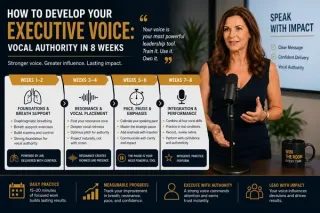
How to Develop Your Executive Voice: Vocal Authority in 8 Weeks
Develop your executive voice with this 8-week vocal authority program. Learn breath support, resonance, pace, pause, and practice routines for senior leaders. ...more
Improve Public Speaking Skills: Expert Tips by Lisa Hugo ,Corporate Communication Tips for CxOs & Executives
July 14, 2026•7 min read
Looking for webinar funnels, digital marketing or a client acquisition system for your coaching or consulting business?
Copyright © 2026 Audacia Marketing Management LLC, All rights reserved.