
Table of Contents
Executive Summary
Introduction: You Are Not Alone
Chapter 1: Understanding Public Speaking Anxiety
Chapter 2: The Science Behind the Fear
Chapter 3: Mindset Transformation
Chapter 4: Physical Techniques for Calm
Chapter 5: Strategic Preparation for Confidence
Chapter 6: In-the-Moment Anxiety Management
Chapter 7: Building Long-Term Confidence
Chapter 8: From Anxiety to Excellence
Conclusion: Your Voice Deserves to Be Heard
Key Takeaways
About the Author
Executive Summary
Public speaking anxiety affects an estimated 75 percent of adults, and executives are not immune. In fact, the higher the stakes of a speaking situation, the more intense the anxiety can become, even for seasoned leaders who appear confident on the surface. The fear of speaking in front of others is not a character flaw, a weakness, or a permanent condition. It is a deeply human response that can be understood, managed, and ultimately transformed into a source of performance energy.
This comprehensive guide is designed for executives, senior leaders, entrepreneurs, and professionals who experience anxiety before or during speaking situations and who are ready to move beyond it. It covers the psychology and neuroscience of speaking anxiety, provides practical mindset strategies for reframing fear, introduces physical techniques for managing the body's stress response, and offers a systematic approach to building lasting confidence through strategic preparation and gradual exposure.
Drawing on more than 20 years of coaching executives through speaking anxiety, including leaders who have gone from avoiding presentations entirely to delivering keynotes with genuine confidence, Lisa Hugo provides a compassionate, evidence-based, and deeply practical roadmap for transformation. This is not about eliminating nervousness. It is about developing such a strong foundation of skill and self-awareness that nervousness becomes a catalyst for peak performance rather than a barrier to it.
Whether your anxiety manifests as a racing heart, a shaking voice, mental blanking, or a persistent dread of upcoming presentations, this guide will give you the understanding and the tools to move forward with confidence.
Introduction: You Are Not Alone
Let me share something that may surprise you. In my more than 20 years of coaching executives, I have worked with CEOs of multinational corporations, government ministers, accomplished entrepreneurs, and seasoned board directors who all share a secret: they experience anxiety before speaking.
Some feel their heart race as they walk to the podium. Others notice their hands trembling as they advance their slides. Some lie awake the night before a major presentation, rehearsing worst-case scenarios in their minds. Others experience a wave of nausea in the minutes before they are introduced. A few have told me they have turned down career-defining opportunities, speaking invitations, leadership roles, and public recognitions, specifically to avoid speaking situations.
If any of this sounds familiar, you are not alone. Public speaking anxiety is one of the most common fears in the human experience, and it does not discriminate based on title, experience, or competence. The difference between those who struggle with it and those who seem unaffected is rarely about natural talent. It is about understanding, strategy, and practice.
It is also important to distinguish between nervousness and debilitating anxiety. A certain level of nervousness before speaking is normal, healthy, and even beneficial. It sharpens focus, elevates energy, and enhances performance. This is the productive adrenaline that athletes, performers, and speakers have channeled for centuries. Anxiety becomes a problem when it overwhelms your ability to function, when it prevents you from accepting opportunities, or when the fear of speaking causes more suffering than the actual speaking event.
This guide takes a compassionate, proven approach to helping you understand your anxiety, manage its physical manifestations, transform your relationship with fear, and build the kind of deep confidence that allows you to speak with authority and authenticity in any setting. You deserve to have your voice heard. Let us make sure nothing stands in the way.
Chapter 1: Understanding Public Speaking Anxiety
The Psychology of Speaking Anxiety
Public speaking anxiety, sometimes called glossophobia, is rooted in some of the most fundamental aspects of human psychology. At its core, speaking anxiety is a fear of social evaluation, the fear that you will be judged, found inadequate, rejected, or humiliated by the group.
This fear is not irrational. For most of human evolutionary history, social rejection was a genuine survival threat. Being cast out of the group meant vulnerability to predators, starvation, and death. Our brains evolved to treat social evaluation as a high-stakes situation worthy of a full threat response, and that ancient wiring remains active in modern boardrooms, conference stages, and meeting rooms.
Key Insight: Public speaking anxiety is not a sign of weakness or incompetence. It is a sign that your brain is doing exactly what it evolved to do: protecting you from perceived social threat. Understanding this removes the shame that often accompanies speaking anxiety and opens the door to effective management strategies.
Physical Symptoms and Their Causes
The physical symptoms of speaking anxiety are uncomfortable but not dangerous. They include rapid heartbeat, shallow breathing, sweating, trembling hands or voice, dry mouth, tightness in the chest or throat, nausea, and what many people describe as "butterflies" in the stomach. Some speakers experience cognitive symptoms as well: racing thoughts, difficulty concentrating, mental blanking, and an inability to recall prepared material.
Each of these symptoms is a direct result of the body's stress response. When your brain perceives a threat, real or imagined, it triggers the release of adrenaline and cortisol. These stress hormones prepare the body for physical action by increasing heart rate, redirecting blood flow to large muscles, and suppressing non-essential functions like digestion and fine motor control.
Understanding that these symptoms are normal, temporary, and manageable is the first step toward reducing their power over you.
The Fear-Performance Relationship
The relationship between fear and performance follows an inverted U-curve, sometimes called the Yerkes-Dodson curve. Too little arousal leads to flat, disengaged performance. Too much arousal leads to impaired performance. In between, there is an optimal zone where arousal enhances focus, energy, and delivery.
The goal of anxiety management is not to eliminate arousal entirely but to regulate it so that it stays within your optimal performance zone. The techniques in this guide are designed to help you find and maintain that zone.
Common Triggers
Speaking anxiety is often triggered by specific situations rather than all speaking contexts equally. Common triggers include speaking to authority figures, presenting to large audiences, speaking on unfamiliar topics, situations where you might be challenged or questioned, formal settings with high stakes, speaking in a non-native language, and being recorded or broadcast.
Quick Tip: Identify your specific triggers by reflecting on past speaking experiences. Which situations generated the most anxiety? Understanding your personal trigger profile allows you to develop targeted management strategies rather than general ones.
Myths vs. Reality
Several myths about speaking anxiety persist and deserve correction. The myth that great speakers are never nervous is false. Research consistently shows that experienced, successful speakers report nervousness before presentations. The myth that you should imagine the audience in their underwear is not helpful and may actually increase anxiety by introducing absurdity into a high-stakes situation. The myth that more preparation always reduces anxiety is partially true, but over-preparation can actually increase anxiety by raising the stakes of perfection.
The reality is that speaking anxiety is manageable, that confidence is built through experience rather than eliminated through willpower, and that many of the world's most compelling speakers have achieved excellence not in spite of their anxiety but because of the discipline and preparation it motivated.
When Anxiety Becomes a Barrier
For most people, speaking anxiety is uncomfortable but manageable. For some, however, it becomes a genuine barrier to career advancement and professional fulfillment. If anxiety causes you to turn down speaking opportunities, avoid leadership roles that require public communication, experience physical symptoms that are visible to your audience and undermine your credibility, or suffer significant distress for days or weeks before a speaking event, then targeted intervention is not just helpful but necessary for your professional growth.
Chapter 2: The Science Behind the Fear
Fight-or-Flight Response
The fight-or-flight response is the body's automatic reaction to perceived threat. When your brain's amygdala, the almond-shaped structure responsible for processing threat, identifies a danger, whether a predator in the forest or a boardroom full of executives, it triggers a cascade of physiological changes designed to prepare you for survival.
Your heart rate increases to pump more blood to your muscles. Your breathing becomes rapid and shallow to increase oxygen intake. Adrenaline floods your bloodstream. Blood is redirected from your extremities and digestive system to your large muscle groups. Your pupils dilate. Your muscles tense.
In a genuine survival situation, these changes are life-saving. In a speaking situation, they create the symptoms we experience as anxiety: pounding heart, shaking hands, dry mouth, and churning stomach.
Key Insight: The fight-or-flight response cannot distinguish between a physical threat and a social threat. Your body responds to the prospect of a board presentation with the same physiological intensity it would apply to a physical danger. Understanding this helps you depersonalize the experience. Your body is not betraying you. It is trying to protect you.
Brain Chemistry and Stress
The stress response involves two primary hormone systems. The first is the sympathetic-adrenal-medullary system, which releases adrenaline (epinephrine) for immediate, short-term response. This is what causes the sudden surge of physical symptoms. The second is the hypothalamic-pituitary-adrenal axis, which releases cortisol for longer-term stress management. This is what causes the sustained worry and anticipatory anxiety that can begin days before a speaking event.
Both systems can be regulated through the techniques described in this guide. Breathing exercises directly counteract sympathetic nervous system activation. Cognitive reframing reduces cortisol production by changing how the brain evaluates the threat. Physical exercise metabolizes excess stress hormones.
Why Preparation Is Not Always Enough
Many anxious speakers believe that if they prepare thoroughly enough, their anxiety will disappear. While preparation is essential and does reduce anxiety, it is rarely sufficient on its own. This is because anxiety operates on an emotional, neurological level that is not fully accessible to rational thought. You can know intellectually that you are well-prepared, that you know your material, and that the worst-case scenario is unlikely, and still feel overwhelmed by anxiety.
This is not a failure of preparation. It is a feature of how the brain processes threat. The amygdala operates faster than the prefrontal cortex, meaning that your emotional response fires before your rational mind can intervene. Effective anxiety management requires techniques that work at the physiological level, not just the intellectual one.
The Role of Self-Perception
How you perceive yourself as a speaker profoundly affects your anxiety levels. If you see yourself as a poor speaker who is likely to fail, every speaking opportunity triggers intense anxiety. If you see yourself as a developing speaker who is improving with each experience, the same situation triggers manageable nervousness.
Self-perception is shaped by past experiences, feedback received, and the stories you tell yourself about your abilities. Many executives carry the weight of a single bad speaking experience from years ago, allowing one moment to define their self-concept as speakers. Rewriting this internal narrative is a critical component of lasting anxiety reduction.
Imposter Syndrome in Executives
Imposter syndrome, the persistent feeling that you are a fraud who will be exposed, is remarkably common among high-achieving executives. Research suggests that up to 70 percent of professionals experience imposter feelings at some point in their careers, and it is particularly acute in speaking situations where you are visible, vulnerable, and subject to evaluation.
Quick Tip: Imposter syndrome thrives on secrecy. Acknowledging it, whether to a coach, a trusted colleague, or even to yourself, significantly reduces its power. You are not an imposter. You are a human being experiencing a common psychological phenomenon.
Neuroscience of Confidence
Confidence is not a fixed trait. It is a neurological state that can be cultivated. When you repeatedly experience success in a challenging situation, your brain creates and strengthens neural pathways that associate that situation with positive outcomes. Over time, the amygdala's threat response diminishes, and the prefrontal cortex's regulatory capacity strengthens.
This is the neuroscience behind gradual exposure therapy, one of the most effective treatments for anxiety. Each positive speaking experience, no matter how small, rewires your brain to associate speaking with success rather than threat.
Chapter 3: Mindset Transformation
Reframing Anxiety as Excitement
One of the most powerful mindset techniques for managing speaking anxiety is cognitive reframing. Research from Harvard Business School demonstrates that simply telling yourself "I am excited" rather than "I am calm" before a performance task significantly improves performance. This works because anxiety and excitement share identical physiological symptoms: increased heart rate, heightened arousal, and elevated energy. The only difference is the label your brain applies.
When you feel pre-speaking anxiety, say to yourself, "I am excited about this opportunity." This simple reframe channels the physiological energy of anxiety into performance fuel rather than a barrier.
Key Insight: Do not try to calm down before a high-stakes presentation. Instead, reframe the energy as excitement and enthusiasm. Fighting your body's arousal response is a losing battle. Redirecting it is a winning strategy.
Growth Mindset for Speaking
Adopting a growth mindset toward speaking, the belief that your speaking ability can be developed through effort and practice, fundamentally changes your relationship with anxiety. With a fixed mindset, every presentation is a test of your innate ability, creating enormous pressure. With a growth mindset, every presentation is a learning opportunity, reducing pressure and increasing resilience.
Tell yourself: "I am not a finished product as a speaker. Every time I speak, I get better. This presentation is practice for the next one, which will be even better."
Self-Talk Strategies
The internal dialogue you maintain about speaking directly influences your anxiety levels. Negative self-talk, such as "I am going to freeze up," "They will think I am incompetent," or "I am terrible at this," creates a self-fulfilling prophecy by priming your brain for threat and failure.
Replace negative self-talk with realistic, encouraging statements: "I have prepared thoroughly and I know this material." "My audience wants me to succeed." "I have spoken before and it went well." "Even if I make a mistake, I will recover." These statements are not false positivity. They are accurate, evidence-based assessments that counteract catastrophic thinking.
Visualization Techniques
Mental rehearsal, or visualization, is a proven technique for reducing anxiety and improving performance. Before a speaking event, spend five to ten minutes in a quiet place. Close your eyes and vividly imagine yourself walking to the podium, feeling calm and confident. See yourself making eye contact with the audience, speaking with a clear, strong voice, and delivering your key messages effectively. Imagine the audience nodding, engaging, and responding positively. See yourself concluding with confidence and receiving appreciation.
This mental rehearsal primes your brain for success by activating the same neural pathways that would be engaged during an actual successful performance. Athletes, surgeons, and performers use visualization extensively, and it is equally effective for executive speakers.
Building Self-Compassion
Many anxious speakers are harshly self-critical, which amplifies anxiety rather than reducing it. Self-compassion, treating yourself with the same kindness and understanding you would offer a friend, is a more effective approach.
When you feel anxious before speaking, acknowledge the feeling without judgment: "I am feeling nervous, and that is completely normal. Many excellent speakers feel this way. I am going to do my best, and that is enough." Self-compassion reduces the secondary anxiety, the anxiety about being anxious, that often escalates the cycle.
Letting Go of Perfectionism
Perfectionism is the enemy of confident speaking. When your standard is perfection, every hesitation, every fumbled word, and every imperfect moment becomes evidence of failure. This creates an impossible standard that guarantees anxiety.
Quick Tip: Replace the goal of perfection with the goal of connection. Your audience does not need you to be perfect. They need you to be genuine, prepared, and engaged. A speaker who connects authentically with occasional imperfections is far more compelling than one who delivers perfectly without warmth.
Chapter 4: Physical Techniques for Calm
Breathing Exercises That Work
Breathing is the most direct and accessible tool for managing speaking anxiety because it directly counteracts the fight-or-flight response. When you breathe slowly and deeply, you activate the parasympathetic nervous system, which calms heart rate, relaxes muscles, and reduces cortisol production.
The most effective technique is 4-7-8 breathing: inhale through your nose for four counts, hold for seven counts, and exhale through your mouth for eight counts. Repeat four times. This extended exhale stimulates the vagus nerve, which directly activates the body's relaxation response.
Practice this technique daily, not just before speaking. Regular practice trains your nervous system to activate the relaxation response more quickly and effectively, making it more powerful when you need it most.
Progressive Muscle Relaxation
Progressive muscle relaxation involves systematically tensing and then relaxing each muscle group in your body. Start with your toes: squeeze them tightly for five seconds, then release. Move to your calves, thighs, abdomen, hands, arms, shoulders, and face, tensing each group for five seconds before releasing.
This technique works because anxiety creates physical tension that feeds back into the anxiety cycle. By deliberately tensing and releasing muscles, you break the cycle and create a physical state of relaxation that your brain interprets as safety.
Key Insight: Progressive muscle relaxation is most effective when practiced regularly, not just in moments of acute anxiety. Regular practice, even five minutes daily, trains your body to release tension more efficiently and reduces your baseline anxiety level over time.
Grounding Techniques
Grounding techniques anchor your attention in the present moment, counteracting the future-focused worry that drives speaking anxiety. The 5-4-3-2-1 technique is particularly effective: identify five things you can see, four things you can hear, three things you can touch, two things you can smell, and one thing you can taste.
This exercise interrupts the anxiety spiral by redirecting your attention from imagined future catastrophes to concrete present-moment sensations. It can be done discreetly in any setting, making it useful immediately before speaking.
Pre-Presentation Rituals
Developing a consistent pre-presentation ritual creates a sense of control and predictability that reduces anxiety. Your ritual might include arriving early to the venue, testing the technology, doing five minutes of breathing exercises, reviewing your opening three sentences, doing vocal warm-ups, and drinking water.
The specific elements matter less than the consistency. When your brain recognizes the ritual, it associates it with successful speaking experiences, creating a conditioned relaxation response that activates automatically.
Managing Adrenaline
Adrenaline is the fuel of the fight-or-flight response, and excess adrenaline creates the shaking, racing, and jittery feelings associated with speaking anxiety. Physical movement is the most effective way to metabolize excess adrenaline before speaking.
Take a brisk walk. Do gentle stretches. Squeeze and release your fists repeatedly. If privacy allows, do a few jumping jacks or push-ups. These activities burn off excess adrenaline and leave you calmer and more centered.
Quick Tip: Arrive early enough to take a walk around the building before your presentation. This simple practice metabolizes adrenaline, calms your nervous system, and gives you a sense of physical and mental preparation.
Voice Warm-Ups for Nerves
A shaking voice is one of the most visible symptoms of speaking anxiety, and it is also one of the most directly addressable. Vocal warm-ups prepare your voice for the demands of speaking and reduce the tremor caused by tension in the throat and larynx.
Hum gently for two minutes, feeling the vibrations in your chest and face. Practice lip trills while sliding up and down your pitch range. Say a few sentences from your opening at full voice, focusing on steady, supported tone. These exercises release throat tension, engage breath support, and warm up the vocal folds, all of which produce a steadier, more confident sound.
Chapter 5: Strategic Preparation for Confidence
Preparation vs. Over-Preparation
There is an important distinction between effective preparation and over-preparation. Effective preparation means knowing your material thoroughly, understanding your audience, rehearsing your delivery, and anticipating questions. Over-preparation means memorizing every word, rehearsing until the material feels stale, and pursuing perfection to the point of diminishing returns.
Over-preparation can actually increase anxiety by raising the stakes. When you have memorized a script, any deviation from that script feels like a failure. When you have rehearsed to the point of staleness, your delivery loses spontaneity and authenticity. Aim for thorough preparation with flexibility, knowing your key messages cold while allowing the specific words and transitions to flow naturally.
Practice Methods That Build Confidence
Not all practice methods are equally effective for building confidence. The most confidence-building practice is full-body rehearsal: standing up, speaking at full volume, using gestures, making eye contact with imagined audience members, and timing yourself. This activates the same neural pathways you will use during the actual presentation, creating familiarity and reducing anxiety.
Speaking in front of a mirror provides immediate visual feedback. Recording yourself on video provides objective evidence of how you actually appear (which is almost always better than you expect). Practicing with a small, supportive audience, such as a colleague or family member, provides social practice with low stakes.
Key Insight: Practice in conditions as close to the actual speaking environment as possible. If you will be standing, practice standing. If you will be using slides, practice with slides. If you will be in a large room, practice projecting your voice to the back of a large space. Familiarity with the conditions reduces anxiety significantly.
Rehearsal Environments
Where you rehearse matters. Practicing quietly at your desk does not prepare you for the physical and vocal demands of a conference stage. Whenever possible, rehearse in the actual venue. Walk the stage, test the microphone, stand at the podium, and experience the room from the speaker's perspective. This familiarity transforms the venue from an unknown threat into a known quantity.
Handling Worst-Case Scenarios
Explicitly planning for worst-case scenarios paradoxically reduces anxiety about them. What if you forget your next point? Have a plan: pause, take a breath, glance at your notes, and continue. What if the technology fails? Have a plan: continue from memory or engage the audience in discussion. What if someone asks a hostile question? Have a plan: respond with calm, factual confidence.
When you have a plan for every scenario that worries you, the scenarios lose their power. They become manageable challenges rather than catastrophic threats.
Having a Plan B (and C)
Bring printed notes as backup even if you rarely use them. Save your presentation on a USB drive as well as in the cloud. Have a colleague ready to assist with technical issues. Know your opening so well that you could deliver it without any visual support. Know the five key points you would make if your allotted time were cut in half.
These backup plans create a safety net that dramatically reduces the anxiety of "what if something goes wrong." The answer becomes: I have a plan for that.
Familiarity Breeds Confidence
Every element of your speaking experience that you can make familiar, the venue, the technology, the audience, the material, reduces anxiety. Visit the venue in advance. Test the technology beforehand. Meet audience members before you speak. Know your opening so well that it flows automatically. Familiarity tells your brain that this is known territory, not uncharted danger.
Quick Tip: Before a major speaking engagement, arrive early enough to shake hands with audience members as they enter. This transforms anonymous, potentially threatening strangers into friendly faces you can look for during your presentation.
Chapter 6: In-the-Moment Anxiety Management
First 60 Seconds Strategies
The first 60 seconds of a presentation are typically the most anxious. Once you are past the opening and into your material, anxiety usually subsides significantly. Design your opening to be as comfortable and familiar as possible.
Memorize your first three sentences so thoroughly that you can deliver them on autopilot. Begin with a smile and a brief pause, establishing your presence before speaking. Use a strong, well-rehearsed opening that you have delivered successfully multiple times. This gives your nervous system time to settle while your conscious mind handles familiar material.
Recovering from Mistakes
Mistakes during a presentation, forgetting a point, stumbling over a word, advancing to the wrong slide, are not catastrophes. They are normal, human occurrences that your audience barely notices and quickly forgets. The key is your reaction.
When you make a mistake, pause. Take a breath. Collect your thoughts. Then continue as if nothing happened. Do not apologize, do not call attention to the error, and do not spiral into self-criticism. Your audience takes their cues from you. If you remain calm and confident, they will not register the mistake as significant.
Key Insight: Audiences are remarkably forgiving of small mistakes when the speaker handles them with composure. In fact, a graceful recovery from a mistake can actually enhance your credibility by demonstrating poise under pressure.
Managing Panic Mid-Presentation
If you experience a surge of panic during a presentation, you have several immediate options. First, pause and take a slow, deep breath. This activates your parasympathetic nervous system within seconds. Second, take a sip of water, which provides a natural pause and a physical action that grounds you. Third, shift your focus from yourself to your audience by asking a question, inviting a response, or making eye contact with a friendly face. Fourth, remind yourself that the feeling is temporary, that it will pass within minutes, and that your audience cannot see it as intensely as you feel it.
Using Notes Effectively
There is no shame in using notes during a presentation, and for anxious speakers, notes provide a critical safety net. Use notes strategically: write your key points and transitions on index cards or a single sheet of paper in large, readable text. Glance at notes during natural pauses or transitions rather than reading from them continuously.
The presence of notes reduces the catastrophic fear of "going blank" by ensuring that a reference point is always available. Even if you never look at them, knowing they are there reduces anxiety.
Handling Challenging Questions
Questions from the audience can spike anxiety, especially when they are unexpected or challenging. Prepare by anticipating the most likely questions and practicing your responses. When you receive a question, pause for a moment before responding. This is not a sign of uncertainty. It is a sign of thoughtfulness.
If you do not know the answer, say so honestly: "That is an excellent question. I do not have that specific information today, but I will follow up with you directly." Honesty is always more credible than bluffing.
Emergency Techniques
For moments of extreme anxiety, use the "anchor phrase" technique. Before your presentation, choose a phrase that centers you: "I know this material," "I belong here," or "This is my area of expertise." When anxiety surges, repeat this phrase internally two or three times. This redirects your attention from anxious thoughts to a grounding truth.
Quick Tip: Another effective emergency technique is to press your tongue firmly against the roof of your mouth. This subtle physical action activates the vagus nerve and triggers a calming response within seconds.
Chapter 7: Building Long-Term Confidence
Gradual Exposure Approach
The most effective long-term strategy for overcoming speaking anxiety is gradual exposure: systematically increasing the challenge of your speaking situations over time. Start with low-stakes environments and progressively move toward higher-stakes ones.
Begin by speaking up more in small team meetings. Then volunteer to present an update in a department meeting. Then offer to lead a workshop for a small group. Then present to a larger audience. Then accept a keynote invitation. Each step builds neural pathways associated with successful speaking, which progressively reduces the amygdala's threat response.
The key is to challenge yourself enough to grow without overwhelming yourself. Each successful experience, no matter how small, builds the foundation for the next.
Joining Speaking Groups
Organizations such as Toastmasters International provide structured, supportive environments for practicing speaking skills and building confidence. These groups offer regular opportunities to speak in front of others, receive constructive feedback, and observe other speakers at various skill levels.
The value of speaking groups lies not only in the practice but in the community. Discovering that others share your anxiety, celebrating each other's progress, and receiving encouragement from people who understand the challenge creates a powerful support system for long-term development.
Seeking Feedback Effectively
Feedback is essential for growth, but the way you seek and receive it matters. Ask for specific, constructive feedback rather than general impressions. "How was my pacing during the introduction?" is more useful than "How did I do?" Ask people you trust to be honest but supportive. Focus on identifying one or two areas for improvement rather than cataloging every imperfection.
Key Insight: After receiving feedback, always acknowledge one thing you did well before focusing on areas for improvement. This balanced perspective prevents the perfectionist spiral that amplifies anxiety.
Celebrating Small Wins
Confidence is built through accumulated positive experiences, and each positive experience deserves acknowledgment. When you speak up in a meeting and it goes well, recognize it. When you deliver a presentation and receive positive feedback, celebrate it. When you handle a tough question with composure, note it.
Keep a "speaking wins" journal where you record each successful speaking experience, no matter how small. Review this journal before challenging speaking situations to remind yourself of your track record of success.
Working with a Coach
An experienced speaking coach provides expert assessment, personalized strategies, accountability, and the kind of honest, constructive feedback that is difficult to obtain on your own. A coach can identify patterns you cannot see, suggest techniques tailored to your specific challenges, and accelerate your development significantly.
Coaching is particularly valuable for executives because the stakes of speaking are high, the opportunities for low-stakes practice are limited, and the cost of ongoing anxiety is significant in terms of career impact and personal wellbeing.
Maintenance Strategies
Once you have built speaking confidence, maintain it through regular practice. Confidence, like fitness, requires ongoing effort. Continue speaking regularly. Continue your pre-presentation routines. Continue seeking feedback. Accept that anxiety may resurface during periods of stress or before unusually high-stakes situations, and respond with the same techniques that built your confidence in the first place.
Chapter 8: From Anxiety to Excellence
The Transformation Journey
The journey from speaking anxiety to speaking excellence is not a straight line. It includes setbacks, plateaus, and breakthrough moments. Some days you will feel confident and empowered. Other days, the anxiety will return with unexpected intensity. This is normal. It is not a sign of failure. It is a sign that you are a human being engaged in genuine growth.
The executives I have coached through this journey share a common arc. First, they acknowledge the anxiety without shame. Then they learn to understand it through the science of stress and fear. They develop physical and psychological management techniques. They practice consistently, starting small and building progressively. And eventually, they reach a point where speaking is not just tolerable but genuinely enjoyable.
Quick Tip: Document your journey. Keep a journal of your speaking experiences, your anxiety levels, your techniques, and your progress. Looking back on how far you have come is one of the most powerful motivators for continued growth.
Success Stories
In my coaching practice, I have had the privilege of witnessing remarkable transformations. A Chief Financial Officer who once turned down a board seat because it required quarterly presentations to shareholders now regularly delivers keynote addresses at industry conferences. A technology entrepreneur who nearly abandoned a funding round because the investor pitch terrified her not only completed the pitch but secured funding exceeding her target. A government official who whispered through her first coaching session now commands rooms of hundreds with authority and warmth.
These transformations did not happen overnight, and they did not happen through willpower alone. They happened through understanding, strategy, practice, and the kind of compassionate, expert support that makes the difficult feel achievable.
Your Action Plan
Based on what you have learned in this guide, create your personal action plan:
Identify your specific triggers and symptoms.
Choose two physical techniques from Chapter 4 and practice them daily for two weeks.
Select one mindset strategy from Chapter 3 and implement it before your next speaking opportunity.
Design a gradual exposure path with three to five progressively challenging speaking situations.
Find an accountability partner, whether a colleague, a friend, or a coach.
Start a speaking wins journal and record every positive experience.
Schedule a review of your progress in 90 days.
Resources and Support
Your journey does not have to be solitary. Resources for developing speaking confidence include speaking groups like Toastmasters, books on communication and anxiety management, online courses and webinars, and professional coaching. If your anxiety is severe, consider working with a therapist who specializes in performance anxiety or cognitive behavioral therapy, which has strong evidence for treating speaking anxiety.
The Path Forward
The path from anxiety to excellence is open to you. It begins with the decision to stop avoiding and start engaging. Every step you take, no matter how small, moves you forward. Every presentation you deliver, no matter how imperfect, builds the neural pathways of confidence. Every moment of anxiety you manage successfully rewrites the story your brain tells about speaking.
You do not need to be fearless. You need to be willing. Willing to feel uncomfortable. Willing to be imperfect. Willing to try, learn, and try again. The confidence you seek is not something you find. It is something you build, one speaking experience at a time.
Conclusion: Your Voice Deserves to Be Heard
Public speaking anxiety is not a life sentence. It is a challenge that millions of professionals face and that thousands overcome every year. The leaders who inspire us from stages, boardrooms, and screens are not those who were born without fear. They are those who learned to move through fear with skill, strategy, and determination.
This guide has provided you with a comprehensive understanding of why speaking anxiety occurs, how your body and brain create the experience of fear, and what you can do to manage, reduce, and ultimately transform that fear into a source of performance energy. You now have physical techniques for calming your body, psychological strategies for reframing your mind, preparation methods for building confidence, in-the-moment tools for managing surges of anxiety, and a long-term plan for progressive growth.
The world needs your ideas, your expertise, and your leadership. Your voice deserves to be heard, in boardrooms and on stages, in meetings and on screens, in one-on-one conversations and before audiences of thousands. Do not let anxiety silence what you have to offer.
If you are ready to accelerate your journey from anxiety to excellence with personalized, expert support, I invite you to explore my Influential Voice Accelerator program. Together, we can build the confidence that frees you to speak, lead, and inspire without limits.
Your next presentation is not a threat. It is an opportunity. Step into it with courage. You are more ready than you think.
Key Takeaways
Public speaking anxiety affects approximately 75 percent of adults, including experienced executives at the highest levels.
Speaking anxiety is a normal, evolutionary response to social evaluation, not a character flaw or sign of incompetence.
The fight-or-flight response cannot distinguish between physical threats and social threats, which is why presentations trigger survival-level reactions.
Reframing anxiety as excitement is more effective than trying to calm down because both states share the same physiology.
Diaphragmatic breathing, specifically the 4-7-8 technique, directly counteracts the fight-or-flight response within seconds.
Preparation builds confidence, but over-preparation can increase anxiety by raising the standard to perfection.
Memorize your first three sentences so thoroughly that you can deliver them on autopilot through the most anxious moments.
Audiences perceive speakers as significantly calmer than the speakers feel, so your anxiety is far less visible than you believe.
Gradual exposure, systematically increasing the challenge of your speaking situations, is the most effective long-term confidence builder.
A speaking wins journal that records every positive experience creates a powerful counter-narrative to anxiety-driven self-doubt.
Working with an experienced coach accelerates confidence development far beyond what self-directed practice can achieve.
The goal is not to eliminate nervousness but to develop such strong skills and self-awareness that nervousness becomes fuel for peak performance.
About the Author
Lisa Hugo is an internationally recognized executive communication coach and speaking confidence expert with more than 20 years of experience helping C-suite leaders, entrepreneurs, and government officials overcome speaking anxiety and communicate with authority and authenticity. Based in Dubai, Lisa works with Fortune 500 executives, senior government leaders, and high-profile entrepreneurs across the Middle East and globally.
Her proprietary Influential Voice Accelerator program has helped hundreds of leaders transform their relationship with public speaking, moving from avoidance and anxiety to confidence and genuine enjoyment. Lisa's approach is compassionate, evidence-based, and deeply practical, combining the science of anxiety management with executive-level communication coaching.
Lisa is a sought-after keynote speaker, workshop facilitator, and trusted advisor to leaders who understand that overcoming speaking anxiety is not just a personal goal but a professional imperative.
Copyright © 2026 Lisa Hugo/Audacia Marketing Management LLC, All rights reserved.
Ready to transform Anxiety into Excitement?



She’s helped 1000s of clients around the world to develop their speaking skill with her 1 : 1 coaching and powerful programs, each centered on a different aspect of speaking, including confidence, voice, presentation, and body language.
COMPANY
LEGAL
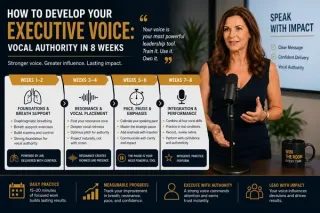
How to Develop Your Executive Voice: Vocal Authority in 8 Weeks
Develop your executive voice with this 8-week vocal authority program. Learn breath support, resonance, pace, pause, and practice routines for senior leaders. ...more
Improve Public Speaking Skills: Expert Tips by Lisa Hugo ,Corporate Communication Tips for CxOs & Executives
July 14, 2026•7 min read
Looking for webinar funnels, digital marketing or a client acquisition system for your coaching or consulting business?
Copyright © 2026 Audacia Marketing Management LLC, All rights reserved.