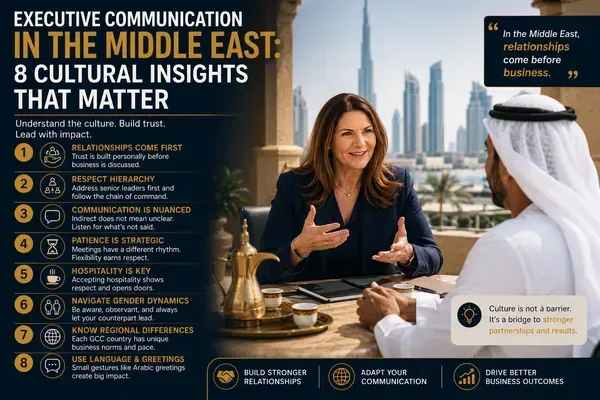
How to Improve Executive Communication in the Middle East: 8 Cultural Insights That Matter
Quick Answer: Effective executive communication in the Middle East requires understanding that relationships precede business, hierarchy shapes communication flow, and patience is a strategic asset. Leaders who invest in cultural awareness and adapt their communication style to local norms build stronger partnerships and close deals faster than those who rely on Western communication frameworks alone.
Introduction
The Middle East, particularly the Gulf Cooperation Council (GCC) region, is one of the world's most dynamic business environments. Dubai, Riyadh, Abu Dhabi, and Doha are global hubs attracting executives from every continent and industry. Yet many international leaders arrive with communication habits calibrated for Western boardrooms and struggle to understand why their approaches fall flat.
The gap is not about language. Most senior business leaders in the GCC speak fluent English. The gap is cultural: the unspoken rules about hierarchy, relationship, pace, and trust that shape how business gets done.
Having coached executives across the GCC for over two decades, I have seen firsthand how cultural communication awareness transforms business outcomes. Leaders who adapt thrive. Leaders who impose their own cultural norms struggle, often without understanding why.
These eight insights are the ones I share most frequently with executives entering or expanding within the Middle Eastern market.
1. Relationships Come Before Business, Always
In Western business culture, the relationship often develops as a byproduct of doing business together. In the Middle East, the relationship is the prerequisite.
What this means in practice:
Expect multiple meetings before any formal business discussion occurs
Accept invitations to coffee, meals, and social events. These are not distractions from business. They are business
Share personal stories and ask about family, health, and well-being before raising professional topics
Follow up with personal gestures: a message during Ramadan, congratulations on national holidays, or a note acknowledging a personal milestone
Key Insight: Attempting to rush past relationship building to "get to business" signals that you do not understand or respect the local culture. In the GCC, trust is built through personal connection, and business follows trust.
2. Hierarchy Shapes Every Interaction
The Middle East operates with a strong hierarchical business culture. Understanding and respecting this hierarchy is essential for effective communication.
Practical guidelines:
Address the most senior person in the room first
Direct key questions and proposals to the decision-maker, not the team
Do not openly challenge or contradict someone senior in a group setting
Wait for the senior leader to set the tone, pace, and direction of a meeting
Use formal titles until invited to use first names
In presentations: When presenting to a mixed-seniority group, acknowledge the most senior leader at the opening. Structure your content so the strategic message is clear without requiring the senior leader to engage in operational details.
3. Communication Style: Indirect Does Not Mean Unclear
Many Western executives expect direct, explicit communication: "yes" means yes, "no" means no. In the Middle East, communication is often more nuanced.
How to read indirect communication:
"We will look into it" may mean the proposal needs significant revision
"Inshallah" (God willing) can signal genuine hope, polite uncertainty, or a soft decline depending on context and tone
Silence after a proposal is not necessarily negative. It may indicate that the decision requires consultation with others
A change of subject may signal discomfort with the current topic rather than agreement
How to adapt your own style:
Be clear in your proposals and recommendations, but deliver them with diplomatic framing
Avoid ultimatums or hard deadlines that force an immediate response
Provide room for the other party to respond on their timeline
Use phrases like "I would welcome your thoughts on this" rather than "Do you agree or disagree?"
Key Insight: Indirect communication is a sign of sophistication, not evasiveness. It preserves relationships, protects face, and allows space for consensus building. Learn to listen for what is not said as carefully as what is.
4. Meeting Etiquette: Patience Is Strategic
Meetings in the Middle East follow a different rhythm than those in New York, London, or Singapore. Understanding this rhythm prevents frustration and demonstrates cultural respect.
What to expect:
Meetings may start later than scheduled. This is not a sign of disrespect
Interruptions (phone calls, visitors, assistants entering) are common and accepted
The agenda may shift organically. Flexibility is expected
Multiple topics may be discussed simultaneously
Decisions may not be finalized during the meeting itself
How to adapt:
Arrive on time even if your counterpart does not
Do not show frustration with delays or interruptions
Be prepared to discuss topics outside your planned agenda
Avoid looking at your watch or signaling impatience
Follow up after the meeting to confirm any verbal agreements in writing
5. The Role of Hospitality in Business
Hospitality is a deeply held cultural value across the Middle East. Accepting hospitality, whether it is coffee, tea, dates, or a meal, is not optional. It is a sign of respect.
Guidelines:
Always accept the first offering of coffee or tea, even if you only take a sip
Arabic coffee (gahwa) is traditionally served in small cups. Accept at least one. To signal you have had enough, gently shake the cup side to side
If invited to a meal, do not rush to leave afterward. Lingering signals that you value the host's company
Reciprocate hospitality when the opportunity arises
6. Gender Dynamics: Navigating with Awareness
Gender dynamics in GCC business settings have evolved significantly, particularly in the UAE and Saudi Arabia where women hold increasingly prominent leadership roles. However, awareness remains important.
Practical approach:
Follow the lead of your local counterpart. If they extend a handshake, reciprocate. If they do not, offer a respectful nod or hand-over-heart gesture
Do not make assumptions about authority or decision-making based on gender
In Saudi Arabia and other GCC nations, women are increasingly present in senior leadership. Treat all participants as professionals first
When uncertain about protocol, observe before acting
Key Insight: The GCC is changing rapidly. What was true five years ago may not apply today. Stay current, remain respectful, and let your counterpart's behavior guide your own. When in doubt, err on the side of formality.
For a complete cultural communication framework, see the Executive Communication in the Middle East Guide.
7. Regional Differences Within the GCC
The GCC is not monolithic. Each country has its own business culture, pace, and communication norms.
Key distinctions:
UAE (Dubai, Abu Dhabi): The most internationally diverse and fast-paced. English is the lingua franca of business. Meetings tend to be more structured and time-conscious than elsewhere in the region
Saudi Arabia: Rapidly transforming under Vision 2030. Business culture blends traditional values with modernization. Relationship building remains central, and patience is especially valued
Qatar: Smaller market with deep personal networks. Introductions through trusted intermediaries carry significant weight
Kuwait: Business is highly relationship-driven with longer decision-making cycles. Family business networks are powerful
Bahrain: Known for its relatively open business environment and accessible leadership
Oman: Values quiet diplomacy and thoughtful communication. Avoid aggressive sales approaches
8. Language and Greetings: Small Gestures, Big Impact
Even basic Arabic greetings create goodwill and signal respect for the culture.
Essential phrases:
"As-salamu alaykum" (Peace be upon you) - standard greeting
"Shukran" (Thank you) - use frequently
"Inshallah" (God willing) - used when discussing future plans
"Mashallah" (God has willed it) - used to express appreciation or admiration
Business card exchange: Present and receive business cards with your right hand or both hands. Take a moment to read the card before putting it away. Having one side of your card translated into Arabic is a thoughtful touch.
Key Takeaways
Relationships are the foundation of business in the Middle East. Invest time before discussing deals
Respect hierarchy in all communication. Address senior leaders first and avoid public disagreement
Learn to read indirect communication cues and adapt your own style accordingly
Patience during meetings is a strategic advantage, not a waste of time
Accept hospitality graciously. It is a cornerstone of the business relationship
Stay current on gender dynamics. The GCC is evolving rapidly
Recognize regional differences across GCC countries. One approach does not fit all
Ready to Communicate Effectively Across the Middle East?
Cultural communication awareness is the difference between deals that close and opportunities that stall. See the Executive Communication in the Middle East Guide for a comprehensive framework covering meeting preparation, negotiation strategies, relationship-building protocols, and country-specific guidance for every GCC market.
About the Author: Lisa Hugo is a Dubai-based executive communication coach with over a decade of experience helping C-suite leaders, entrepreneurs, and senior executives command rooms, cameras, and conversations. She is the creator of the Win The Room program.