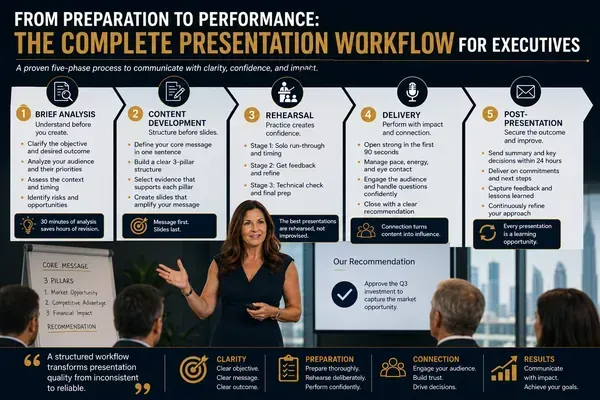
From Preparation to Performance: What is The Complete Presentation Workflow for Executives?
Quick Answer: The best executive presentations follow a five-phase workflow: brief analysis, content development, structured rehearsal, confident delivery, and strategic follow-up. Leaders who treat presentations as a disciplined process, rather than a creative exercise, consistently outperform those who rely on talent or improvisation alone.
Introduction
Most executives approach presentations backwards. They open their laptop, start building slides, and figure out the structure as they go. The result is a presentation shaped by the tool rather than by the audience or the objective.
The leaders who consistently deliver high-impact presentations follow a repeatable process. They invest the majority of their time before the slides are created and after the rehearsal is complete. Slide design is the smallest part of the workflow.
This guide walks through the complete presentation workflow, from the moment you receive the brief to the follow-up conversation after you leave the room. Each phase has specific actions, decisions, and checkpoints that ensure your presentation achieves its objective.
Whether you are presenting a quarterly update to the board, pitching to investors, or leading a company-wide town hall, this workflow applies. Adapt the depth of each phase to the stakes involved, but never skip a phase entirely.
Phase 1: Brief Analysis (Before You Create Anything)
The most common presentation mistake happens before a single slide is created: starting without a clear understanding of the objective, audience, and context.
The Brief Analysis Framework:
Objective clarity:
What specific outcome do I need from this presentation?
Is this a decision, an update, a persuasion, or an alignment session?
What does success look like 24 hours after this presentation?
Audience analysis:
Who will be in the room? What are their priorities and concerns?
What do they already know about this topic?
What is their likely disposition: supportive, skeptical, neutral, or hostile?
Who is the decision-maker, and what matters most to them?
Context assessment:
What happened in the last meeting on this topic?
What external factors (market conditions, company performance, recent events) might influence how this presentation is received?
What time slot do I have? What comes before and after me on the agenda?
Key Insight: Thirty minutes of brief analysis saves hours of revision later. The executives who skip this phase end up rebuilding their presentations multiple times because they solved the wrong problem or addressed the wrong audience.
Phase 2: Content Development (Structure Before Slides)
With a clear brief in hand, content development follows a specific sequence: message first, structure second, evidence third, slides last.
Step 1: Define Your Core Message
Your entire presentation should be expressible in one sentence. If you cannot articulate your core message in 15 words or fewer, your presentation is not focused enough.
Examples:
"We need to approve the Q3 investment to capture the market window before December."
"Our retention strategy is working, but we need to accelerate hiring in two key regions."
"The data supports a full product launch in Q2, with three risk mitigations in place."
Step 2: Build Your Structure
Use a proven structural framework rather than inventing a new one for each presentation.
The 3-pillar structure:
Opening hook and core message (2 minutes)
Pillar 1: the strongest supporting argument with evidence (5 minutes)
Pillar 2: the second supporting argument with evidence (5 minutes)
Pillar 3: the third supporting argument or the risk/mitigation perspective (5 minutes)
Summary, recommendation, and call to action (3 minutes)
Step 3: Select Your Evidence
For each pillar, choose one to two pieces of evidence that are:
Specific (numbers, dates, names)
Relevant to the audience's priorities
Visual or memorable (a chart, a comparison, a brief story)
Step 4: Build Your Slides (If Needed)
Slides support your message. They do not replace it.
Slide design principles for executives:
One idea per slide
Use headlines that state the insight, not the category ("Revenue grew 12% in Q3" not "Q3 Revenue")
Minimize text. If the audience is reading, they are not listening to you
Use data visualization instead of tables when possible
Include a clearly labeled source for every data point
Key Insight: The best executive presentations often use fewer than 10 slides for a 20-minute session. If you have more than 15 slides, you are probably trying to say too much.
For a complete content development framework with templates, see the The Executive's Guide to Confident Presentations: From Preparation to Performance.
Phase 3: Rehearsal (The Phase Most Executives Skip)
Rehearsal is the highest-leverage activity in the entire presentation workflow. It is also the one most executives skip or underinvest in.
The three-stage rehearsal process:
Stage 1: Solo run-through (Day 2 before the presentation)
Deliver the full presentation standing, at performance energy
Time yourself. Aim for 80% of your allotted time to leave room for questions and natural expansion
Identify sections that feel unclear or overly long
Refine transitions between sections
Stage 2: Feedback rehearsal (Day 1 before the presentation)
Deliver to a trusted colleague or coach who represents the audience's perspective
Ask for specific feedback: "Where did you lose interest?" "Was my recommendation clear?" "What would you challenge?"
Refine based on feedback
Stage 3: Technical check (Morning of the presentation)
Test your slides, audio, and video setup in the actual room or virtual platform
Practice your opening and closing one more time
Do your vocal warm-up
Phase 4: Delivery (Performing Under Pressure)
With thorough preparation and rehearsal, delivery becomes execution rather than improvisation.
Delivery priorities:
Opening: Deliver your hook and core message in the first 90 seconds. Set the agenda briefly
Pace: Speak slightly slower than feels natural. Pause deliberately after key points
Eye contact: Use the 3-second rule. Hold eye contact with one person per thought
Energy: Match your energy to the content. Data requires calm authority. Vision requires elevated conviction
Audience awareness: Watch for signals. Adjust if you see disengagement or confusion
Questions: Welcome them. Pause before answering. Keep responses to 60 seconds or less
Closing: Restate your core message. Deliver your call to action with confidence
If something goes wrong:
Technology failure: Have a backup plan. Know your material well enough to present without slides
Hostile question: Acknowledge the concern. Respond with data, not emotion. Offer to continue offline if needed
Running out of time: Skip to your closing. Deliver the recommendation and offer to send supporting details in a follow-up
Phase 5: Post-Presentation (Securing the Outcome)
The presentation does not end when you stop speaking. The follow-up phase secures the outcome you worked for.
Follow-up actions within 24 hours:
Send a concise email summarizing key points and decisions
Deliver on any promises made during Q&A
Share the slide deck or a one-page summary with attendees
Note feedback received and incorporate it into future preparations
If a decision was deferred, schedule the follow-up meeting or communication
Continuous improvement log:
After every significant presentation, record:
What worked well (keep doing this)
What did not land as intended (adjust next time)
Audience feedback received
Questions you were not prepared for
Key Insight: The executives who improve fastest are those who treat every presentation as a learning event. A five-minute debrief after each presentation compounds into transformational improvement over a year.
Key Takeaways
Start with brief analysis, not slide design. Clarify the objective, audience, and context before creating content
Define your core message in one sentence before building your structure
Use the 3-pillar structure for clarity and impact in any presentation setting
Rehearse in three stages: solo run-through, feedback rehearsal, and technical check
During delivery, prioritize pace, eye contact, and energy management over slide content
Follow up within 24 hours with a summary of decisions and action items
Maintain a continuous improvement log to compound your presentation skills over time
Ready to Build Your Presentation Workflow?
A structured workflow transforms presentation quality from inconsistent to reliable. See the Confident Presentations Guide for the complete system, including brief analysis templates, structural frameworks, rehearsal checklists, and post-presentation review tools designed for senior leaders.
About the Author: Lisa Hugo is a Dubai-based executive communication coach with over a decade of experience helping C-suite leaders, entrepreneurs, and senior executives command rooms, cameras, and conversations. She is the creator of the Win The Room program.