
Table of Contents
Executive Summary
Introduction
Chapter 1: The Foundation - Understanding Your Brief
Chapter 2: Strategic Content Development
Chapter 3: Visual Design Excellence
Chapter 4: Rehearsal Strategies That Build Confidence
Chapter 5: Pre-Presentation Preparation
Chapter 6: Confident Delivery Techniques
Chapter 7: Advanced Performance Skills
Chapter 8: Post-Presentation Excellence
Conclusion
Key Takeaways
About the Author
Executive Summary
Confident presentations do not happen by accident. They are the result of a deliberate, systematic process that begins long before you step in front of an audience and continues long after you leave the stage. This guide provides a complete framework for developing, preparing, and delivering presentations that project confidence, credibility, and authority at the executive level.
From the moment you receive a speaking brief to the follow-up actions after your final slide, every stage of the presentation process presents an opportunity to build or undermine your confidence. This guide addresses each stage in detail, providing practical techniques, proven strategies, and actionable insights that you can apply immediately.
This guide serves C-suite executives, senior leaders, entrepreneurs, and ambitious professionals who want to transform their presentation skills from adequate to exceptional. Whether you are presenting to a board of directors, keynoting an industry conference, pitching to investors, or addressing your team, the principles in this guide will help you prepare more effectively, deliver more confidently, and achieve greater impact with every presentation.
What makes this guide comprehensive is its end-to-end approach. Most presentation resources focus on delivery alone, ignoring the critical preparation stages that determine whether a speaker feels confident or anxious. This guide covers the entire journey: clarifying your brief, developing strategic content, designing powerful visuals, rehearsing effectively, preparing mentally and physically, delivering with authority, handling the unexpected, and learning from every experience. By mastering each stage, you build the deep, genuine confidence that audiences can see, hear, and feel.
Introduction
Why Confidence Matters More Than Content
In over 20 years of coaching, I have observed a consistent truth: audiences respond to confidence as much as, and often more than, they respond to content. A well-researched, beautifully structured presentation delivered without confidence falls flat. A slightly imperfect presentation delivered with genuine confidence and conviction inspires trust, engagement, and action.
This does not mean content is unimportant. It means that confidence is the vehicle through which great content reaches your audience. Without it, even the most compelling ideas fail to land. With it, good ideas become powerful, and great ideas become transformative.
The Preparation-Confidence Connection
The single most important insight about presentation confidence is this: confidence is not a personality trait. It is the direct result of thorough, strategic preparation. Every executive I have coached who has significantly improved their presentation confidence has done so primarily by improving their preparation process.
When you know your material deeply, when you have anticipated every question, when you have rehearsed until your delivery feels natural, and when you have prepared for every possible technical or logistical challenge, confidence follows naturally. The anxiety that undermines most presenters comes not from a lack of talent but from a lack of preparation.
Lisa's Proven Framework
The framework presented in this guide is the result of years of working with C-suite leaders, government officials, and entrepreneurs across the globe. It has been refined through thousands of coaching sessions and applied in boardrooms, conference stages, media studios, and parliamentary chambers. It is not theoretical. It is practical, tested, and proven.
This framework treats presentation excellence as a process, not a performance. By focusing on the process, you remove the pressure of "performing" and replace it with the confidence that comes from following a reliable, repeatable system.
How to Use This Guide
Read this guide from beginning to end to understand the complete framework. Then use individual chapters as reference material when preparing for specific engagements. Each chapter is designed to be both part of a comprehensive system and a standalone resource for targeted improvement. Throughout the guide, you will find Quick Tips and Key Insights that highlight the most actionable strategies for immediate application.
Chapter 1: The Foundation - Understanding Your Brief
Clarifying Objectives
Every confident presentation begins with absolute clarity about what you are trying to achieve. Before you write a single word or design a single slide, you must answer one fundamental question: What do I want my audience to know, believe, or do differently after this presentation?
This question seems simple, but many executives skip it or answer it vaguely. "I want to update the board on Q3 results" is not a clear objective. "I want the board to approve our revised growth strategy based on Q3 performance data" is a clear objective. The difference between these two statements is the difference between a presentation that wanders and one that drives toward a specific outcome.
Quick Tip: Write your presentation objective in a single sentence and keep it visible throughout your preparation process. Every slide, every story, every data point should serve this objective. If it does not, remove it.
Audience Analysis Deep Dive
Understanding your audience is not a superficial exercise. For executive presentations, audience analysis should be thorough and specific. Consider: Who will be in the room? What are their priorities, concerns, and decision-making criteria? What do they already know about your topic? What are their likely objections or questions? What is their emotional state, supportive, skeptical, hostile, or neutral? What communication style do they prefer?
The more deeply you understand your audience, the more precisely you can tailor your content, tone, and delivery. This precision creates confidence because you know you are speaking directly to the people in front of you, not delivering a generic presentation that could be aimed at anyone.
Context and Constraints
Every presentation takes place within a specific context that shapes what is appropriate, expected, and effective. Consider the organizational context: What is happening in the company or industry right now? What recent events, decisions, or changes are relevant? Consider the physical context: What is the venue, the room setup, the technology available? Consider the political context: Are there sensitivities, competing agendas, or interpersonal dynamics that you need to navigate?
Understanding these constraints does not limit your presentation. It focuses it. Working within constraints forces clarity and creativity, both of which enhance confidence.
Success Metrics Definition
Define in advance how you will measure the success of your presentation. For some presentations, success means a specific decision or approval. For others, it means a shift in audience understanding or sentiment. For keynotes or thought leadership talks, success might be measured by audience engagement, media coverage, or post-event inquiries. Having clear success metrics keeps your preparation focused and gives you a concrete standard against which to evaluate your performance.
Stakeholder Alignment
For many executive presentations, the content and messaging require alignment with other stakeholders before delivery. This might include board members, co-presenters, legal counsel, communications teams, or other senior leaders. Addressing alignment early in your preparation process prevents last-minute changes that can undermine your confidence and the quality of your delivery.
Key Insight: The most common source of last-minute presentation anxiety is not nervousness about speaking. It is uncertainty about whether the content has been fully approved or whether a surprise objection will arise. Eliminate this uncertainty through early, thorough stakeholder alignment.
Time and Format Considerations
Understanding the time available and the expected format is essential for calibrating your content and delivery. A 10-minute board update requires a fundamentally different approach than a 45-minute keynote. A panel discussion demands different skills than a solo presentation. A virtual presentation has different requirements than an in-person event.
Plan your content to fit comfortably within your time allocation, leaving room for Q&A if expected. Structure your delivery to match the format. And always have a plan for finishing early or running long, so you can adapt smoothly.
Setting Yourself Up for Success
The foundation stage is where confident presentations are won or lost. By investing time in clarifying your objectives, analyzing your audience, understanding the context, defining success, aligning stakeholders, and planning for the format, you build the deep understanding that fuels genuine confidence. Skipping or rushing this stage is the most common mistake executives make, and it is the most costly.
Chapter 2: Strategic Content Development
Message Architecture
Once your foundation is solid, you can begin building your message architecture, the structural framework that organizes your content for maximum clarity and impact. Effective message architecture follows a clear hierarchy: one core message, supported by two to four key themes, each backed by specific evidence, examples, or stories.
This architecture serves two purposes. First, it ensures that your audience can follow your logic and remember your key points. Second, it gives you a reliable structure to follow during delivery, which reduces the mental load of remembering what comes next and allows you to focus on connection and engagement.
Quick Tip: Before developing your content, write your message architecture on a single page. Core message at the top, key themes below, supporting points underneath each theme. If it does not fit on one page, your structure is too complex.
The Narrative Structure
Every great presentation tells a story. Even the most data-heavy board presentation benefits from a narrative structure that takes the audience on a journey from a starting point to a destination. The most effective narrative structures for executive presentations include the situation-complication-resolution model, which presents a challenge and its solution, and the past-present-future model, which shows where you have been, where you are, and where you are going.
Narrative structure creates momentum and engagement. It gives your audience a reason to keep listening because they want to know what happens next. And it provides you with a natural flow that makes delivery feel easier and more confident.
Research and Evidence Gathering
Confident presenters know their material inside and out. This requires thorough research that goes beyond the content you plan to present. You should understand the broader context, the competing perspectives, the potential objections, and the latest data relevant to your topic. This depth of knowledge gives you the flexibility to adapt your presentation in the moment and the confidence to handle any question.
Gather evidence from multiple sources: internal data, industry research, academic studies, case examples, and expert opinions. Verify the accuracy and currency of every data point. And ensure that your evidence directly supports your key messages rather than serving as impressive but irrelevant filler.
Supporting Your Arguments
Each key theme in your message architecture needs specific, credible support. The most effective forms of support for executive presentations include quantitative data, qualitative evidence, expert testimony, case studies, and personal experience. The strongest presentations use a mix of these forms, appealing to both the analytical and emotional dimensions of decision-making.
Key Insight: The quality of your supporting evidence is more important than the quantity. Three powerful, well-chosen data points are more persuasive than fifteen mediocre ones. Select your evidence for maximum impact, not maximum volume.
Anticipating Objections
One of the most effective confidence-building strategies is anticipating and addressing potential objections before they are raised. If you know that a board member is concerned about risk, build risk mitigation into your presentation. If you expect skepticism about your timeline, include evidence of similar timelines achieved elsewhere. By addressing objections proactively, you demonstrate thoroughness and prevent uncomfortable surprises during Q&A.
Building Persuasive Flow
Persuasive flow is the logical and emotional progression that moves your audience from their current position to the position you want them to hold. This requires understanding where your audience starts, what barriers exist between their current view and your desired outcome, and what combination of logic, evidence, and emotion will move them across those barriers.
Effective persuasive flow typically moves from establishing common ground, to presenting the problem or opportunity, to introducing your solution or perspective, to addressing potential concerns, to calling for action or commitment.
Editing for Impact
The final stage of content development is ruthless editing. Remove anything that does not directly serve your core message. Simplify complex language. Shorten long sentences. Eliminate jargon that your audience may not share. And cut any section that, however interesting, does not contribute to your stated objective. The result should be content that is lean, focused, and powerful, content that you can deliver with conviction because every element earns its place.
Chapter 3: Visual Design Excellence
Slide Design Principles for Executives
Visual aids should enhance your presentation, not replace it. The best executive slides are clean, focused, and visually compelling. They support your spoken message without competing with it. They provide visual emphasis for key points without overwhelming the audience with information.
The foundational principle of executive slide design is restraint. Every element on a slide, whether text, image, chart, or graphic, should be there for a specific reason. If you cannot articulate why an element is on the slide, remove it. White space is not empty space. It is breathing room that helps your audience focus on what matters.
Quick Tip: Apply the "glance test" to every slide. If your audience cannot understand the slide's main point within three seconds of seeing it, the slide needs to be simplified.
Less Is More Philosophy
The most common mistake in executive presentations is putting too much information on each slide. Dense slides with multiple bullet points, small text, and complex graphics force your audience to read instead of listen. When they are reading, they are not listening to you. When they are not listening, your personal impact is lost.
Adopt the less is more philosophy: one main idea per slide, minimal text, and large, clear visuals. Use your slides as a backdrop for your spoken narrative, not as a script or a document. If your audience needs detailed information, provide it in a handout or follow-up document, not on your slides.
Data Visualization Mastery
Executives frequently present complex data, and the ability to visualize that data effectively is a critical skill. The best data visualizations are clear, accurate, and focused on the insight rather than the raw numbers. Choose chart types that match the story your data tells: bar charts for comparisons, line charts for trends, pie charts for proportions (used sparingly), and tables for detailed reference.
Remove chart clutter, including unnecessary gridlines, excessive labels, decorative elements, and 3D effects that distort perception. Highlight the key insight in each chart with color, annotation, or callout. And ensure that every data visualization answers a specific question that supports your message.
Typography and Readability
Typography choices affect how your audience perceives and processes your content. Use clean, modern sans-serif fonts for presentations. Maintain a minimum font size of 24 points for body text and 36 points for titles. Limit yourself to two fonts at most, one for headings and one for body text. And ensure strong contrast between text and background for readability in all lighting conditions.
Color Psychology and Branding
Color choices in your presentations communicate at a subconscious level. Blues convey trust and professionalism. Greens suggest growth and balance. Reds create urgency and energy. Ensure that your color palette aligns with your brand and the tone of your message. Maintain consistency throughout the presentation, and use accent colors sparingly to draw attention to key elements.
Key Insight: If your organization has a brand style guide, follow it for all presentations. Brand consistency reinforces professionalism and avoids the distraction of inconsistent visuals.
Animation and Transitions (When and How)
Animation and transitions should be used with extreme restraint in executive presentations. Subtle animations can be effective for revealing data progressively or guiding attention through a complex visual. Flashy transitions between slides are almost always distracting and unprofessional.
If you use animation, choose simple effects such as fade or appear. Use them consistently throughout the presentation. And ensure they serve a communication purpose, not a decorative one. When in doubt, skip the animation entirely.
Accessibility Considerations
Ensure that your presentations are accessible to all audience members. Use high-contrast color combinations. Avoid relying solely on color to convey meaning. Use alt text for images in digital distributions. Choose readable fonts at sufficient sizes. And test your slides in the actual presentation environment, including lighting and screen size, to ensure they are clear and legible for everyone in the room.
Chapter 4: Rehearsal Strategies That Build Confidence
Types of Rehearsal
Effective rehearsal is the single most powerful confidence-building tool available to any presenter. But not all rehearsal is created equal. Different types of rehearsal serve different purposes, and a comprehensive rehearsal strategy includes all of them.
Silent rehearsal involves reviewing your material mentally, visualizing your delivery, and working through the flow of your presentation in your mind. This is useful for familiarizing yourself with the content but insufficient on its own. Spoken rehearsal means delivering your presentation out loud, either to yourself or to a practice audience. This is essential for developing your vocal delivery, timing, and natural language. Full dress rehearsal replicates the actual presentation conditions as closely as possible, including the venue, technology, attire, and audience.
Quick Tip: Schedule at least three spoken rehearsals for any important presentation: one for content review, one for timing and delivery, and one full dress rehearsal. Each serves a different purpose and builds confidence incrementally.
Progressive Practice Approach
The progressive practice approach builds confidence gradually by starting with low-pressure rehearsals and progressively increasing the intensity. Begin by rehearsing alone, focusing on content and flow. Then rehearse in front of a trusted colleague or coach, focusing on delivery and engagement. Then rehearse in front of a small group that can provide critical feedback. Finally, do a full dress rehearsal in conditions as close to the actual presentation as possible.
Each stage of this progression builds on the last, allowing you to refine your content, delivery, and confidence in manageable increments rather than attempting a single, high-pressure rehearsal that may increase anxiety rather than reduce it.
Timing and Pacing Practice
Timing is one of the most practical aspects of rehearsal. Time your full presentation at least twice during rehearsal to ensure it fits comfortably within your allocation. Identify sections that run long and edit them. Note natural transition points where you can adjust your pace if needed during the actual delivery.
Pacing practice involves deliberately varying your speed throughout the presentation. Practice slowing down for key messages and speeding up slightly for transitional or supporting material. This variation maintains audience engagement and gives your delivery a natural, dynamic rhythm.
Vocal Rehearsal Techniques
Dedicate specific rehearsal time to vocal technique. Practice projection by rehearsing in a space similar in size to your venue. Practice variation by deliberately changing your pitch, pace, and volume at different points in your presentation. Practice emphasis by identifying the key words and phrases in each section and rehearsing how you will highlight them vocally.
Record your vocal rehearsals and listen back critically. Pay attention to clarity, pace, filler words, and energy level. This objective feedback is invaluable for refining your delivery.
Movement and Blocking
If your presentation involves a stage or open space, rehearse your movement as deliberately as your words. Plan where you will stand for your opening, where you will move during transitions, and where you will position yourself for key moments. Practice walking to specific points on the stage while maintaining your vocal delivery and eye contact.
Key Insight: Rehearsing movement in advance transforms it from a source of anxiety into a source of confidence. When you know where you are going to be at each point in your presentation, you can focus entirely on your message and your audience.
Tech Run-Throughs
Technical failures are one of the most common sources of presentation anxiety. Eliminate this anxiety by conducting a thorough technical rehearsal. Test your slides on the actual presentation equipment. Check audio and visual quality. Verify that videos and animations play correctly. Ensure that remote controls, microphones, and lighting are working properly. And develop a backup plan for every technical component.
Feedback Incorporation
After each rehearsal, gather feedback and incorporate it into your next practice session. Ask your practice audience for specific, actionable feedback on your content, delivery, pacing, visuals, and overall impact. Prioritize the feedback that addresses your most significant development areas and resist the urge to overhaul your presentation based on every comment. The goal is incremental improvement, not constant reinvention.
Chapter 5: Pre-Presentation Preparation
The 24 Hours Before
The day before a major presentation is a critical period that many executives mismanage. The temptation is to cram in last-minute rehearsals, make significant content changes, or obsess over details. A more effective approach is to use this time for final review, relaxation, and mental preparation.
Review your presentation one final time, focusing on your opening, your key messages, and your closing. Make only minor adjustments. Ensure that all logistics are confirmed. Then step away from your presentation and focus on rest and recovery. A well-rested presenter with slightly imperfect slides will always outperform an exhausted presenter with flawless slides.
Quick Tip: Set a "content freeze" deadline at least 12 hours before your presentation. After this point, make no further changes to your slides or script. This boundary prevents the destructive cycle of last-minute tinkering that increases anxiety and decreases confidence.
Physical Preparation
Your physical state directly affects your presentation performance. In the 24 hours before a major presentation, prioritize sleep, hydration, and light nutrition. Avoid heavy meals, excessive caffeine, and alcohol. Exercise lightly if it is part of your routine, but avoid exhausting workouts. Your body is your instrument, and it needs to be in optimal condition for peak performance.
Mental Preparation
Mental preparation is as important as physical preparation. Practice visualization by mentally rehearsing your presentation from start to finish, imagining yourself delivering confidently and your audience responding positively. Use positive affirmations to counter any negative self-talk. And engage in whatever calming activities help you achieve a focused, confident mental state, whether that is meditation, journaling, listening to music, or spending time with supportive people.
Logistics and Tech Check
Arrive at the venue early enough to conduct a thorough logistics and technology check. Test every piece of equipment. Walk the stage or presentation area. Check the lighting and sightlines from different audience positions. Confirm that your backup plan is ready. The more familiar and controlled the environment feels, the more confident you will be when you begin.
Backup Plans
Every confident presenter has a backup plan. What will you do if your slides fail? If the microphone stops working? If a key piece of technology malfunctions? Having thought through these scenarios and prepared alternatives means that even if something goes wrong, you have a plan. This preparedness is one of the deepest sources of genuine confidence.
Wardrobe and Appearance
Choose your wardrobe in advance, not on the morning of the presentation. Select attire that is appropriate for the context, comfortable enough to move freely, and consistent with the professional image you want to project. Avoid anything new or untested that might cause discomfort or distraction. Lay out your complete outfit the night before, including shoes and accessories, so that getting dressed is effortless.
Pre-Game Rituals
Develop a personal pre-presentation ritual that helps you transition from preparation mode to performance mode. This might include breathing exercises, a brief physical warm-up, vocal exercises, a few minutes of quiet reflection, or a specific piece of music. The consistency of this ritual creates a psychological trigger that signals to your mind and body that it is time to perform at your best.
Key Insight: The most confident presenters do not rely on willpower to manage their nerves. They rely on rituals, routines, and systematic preparation that make confidence a predictable outcome rather than a hopeful aspiration.
Chapter 6: Confident Delivery Techniques
The First 60 Seconds Mastery
The opening of your presentation sets the tone for everything that follows. In the first 60 seconds, your audience decides whether to lean in or tune out, whether to trust you or question you, whether to engage or disconnect. Mastering this critical window is one of the most impactful investments you can make in your presentation skills.
Begin with presence, not words. Walk to your position with purpose. Stand still. Make eye contact. Breathe. Let a moment of silence establish your command of the room. Then deliver your opening with energy, clarity, and conviction.
Avoid the most common opening mistakes: starting with an apology, a disclaimer, or a weak "Thank you for having me." Instead, open with a bold statement, a provocative question, a compelling statistic, or a brief, relevant story that immediately captures attention and establishes your authority.
Quick Tip: Memorize and rehearse your opening 60 seconds until you can deliver them flawlessly without notes. This gives you a strong, confident start that builds momentum for the rest of your presentation.
Maintaining Energy Throughout
Energy management is a critical skill for confident delivery, particularly in longer presentations. Your energy level communicates your passion, conviction, and engagement. If your energy drops, your audience's attention drops with it.
Maintain consistent energy by varying your delivery throughout the presentation. Alternate between higher-energy segments, such as key messages and stories, and more measured segments, such as data analysis and detailed explanations. Use physical movement, vocal variation, and audience interaction to maintain your own energy and your audience's engagement.
Voice Modulation and Projection
Your voice is your most powerful delivery tool. Confident presenters use their voice deliberately, modulating pitch, pace, volume, and tone to create emphasis, maintain interest, and convey emotion. A monotone delivery, regardless of how excellent the content, signals disengagement and undermines confidence.
Project your voice to fill the room without shouting. Speak from your diaphragm, not your throat. Practice varying your volume, speaking more softly to create intimacy and more loudly to create emphasis. Use your natural pitch range fully, avoiding the trap of speaking in a single, flat tone.
Body Language Confidence Signals
Your body language communicates confidence, or the lack of it, constantly. Open body language, including uncrossed arms, visible palms, relaxed shoulders, and steady eye contact, signals confidence and openness. Closed body language, such as crossed arms, fidgeting, avoiding eye contact, and gripping the podium, signals anxiety and defensiveness.
Stand tall with your weight evenly distributed. Use purposeful gestures that reinforce your words. Move deliberately and with intention. And maintain eye contact with different sections of your audience throughout your delivery.
Managing Notes and Prompts
Confident presenters use notes as a safety net, not a script. If you need notes, use brief keyword prompts rather than full sentences. Place them where you can glance at them naturally without breaking your connection with the audience. Practice with your notes until you can reference them seamlessly and infrequently.
Key Insight: The audience does not expect you to speak without notes. They expect you to speak with them in a way that does not interfere with your delivery or your connection. A confident glance at well-organized notes is far more professional than a desperate search through disorganized pages.
Connecting with Audience
Genuine audience connection is the hallmark of confident delivery. Connection comes from making your audience feel seen, heard, and valued. Use eye contact, direct address, relevant examples, and authentic emotion to bridge the gap between you and your audience. Ask questions, invite responses, and acknowledge the audience's perspective. The more connected you are to your audience, the more confident and natural your delivery will feel.
Handling the Unexpected
No matter how thoroughly you prepare, unexpected events will occur during presentations. Equipment may malfunction. Someone may ask an unusual question. A fire alarm may sound. Your ability to handle these moments with composure defines your credibility as a speaker.
The key to handling the unexpected is acceptance. Accept that surprises are part of live presentations. Respond with calm, humor, or practical action as appropriate. Never panic, never apologize excessively, and never let an unexpected event derail your entire presentation.
Chapter 7: Advanced Performance Skills
Reading the Room
The ability to read the room, to sense the audience's energy, engagement, and emotional state in real time, is an advanced skill that distinguishes exceptional presenters from merely competent ones. Reading the room allows you to adapt your delivery on the fly, spending more time on topics that resonate, moving quickly past sections that are losing attention, and adjusting your tone to match the audience's mood.
Pay attention to body language signals from your audience: leaning forward indicates engagement, checking phones indicates disengagement, nodding indicates agreement, and frowning or crossed arms may indicate skepticism or resistance. Use these signals to calibrate your delivery in real time.
Quick Tip: Identify three or four "indicator" audience members in different parts of the room. Monitor their engagement throughout your presentation as representative signals of the broader audience's state.
Adapting on the Fly
Adaptation is the practical application of reading the room. When you sense that your audience is losing engagement, change your approach. Speed up, slow down, tell a story, ask a question, or skip ahead to more compelling content. When you sense strong engagement, lean into the topic. When you encounter resistance, address it directly rather than ignoring it.
Confident adaptation requires deep knowledge of your material. You can only deviate from your plan if you are secure enough in your content to find your way back. This is another reason why thorough preparation is the foundation of confidence.
Humor and Timing
Humor, used appropriately, is a powerful tool for executive presenters. It builds rapport, creates memorable moments, defuses tension, and demonstrates confidence. But humor in executive presentations requires careful calibration. It should be relevant to your topic, appropriate for your audience, and delivered with natural timing.
The safest forms of executive humor include self-deprecating observations, ironic contrasts, unexpected analogies, and amusing real-world examples. Avoid jokes that could offend, humor that undermines your authority, or comedy that feels forced or rehearsed. The best executive humor feels spontaneous even when it is carefully planned.
Storytelling Techniques
Stories are the most powerful communication tool available to any presenter. They engage emotions, create mental images, and make abstract concepts concrete and memorable. Confident presenters weave stories throughout their presentations, using them to illustrate key points, create emotional connection, and provide relief from data-heavy sections.
Effective presentation stories are brief, specific, and directly relevant to your message. They follow a clear structure: context, challenge, action, and outcome. And they include sensory details that bring the story to life without overloading the audience with unnecessary description.
Emotional Intelligence in Delivery
Emotional intelligence in presentation delivery means being aware of and responsive to the emotional dynamics of your interaction with the audience. This includes managing your own emotional state, reading the emotional state of your audience, and using emotional appeals purposefully and ethically.
Key Insight: The most impactful presentations create an emotional journey for the audience, moving them from curiosity to concern to hope to commitment, or from complacency to urgency to resolve. This emotional arc is as important as your logical argument in driving action and change.
Handling Technical Difficulties
Technical difficulties are an inevitable part of presenting with technology. The confident executive handles them with composure and grace. If your slides freeze, continue your presentation from memory or notes. If a microphone fails, project your voice and move closer to the audience. If a video will not play, describe the content and move on.
The key principle is to never let technology control you. You are the presentation, not your slides or your equipment. Your audience will remember how you handled the difficulty far longer than they will remember the difficulty itself.
Managing Q&A Confidently
The question-and-answer segment is where many presenters lose their confidence. Without the structure of prepared remarks, they feel exposed and vulnerable. The solution is to prepare for Q&A as rigorously as you prepare for your main presentation.
Anticipate the most likely questions and prepare concise, clear answers. Develop bridging techniques for redirecting difficult questions back to your key messages. Practice handling hostile or unfair questions with composure. And establish clear Q&A boundaries at the outset, including how many questions you will take and how long the session will last.
Chapter 8: Post-Presentation Excellence
Closing with Impact
Your closing is the last impression your audience takes away and often the part they remember most vividly. A strong closing should accomplish three things: summarize your core message, create emotional resonance, and provide a clear call to action or next step.
Avoid the common mistake of trailing off with "so, that's it" or "any questions?" Instead, deliver a purposeful, rehearsed closing that leaves your audience energized, informed, and motivated. Return to the theme or story from your opening to create a satisfying narrative arc. End with a statement that is bold, memorable, and aligned with your objective.
Quick Tip: Memorize your closing as carefully as your opening. The final 30 seconds of your presentation should be delivered with the same energy, conviction, and polish as the first 30 seconds.
Handling Post-Talk Questions
After a formal Q&A, many presenters face additional questions in informal settings, including hallway conversations, networking breaks, and follow-up meetings. These interactions offer valuable opportunities to reinforce your message, build relationships, and address individual concerns.
Approach post-talk questions with the same professionalism and message discipline as your formal presentation. Listen actively, respond thoughtfully, and use these conversations to deepen the impact of your main presentation.
Follow-Up Strategies
The period immediately after your presentation is a valuable window for reinforcing your message and building on the momentum you have created. Follow up with key stakeholders to address any outstanding questions. Share supplementary materials, such as detailed reports, data sets, or reading lists, that support your presentation. And connect personally with audience members who expressed particular interest or raised important questions.
Self-Assessment
After every presentation, conduct an honest self-assessment. What went well? What could be improved? Were there moments where you felt particularly confident or particularly uncertain? Did you achieve your stated objective? Self-assessment is not self-criticism. It is a structured review that identifies strengths to maintain and areas to develop.
Gathering Feedback
In addition to self-assessment, seek external feedback from trusted sources. Ask specific questions rather than general ones: "How effective was my opening?" "Did the data visualization support my argument?" "Where did you feel my energy drop?" Specific questions generate specific, actionable feedback that you can use to improve.
Key Insight: The presenters who improve fastest are those who seek feedback most actively. Create a personal advisory board of two or three trusted colleagues or mentors who will give you honest, constructive feedback after important presentations.
Learning and Improving
Document your learnings from each presentation in a personal development journal. Track patterns over time: Are you consistently strong in certain areas and weak in others? Are specific types of audiences or formats more challenging for you? Use these patterns to direct your ongoing development efforts.
Review recordings of your presentations when available. Watching yourself present is one of the most uncomfortable and most valuable development activities you can undertake. It reveals habits, mannerisms, and delivery patterns that you may not be aware of, giving you specific targets for improvement.
Building Momentum
Each successful presentation builds confidence for the next one. Use this positive momentum deliberately. After a strong performance, schedule your next speaking engagement while your confidence is high. Reflect on what you did well and carry those strengths forward. And share your success with colleagues or mentors who can reinforce your progress.
Conclusion
Your Confidence Journey
Presentation confidence is not a fixed trait that you either have or lack. It is a skill that develops through deliberate, systematic preparation and practice. Every executive who commits to the process outlined in this guide will experience significant improvements in their confidence, their delivery, and their impact.
From Preparation to Mastery
The journey from preparation to mastery follows a predictable path. You begin by establishing strong preparation habits that eliminate the uncertainty that causes anxiety. You develop delivery techniques that project authority and create connection. You build advanced skills that allow you to adapt, engage, and perform at the highest level. And you commit to continuous learning that keeps you growing and improving.
Continued Growth
Presentation mastery is a lifelong pursuit. The most compelling executive presenters are those who never stop learning, practicing, and refining their skills. They seek feedback, study other great speakers, experiment with new techniques, and push themselves beyond their comfort zones. This commitment to growth is what separates truly exceptional presenters from those who are merely adequate.
Resources and Support
If you are ready to accelerate your presentation confidence, consider working with a professional executive communication coach. Lisa Hugo has spent years helping C-suite leaders, entrepreneurs, and government officials develop the presentation skills that drive real business results. Through personalized coaching, executive workshops, and comprehensive communication programs, Lisa provides the guidance, feedback, and accountability that accelerate your development. Connect with Lisa to begin your journey from preparation to confident performance.
Key Takeaways
Confidence is not a personality trait. It is the direct result of thorough, strategic preparation.
Every confident presentation begins with absolute clarity about your objective. Define what you want your audience to know, believe, or do differently.
Audience analysis should be thorough and specific, covering priorities, concerns, knowledge level, and decision-making criteria.
Message architecture built around one core message and two to four supporting themes creates clarity for both the presenter and the audience.
Visual slides should follow the "less is more" philosophy: one main idea per slide, minimal text, and clear visuals.
Rehearsal is the single most powerful confidence-building tool. Use progressive practice to build confidence incrementally.
Set a "content freeze" deadline at least 12 hours before your presentation to prevent last-minute anxiety.
The first 60 seconds of your presentation set the tone for everything that follows. Memorize and rehearse your opening.
Reading the room and adapting on the fly require deep knowledge of your material and genuine audience awareness.
Post-presentation follow-up and self-assessment are essential for building momentum and driving continuous improvement.
Seek specific, actionable feedback from trusted sources after every important presentation.
Presentation mastery is a lifelong pursuit. Commit to continuous learning, practice, and development.
About the Author
Lisa Hugo is an executive communication coach and presentation skills specialist with years of experience helping C-suite leaders, entrepreneurs, and government officials present with confidence, clarity, and impact.
Based in Dubai, Lisa works with clients across the globe, including Fortune 500 executives, senior government leaders, and high-growth entrepreneurs. Her comprehensive approach covers every stage of the presentation process, from initial brief to post-presentation follow-up, ensuring that her clients develop deep, genuine confidence rooted in thorough preparation and proven technique.
Lisa's clients consistently achieve measurable improvements in their presentation effectiveness, audience engagement, and professional reputation. She is recognized as one of the leading executive communication coaches in the Middle East and internationally.
Copyright © 2026 Lisa Hugo/Audacia Marketing Management LLC, All rights reserved.
Ready to transform Your Presentation Skills?



She’s helped 1000s of clients around the world to develop their speaking skill with her 1 : 1 coaching and powerful programs, each centered on a different aspect of speaking, including confidence, voice, presentation, and body language.
COMPANY
LEGAL
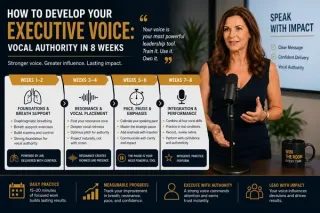
How to Develop Your Executive Voice: Vocal Authority in 8 Weeks
Develop your executive voice with this 8-week vocal authority program. Learn breath support, resonance, pace, pause, and practice routines for senior leaders. ...more
Improve Public Speaking Skills: Expert Tips by Lisa Hugo ,Corporate Communication Tips for CxOs & Executives
July 14, 2026•7 min read
Looking for webinar funnels, digital marketing or a client acquisition system for your coaching or consulting business?
Copyright © 2026 Audacia Marketing Management LLC, All rights reserved.