
Table of Contents
Executive Summary
Introduction
Chapter 1: The C-Suite Speaking Landscape
Chapter 2: Finding Your Executive Voice
Chapter 3: Strategic Message Development
Chapter 4: Stage Presence and Physical Command
Chapter 5: Handling Pressure and Expectations
Chapter 6: Media and Public Speaking
Chapter 7: Building Your Speaking Brand
Chapter 8: The C-Suite Speaker's Toolkit
Conclusion
Key Takeaways
About the Author
Executive Summary
Public speaking is one of the most critical skills a C-suite leader can develop. It shapes how stakeholders perceive your leadership, influences company culture, and directly impacts your organization's reputation and market position. Yet many senior executives, despite decades of business experience, never receive formal training in this essential discipline.
This guide is written specifically for chief executives, managing directors, senior vice presidents, and other C-suite professionals who must communicate with authority, clarity, and confidence across a range of high-stakes settings. Whether you are addressing a boardroom, keynoting a global conference, navigating a media interview, or rallying your workforce during a period of change, the principles in this guide will help you command every room you enter.
What sets this guide apart from generic public speaking advice is its exclusive focus on the demands, expectations, and realities of executive-level communication. You will learn how to develop a distinctive speaking signature, craft messages that resonate with sophisticated audiences, project physical authority on stage, handle hostile questions with composure, and build a long-term speaking brand that reinforces your leadership position.
Drawing on over a decade of experience coaching Fortune 500 executives, government leaders, and entrepreneurs across the globe, Lisa Hugo presents a proven framework for speaking mastery that balances authenticity with authority. Each chapter includes practical techniques, real-world insights, and actionable strategies you can implement immediately.
By the end of this guide, you will have a comprehensive roadmap for transforming your public speaking from adequate to exceptional, ensuring that every time you take the stage, you leave a lasting and positive impression.
Introduction
At the C-suite level, public speaking is not optional. It is a core leadership function that determines how you are perceived by investors, board members, employees, customers, media, and the broader market. Your ability to articulate a vision, inspire confidence, and communicate under pressure directly affects your organization's success and your personal reputation.
The visibility imperative for today's executives is greater than ever before. In an era of social media, 24-hour news cycles, and constant stakeholder scrutiny, senior leaders are expected to be visible, vocal, and compelling communicators. A single keynote can shape market sentiment. A poorly handled media interview can erode years of brand building. An uninspiring town hall can undermine employee morale and retention. The stakes are simply too high for C-suite leaders to treat public speaking as a secondary skill.
Yet most executive communication training falls short. Generic public speaking courses focus on overcoming basic fears, organizing simple presentations, and making eye contact. While these fundamentals matter, they do not address the unique challenges that C-suite leaders face: speaking to highly informed audiences who scrutinize every word, balancing transparency with strategic discretion, maintaining authority while showing vulnerability, and communicating complex business narratives with clarity and conviction.
This guide addresses those challenges directly. Each chapter is designed to build upon the last, taking you from a foundational understanding of the C-suite speaking landscape through the development of your unique executive voice, strategic message creation, stage presence, pressure management, media mastery, and long-term brand building.
Your path to mastery begins with a commitment to treating public speaking as a skill worthy of the same rigorous development you bring to strategy, finance, and leadership. The executives who invest in their speaking ability consistently outperform their peers in influence, visibility, and career advancement. This guide will show you how to join their ranks.
Chapter 1: The C-Suite Speaking Landscape
Types of Speaking Opportunities at C-Level
The range of speaking opportunities available to C-suite leaders is vast and varied. Unlike mid-level managers who may present primarily within their teams, senior executives are expected to communicate effectively across multiple formats, audiences, and contexts. Understanding this landscape is the first step toward mastering it.
Industry conferences represent one of the most visible speaking platforms for C-suite leaders. These events, whether global summits, sector-specific forums, or regional business gatherings, offer the opportunity to position yourself and your organization as thought leaders. A well-delivered keynote at a major conference can generate media coverage, attract talent, open partnership opportunities, and reinforce brand authority. The best executive speakers treat conference appearances as strategic assets, selecting events that align with their business objectives and preparing rigorously.
Quick Tip: Before accepting any conference speaking invitation, ask three questions: Does this audience align with my strategic goals? Will this event enhance or dilute my personal brand? Can I deliver genuinely valuable content that differentiates me from other speakers?
Stakeholder Expectations
Stakeholders at the executive level expect more than competent delivery. They expect insight, conviction, and presence. Board members want concise, evidence-based communication that demonstrates strategic thinking. Investors expect confident, transparent messaging that builds trust. Employees want authentic, inspiring communication that creates a sense of shared purpose. Customers and partners want credibility and vision.
Meeting these expectations requires a nuanced understanding of each audience segment and the ability to adapt your communication style without losing your core identity. The most effective C-suite speakers do not change who they are for different audiences. Instead, they adjust their emphasis, tone, and level of detail while maintaining a consistent leadership persona.
The Cost of Poor Speaking at Executive Level
The consequences of poor public speaking at the C-suite level are significant and far-reaching. A rambling, unfocused board presentation can undermine confidence in your leadership. A nervous, unconvincing media appearance can trigger negative coverage and investor concern. An uninspiring company-wide address can accelerate disengagement and attrition. In the most extreme cases, a single poorly handled public statement during a crisis can damage an organization's reputation for years.
Key Insight: Research consistently shows that audiences form judgments about a speaker's credibility within the first 30 seconds. For C-suite leaders, those initial moments carry even greater weight because the audience already has expectations about your authority and competence. Failing to meet those expectations immediately creates a credibility gap that is difficult to close.
Media Interviews and PR
Media appearances represent a unique speaking challenge for C-suite leaders. Unlike controlled environments such as board meetings or company events, media interviews place you in a setting where you have limited control over the questions, the framing, and the final edit. Broadcast interviews demand the ability to deliver clear, concise sound bites under time pressure. Print interviews require careful attention to how your words may be quoted out of context.
Internal Communications and Town Halls
Internal speaking opportunities, including town halls, all-hands meetings, leadership updates, and team addresses, are often undervalued by C-suite leaders who focus their preparation energy on external events. This is a mistake. Your employees hear you speak more often than any other audience, and the quality of your internal communication directly influences culture, engagement, and retention. Town halls, in particular, offer a powerful opportunity to connect with your workforce, address concerns transparently, and reinforce organizational values.
Board Presentations
Board presentations demand a specific set of skills that differ from other speaking contexts. Board members are typically sophisticated, time-constrained professionals who expect concise, well-structured communication backed by data and strategic analysis. The ability to distill complex information, answer probing questions with confidence, and manage the dynamics of a board discussion is essential for every C-suite leader.
Quick Tip: For board presentations, follow the "headline first" approach. Lead with your conclusion or recommendation, then provide the supporting evidence. Board members want to know where you stand before they evaluate the data behind your position.
Chapter 2: Finding Your Executive Voice
Authenticity vs. Authority
One of the most common tensions C-suite leaders face in their speaking development is the perceived conflict between authenticity and authority. Many executives believe they must adopt a formal, authoritative persona when they speak publicly, suppressing their natural personality in favor of a more "executive" style. Others swing too far in the opposite direction, prioritizing casual authenticity at the expense of gravitas.
The truth is that the most compelling executive speakers find a way to integrate both. Authenticity without authority can make you seem approachable but not credible. Authority without authenticity can make you seem competent but not trustworthy. The goal is to develop a speaking style that feels genuinely yours while projecting the confidence, composure, and credibility that your role demands.
Developing Your Speaking Signature
Your speaking signature is the distinctive combination of vocal quality, delivery style, message framing, and personal energy that makes your communication uniquely yours. Think of the most memorable business leaders you have heard speak. Each one has a recognizable style, a way of communicating that is instantly identifiable and consistently engaging.
Developing your speaking signature begins with self-awareness. Record yourself speaking in different contexts, from formal presentations to casual conversations, and analyze the patterns. What are your natural strengths? Where do you lose energy or clarity? What feedback have you consistently received? Use these observations as the foundation for a deliberate development process.
Key Insight: Your speaking signature should not be a performance or a character. It should be a refined, intentional version of your natural communication style, amplified for the demands of executive-level speaking.
Vocal Presence and Gravitas
Your voice is your primary instrument as a speaker, and vocal presence is one of the most important elements of executive communication. A strong, resonant voice conveys authority. A varied, expressive voice maintains engagement. A controlled, measured voice projects confidence under pressure.
Vocal gravitas comes from several key elements: appropriate depth and resonance, controlled pacing, deliberate emphasis on key words and phrases, and the confident use of silence. Many executives speak too quickly, too softly, or with too little variation, all of which undermine their vocal authority.
The Power of Pause
The pause is one of the most underused and most powerful tools in an executive speaker's repertoire. A well-placed pause creates emphasis, builds anticipation, allows your audience to absorb a key point, and projects confidence. Many speakers fear silence because they associate it with forgetting their lines or losing momentum. In reality, the opposite is true. Audiences perceive speakers who use pauses deliberately as more confident, more thoughtful, and more in command of their material.
Quick Tip: Practice inserting a full two-second pause after every major point in your next presentation. It will feel uncomfortably long to you but perfectly natural to your audience.
Eliminating Filler Words
Filler words such as "um," "uh," "like," "you know," and "so" are among the most common barriers to vocal authority. While occasional fillers are natural in casual conversation, frequent use in executive speaking undermines your credibility and distracts from your message. The most effective approach to eliminating fillers is awareness followed by deliberate practice. Record yourself, count the fillers, and work systematically to replace them with pauses.
Pace and Rhythm for Executives
Effective executive speaking requires a deliberate approach to pace and rhythm. Speaking too quickly signals nervousness and makes it difficult for your audience to process complex information. Speaking too slowly can come across as condescending or disengaged. The ideal pace for executive communication varies by context, but generally falls between 130 and 160 words per minute, with significant variation for emphasis and impact.
Rhythm refers to the pattern of speed, volume, and intensity throughout your delivery. A monotonous rhythm, where every sentence sounds the same, is one of the fastest ways to lose an audience. Vary your rhythm by alternating between faster passages of context setting and slower, more emphatic delivery of key messages.
Regional and Cultural Voice Considerations
In today's global business environment, C-suite leaders frequently speak to international audiences with diverse cultural expectations. Accent, idiom, humor, and communication norms vary significantly across regions. While you should never try to eliminate your natural accent, you should be conscious of clarity and pace when speaking to audiences for whom your language is not their first. Similarly, be aware that communication styles perceived as authoritative in one culture may seem aggressive in another, and what feels approachable in your home market may seem unprofessional elsewhere.
Chapter 3: Strategic Message Development
Clarity Over Complexity
The greatest challenge in executive communication is not developing complex ideas. It is simplifying them without losing their substance. C-suite leaders frequently deal with intricate business strategies, multi-layered financial narratives, and nuanced operational realities. The temptation is to share all of this complexity with your audience in an effort to demonstrate thoroughness. This is almost always a mistake.
Audiences, regardless of their sophistication, have limited capacity to absorb information during a live presentation. Your job as an executive speaker is to distill your message to its essential elements and deliver those elements with clarity, conviction, and purpose. This does not mean dumbing down your content. It means structuring it so that the most important ideas are impossible to miss.
Key Insight: If you cannot summarize your core message in one sentence, you have not finished developing it. Every great executive speech or presentation is built around a single, clear, compelling idea that everything else supports.
The Executive Message Framework
Effective executive messaging follows a clear framework. Start with the outcome, the one thing you want your audience to know, believe, or do after hearing you speak. Then build your supporting structure with no more than three primary pillars, each backed by evidence, examples, or stories. Finally, close with a clear call to action or a powerful, memorable statement that reinforces your core message.
This framework works whether you are delivering a 5-minute board update, a 20-minute conference keynote, or a 45-minute town hall. The difference lies not in the structure but in the depth and detail you provide within each section.
Distilling Complex Ideas
Distilling complex ideas for executive communication requires three skills: prioritization, analogy, and ruthless editing. Prioritization means identifying the two or three elements of a complex topic that truly matter for your specific audience. Analogy means finding comparisons that make abstract or technical concepts immediately understandable. Ruthless editing means removing everything that does not directly serve your core message, no matter how interesting or impressive it may be.
Quick Tip: Use the "elevator test" for every key message. If you could not explain it clearly and compellingly in a 60-second elevator ride, simplify further.
Memorable Messaging Techniques
The most effective executive communicators use specific techniques to make their messages stick. These include the rule of three, which groups ideas into sets of three for maximum memorability. They include contrast, which highlights differences to create clarity and emphasis. They include repetition, which reinforces key themes through strategic reiteration. And they include vivid language, which replaces abstract concepts with concrete, sensory-rich descriptions.
Storytelling for Business Impact
Storytelling is one of the most powerful tools in executive communication, yet it is also one of the most underused and misunderstood. Many C-suite leaders avoid stories because they seem informal or irrelevant in a business context. Others tell stories poorly, burying the point in unnecessary detail or choosing anecdotes that do not connect to their message.
Effective business storytelling follows a simple structure: situation, complication, resolution, and lesson. The situation sets the scene. The complication creates tension or interest. The resolution shows what happened. And the lesson connects the story directly to the point you are making. The best executive stories are brief, specific, emotionally engaging, and directly relevant to the audience's experience.
Data and Emotional Appeal Balance
C-suite audiences expect data-driven communication, but data alone rarely persuades. The most effective executive speakers balance analytical rigor with emotional resonance, using data to establish credibility and stories or vivid language to create connection. A presentation that is all data feels cold and forgettable. A presentation that is all emotion feels unsubstantiated and manipulative. The combination of both creates compelling, credible communication that moves people to action.
Adapting Messages for Different Audiences
The ability to adapt your core message for different audiences without changing its substance is a hallmark of executive communication mastery. The same strategic initiative may need to be framed differently for the board, for employees, for investors, for media, and for customers. In each case, the underlying message remains consistent, but the emphasis, examples, language, and level of detail shift to match the audience's priorities, knowledge level, and decision-making context.
Chapter 4: Stage Presence and Physical Command
Owning the Stage Before You Speak
Stage presence begins long before you open your mouth. It starts the moment you enter the room, walk to the podium, or appear on screen. Audiences begin evaluating your confidence, credibility, and authority based on your physical behavior before you say a single word. The most impactful executive speakers understand this and use the moments before they speak to establish command and connection.
Walk to the stage with purpose. Stand still and centered before you begin. Make eye contact with the audience. Take a breath. Let the silence build for a moment. Then speak. This simple sequence projects confidence, control, and authority. It tells the audience that you are in command of the moment and ready to deliver something worth hearing.
Quick Tip: Arrive at the venue early and spend time on the stage or at the podium before the audience arrives. Familiarity with the physical space dramatically reduces anxiety and increases your sense of ownership.
Power Poses and Positioning
Your physical positioning on stage or in a room sends powerful signals about your confidence and authority. Standing tall with your feet shoulder-width apart, shoulders relaxed, and chin level projects strength and stability. Leaning forward slightly signals engagement and energy. Stepping closer to the audience at key moments creates intimacy and emphasis.
Avoid the common executive traps of gripping the podium, crossing your arms, putting your hands in your pockets, or standing rigidly in one spot. Each of these positions communicates defensiveness, discomfort, or disengagement, even if you feel perfectly confident internally.
Movement with Purpose
Effective stage movement is deliberate and meaningful. Moving to different parts of the stage can help you connect with different sections of the audience, signal transitions between topics, and maintain visual interest. The key is that every movement should have a purpose. Walking toward the audience emphasizes a point. Moving to a new position signals a new idea. Returning to center marks a summary or conclusion.
Avoid pacing, which signals nervousness, and avoid staying rooted in one spot, which projects rigidity. Practice your movement as deliberately as you practice your words.
Gesture Techniques for Executives
Gestures are a critical element of executive stage presence. Natural, purposeful gestures reinforce your words, add emphasis, and help your audience process information. Stiff, repetitive, or absent gestures undermine your delivery and make you appear uncomfortable.
The most effective executive gestures are open (palms visible, arms away from the body), varied (using different gestures for different types of points), and proportional (larger gestures for larger rooms and larger ideas, more contained gestures for intimate settings and detailed points).
Key Insight: Your gestures should precede your words by a fraction of a second. This creates the impression that your physical expression is driving your verbal communication, which audiences perceive as confident and authentic.
Eye Contact Strategies for Large Audiences
Maintaining meaningful eye contact with a large audience requires a deliberate strategy. Rather than scanning the room continuously, which can appear nervous or unfocused, divide the audience into sections and make sustained eye contact with individuals in each section. Hold each connection for three to five seconds, long enough to feel personal without becoming uncomfortable.
For very large audiences where individual eye contact is not possible, focus on making connections with different zones of the room, directing your gaze and energy to specific areas at specific moments in your delivery.
Managing Energy and Projection
Energy management is a crucial skill for executive speakers, particularly during longer presentations or multi-session events. Your energy level must be high enough to engage your audience but controlled enough to project authority and composure. The key is to match your energy to the moment: higher energy for opening and closing segments, more measured energy for data-heavy sections, and increased intensity for key messages.
Projection refers to the physical effort of making your voice, gestures, and presence fill the room. In large venues, you must amplify everything, from vocal volume to gesture size to facial expression, to ensure your communication reaches the back row with the same impact as the front.
Wardrobe and Appearance Impact
While content and delivery are the primary drivers of speaking success, your wardrobe and appearance contribute to the overall impression you make. For C-suite speakers, the goal is to look polished, professional, and appropriate for the context without being distracting. Your appearance should reinforce your authority, not compete with your message.
Chapter 5: Handling Pressure and Expectations
Managing Pre-Speech Nerves at Executive Level
Even the most experienced C-suite leaders experience nervousness before high-stakes speaking engagements. The difference between great speakers and average ones is not the absence of nerves but the ability to channel that nervous energy into focused, dynamic delivery. Pre-speech anxiety is your body's way of preparing for a performance, and with the right techniques, you can transform it from a liability into an asset.
Effective nerve management starts well before the event. Physical preparation, including adequate sleep, proper hydration, and light exercise, creates a physiological foundation for calm, focused delivery. Mental preparation, including visualization, positive self-talk, and rehearsal, builds confidence and reduces uncertainty. And logistical preparation, including arriving early, checking equipment, and reviewing your opening, eliminates the practical concerns that often amplify anxiety.
Quick Tip: In the 10 minutes before you speak, focus on deep, slow breathing. Inhale for four counts, hold for four counts, exhale for six counts. This activates your parasympathetic nervous system and physically reduces the stress response.
Performance Under Scrutiny
C-suite leaders speak under a level of scrutiny that most professionals never experience. Every word, gesture, and expression is observed, interpreted, and often recorded. This scrutiny comes from multiple directions: media, social media, employees, investors, competitors, and regulators. The pressure to be perfect can be paralyzing.
The most effective approach to performing under scrutiny is preparation combined with acceptance. Prepare rigorously so you are confident in your content and delivery. Then accept that perfection is neither possible nor necessary. Audiences connect with speakers who are human, composed, and authentic, not with speakers who are flawless but robotic.
Dealing with Hostile Audiences
At some point in your career, you will face a hostile or skeptical audience. This might be angry employees during a restructuring, aggressive investors after a disappointing quarter, or adversarial media during a crisis. Handling these situations with composure and skill is one of the defining tests of executive communication.
The first rule of hostile audience management is to acknowledge the emotion in the room without becoming defensive. Validate concerns before presenting your perspective. Maintain a calm, measured tone regardless of the provocation. Listen actively to questions and comments, and respond directly without evasion. And above all, resist the urge to match hostility with hostility, which only escalates the situation.
Crisis Communication Speaking
Crisis communication represents the most challenging speaking context for any C-suite leader. During a crisis, you must communicate quickly, accurately, empathetically, and strategically, often with incomplete information and under intense public pressure. The principles of crisis speaking include leading with empathy, sharing what you know and what you do not know, committing to action and updates, and maintaining calm authority throughout.
Key Insight: In crisis communication, what you say in the first 24 hours shapes the narrative for weeks or months to come. Prepare crisis communication frameworks before you need them, not after.
Speaking When Stakes Are Highest
Some speaking engagements carry stakes that go beyond normal pressure. These include merger announcements, IPO roadshows, regulatory hearings, and major strategic pivots. In these moments, your communication is not merely informative. It is a strategic action that directly influences outcomes.
Preparation for high-stakes speaking should be more intensive and more collaborative than for routine engagements. Work with advisors, communication professionals, and legal counsel to ensure your message is accurate, strategic, and legally sound. Rehearse extensively, including simulated Q&A with difficult questions. And establish clear boundaries for what you will and will not address.
Maintaining Composure
Composure is the executive speaker's most valuable asset in high-pressure situations. It signals control, confidence, and trustworthiness. Maintaining composure under pressure is partly a matter of temperament, but it is also a skill that can be developed through practice and technique. The key practices include slowing your speech, keeping your breathing steady, maintaining neutral body language, and focusing on the audience rather than your own anxiety.
Recovery Techniques
Every speaker, regardless of experience, will occasionally stumble, lose their place, or face an unexpected disruption. The ability to recover gracefully is what separates seasoned executive speakers from novices. When you make a mistake, acknowledge it briefly and move on. When you lose your place, pause, breathe, and consult your notes without apology. When technology fails, address the situation with humor or composure and adapt your delivery accordingly.
Chapter 6: Media and Public Speaking
Broadcast Interview Mastery
Broadcast interviews, whether television, radio, or live-streamed digital formats, require a specific set of skills that differ significantly from stage speaking. The format is compressed, the pace is fast, the questions may be challenging, and the audience is typically watching from a distance, often while multitasking. Mastering broadcast interviews means learning to deliver concise, compelling messages in short timeframes while maintaining authority and warmth.
The foundation of broadcast interview mastery is message discipline. Before any interview, identify your three key messages, the points you want to make regardless of the questions asked. Practice pivoting from challenging or off-topic questions back to these messages using bridging techniques. Common bridges include phrases such as "The important point here is," "What I want to emphasize is," and "Let me give you the broader context."
Quick Tip: For television interviews, look at the interviewer, not the camera, unless specifically directed otherwise. This creates a natural, conversational appearance. Speak in short, complete sentences that can be easily edited into sound bites without losing meaning.
Print and Digital Media Best Practices
Print and digital media interviews allow more time for nuanced communication but carry the risk that your words will be selected, arranged, and framed by someone else. The key practices include being quotable, being specific, and being consistent. Provide clear, concise statements that convey your message even when extracted from their original context. Avoid speculative or hypothetical responses that could be misinterpreted.
Sound Bite Development
Sound bites, brief, memorable statements that capture your key message in 10 to 15 seconds, are essential tools for media communication. The best sound bites are clear, vivid, and repeatable. They use simple language, strong imagery, and a clear point of view. Develop and rehearse sound bites for your key messages before any media engagement so that your most important points are delivered in their most powerful form.
Staying on Message
Message discipline is the ability to communicate your core messages consistently across multiple questions, formats, and interactions. This does not mean repeating the same words robotically. It means ensuring that every answer you give reinforces your key themes, even when questions attempt to pull you in different directions. Practice the art of answering the question asked while guiding the conversation back to your strategic messages.
Handling Tough Journalists
Experienced journalists will test your composure, challenge your assertions, and attempt to generate newsworthy responses through provocative questioning. Handle these situations by remaining calm, answering directly, and refusing to be drawn into speculation or emotional reactions. Remember that the journalist is doing their job. Your job is to communicate your message effectively while maintaining a professional, respectful relationship.
Building Media Relationships
Strong media relationships are built over time through consistent, reliable, and honest communication. Be accessible, be prepared, and be trustworthy. Journalists value sources who provide accurate information, return calls promptly, and treat the media relationship as a professional partnership rather than an adversarial encounter.
Thought Leadership Platforms
Beyond traditional media, C-suite leaders now have access to a range of thought leadership platforms, including podcasts, webinars, LinkedIn articles, industry publications, and digital speaking events. These platforms offer greater control over your message and broader reach than traditional media alone. Develop a content strategy that leverages these platforms to reinforce your speaking brand and extend your influence.
Chapter 7: Building Your Speaking Brand
Establishing Thought Leadership
Your speaking brand is the reputation you build through consistent, high-quality public communication over time. Establishing thought leadership through speaking requires a clear point of view, a defined area of expertise, and a commitment to sharing valuable insights with your audiences. Thought leadership is not about promoting yourself. It is about contributing ideas that advance your industry, challenge conventional thinking, and provide genuine value.
Begin by identifying the two or three topics where your experience, insight, and perspective are truly distinctive. These should be areas where you can offer original thinking, not just repeat common wisdom. Build your speaking brand around these topics, developing a portfolio of talks, articles, and media appearances that consistently reinforce your expertise.
Key Insight: Thought leadership is a long-term investment. The executives who are recognized as leading voices in their industries have typically spent years building their speaking brand through consistent, high-quality contributions across multiple platforms.
Conference Speaking Strategies
Conference speaking is one of the most effective ways to build your executive speaking brand. To maximize the impact of conference appearances, be strategic about which events you accept, what topics you present, and how you leverage each appearance. Focus on conferences where your target audience is present, where the other speakers are of comparable caliber, and where the event's reputation will enhance your own.
Prepare for conference speaking with the same rigor you bring to your most important business decisions. Understand the event's theme, the audience's expectations, and the other speakers' topics. Then deliver a talk that is uniquely yours, offering perspectives and insights that no one else on the program can provide.
Building a Speaking Portfolio
A speaking portfolio is a curated collection of your best speaking moments, including video clips, testimonials, audience feedback, and media coverage. This portfolio serves multiple purposes. It helps event organizers evaluate your suitability as a speaker. It provides material for marketing and promotion. And it serves as a personal development tool, allowing you to track your growth and identify areas for improvement.
Video and Recorded Content
In today's digital landscape, video content extends the reach and lifespan of your speaking far beyond the live event. Ensure that your major speaking engagements are professionally recorded. Edit highlights for use on social media, your website, and your speaking portfolio. Consider creating original video content, such as short talks, commentary on industry trends, or responses to current events, to maintain visibility between live appearances.
Social Media Amplification
Social media provides a powerful channel for amplifying your speaking brand. Share key insights from your talks, post behind-the-scenes content from major events, and engage with your audience's responses. LinkedIn, in particular, is an effective platform for C-suite speakers to share thought leadership content, connect with other industry leaders, and extend the impact of their live appearances.
Measuring Speaking Impact
Like any strategic activity, your speaking should be measured and evaluated. Key metrics include audience engagement, media coverage, social media reach, post-event inquiries, and qualitative feedback. Track these metrics over time to understand which topics, formats, and events generate the greatest impact, and use this data to refine your speaking strategy.
Long-Term Reputation Building
Building a lasting speaking reputation requires patience, consistency, and continuous improvement. The most respected executive speakers have spent years refining their craft, developing their perspective, and building relationships with event organizers, media, and audiences. Commit to a long-term development plan that includes regular speaking engagements, ongoing skill development, and strategic relationship building.
Chapter 8: The C-Suite Speaker's Toolkit
Preparation Checklist
Every successful speaking engagement begins with thorough preparation. Use this checklist to ensure you are fully ready for each event.
Confirm the audience profile, size, and expectations. Clarify the event format, timing, and technical setup. Develop and refine your core message and supporting points. Create any visual aids or slides. Rehearse your delivery at least three times, including one full dress rehearsal. Prepare for anticipated questions. Arrange travel and logistics with buffer time. Confirm wardrobe and appearance details. Prepare backup plans for technical failures. Review any media commitments associated with the event.
Quick Tip: Create a personal preparation template that you can customize for each engagement. Consistency in your preparation process builds confidence and ensures nothing is overlooked.
Pre-Speech Rituals
Many top executive speakers develop personal pre-speech rituals that help them transition into performance mode. These rituals might include physical warm-ups, vocal exercises, breathing techniques, a specific playlist, a quiet moment of reflection, or a brief conversation with a trusted colleague. The specific ritual matters less than its consistency. Having a reliable routine signals to your body and mind that it is time to perform at your best.
In-the-Moment Techniques
During your speech, several techniques can help you maintain focus, energy, and connection. Scan the audience regularly to gauge engagement. Use pauses strategically to emphasize key points and give yourself a moment to collect your thoughts. Vary your pace and volume to maintain interest. Stay present by focusing on the audience rather than your internal monologue. If you lose your place, breathe, pause, and consult your notes calmly.
Post-Speech Analysis
After every speaking engagement, take time to analyze your performance. Review any available recordings. Solicit feedback from trusted colleagues or coaches. Identify what worked well and what needs improvement. Note audience reactions, questions, and engagement levels. Document your observations in a speaking journal that you can review before future engagements.
Continuous Improvement Plan
Speaking mastery is not a destination. It is an ongoing journey. Develop a continuous improvement plan that includes regular practice, periodic coaching, attendance at other speakers' events for inspiration and learning, reading on communication and persuasion, and deliberate experimentation with new techniques and approaches.
Resources and Next Steps
Invest in your speaking development through professional coaching, peer groups, and curated learning. Consider joining executive speaking organizations, attending masterclasses, and working with a dedicated communication coach who understands the unique demands of C-suite speaking. The most successful executive speakers treat their development as seriously as any other professional skill.
Conclusion
Your Speaking Mastery Journey
Public speaking mastery at the C-suite level is a journey that requires commitment, practice, and continuous refinement. The principles and techniques outlined in this guide provide a comprehensive framework for developing the speaking skills that will enhance your leadership effectiveness, increase your visibility, and strengthen your influence.
From Competence to Excellence
Most C-suite leaders are competent speakers. They can deliver a presentation, handle a meeting, and communicate their ideas adequately. But adequacy is not enough at the executive level. The leaders who achieve the greatest impact, build the strongest brands, and inspire the deepest loyalty are those who pursue excellence in their communication. They treat every speaking engagement as an opportunity to connect, persuade, and inspire.
Next Steps
Begin by assessing your current speaking strengths and development areas using the frameworks in this guide. Identify the two or three areas where improvement would have the greatest impact on your leadership effectiveness. Create a development plan with specific goals, timelines, and accountability measures. And commit to treating your speaking development as a strategic priority, not an afterthought.
How Lisa Can Help
Lisa Hugo has spent years helping C-suite leaders, entrepreneurs, and government officials transform their public speaking from competent to exceptional. Through personalized coaching, executive workshops, and strategic communication consulting, Lisa works with leaders across the globe to develop the speaking skills that drive real business results. If you are ready to take your executive communication to the next level, connect with Lisa to explore how her proven approach can accelerate your speaking mastery journey.
Key Takeaways
Public speaking is a core leadership function for C-suite executives, not a secondary skill or optional activity.
Your speaking signature should be a refined, intentional version of your natural communication style, balancing authenticity with authority.
Clarity over complexity is the foundation of effective executive messaging. If you cannot summarize your core message in one sentence, simplify further.
Stage presence begins before you speak. Your physical behavior from the moment you enter the room shapes audience perception.
The pause is one of the most powerful and underused tools in executive speaking. Practice using silence deliberately.
Preparation is the foundation of confidence. Rigorous, systematic preparation reduces anxiety and improves performance.
Media communication requires specific skills including message discipline, sound bite development, and the ability to stay on message under pressure.
Building a speaking brand is a long-term investment that requires consistency, quality, and strategic positioning.
Every speaking engagement is an opportunity to learn and improve. Analyze your performance systematically after each event.
Crisis communication skills should be developed before they are needed, not during a crisis.
High-stakes speaking demands more intensive preparation, including simulated Q&A and collaboration with advisors.
Continuous improvement is the path to mastery. Commit to ongoing development through coaching, practice, and learning.
About the Author
Lisa Hugo is an executive communication coach and public speaking specialist with over 20 years of experience helping C-suite leaders, entrepreneurs, and government officials communicate with clarity, confidence, and impact.
Based in Dubai, Lisa works with clients across the globe, including Fortune 500 executives, senior government leaders, and high-growth entrepreneurs. Her approach combines strategic message development, vocal and physical coaching, and real-world practice to deliver measurable improvements in speaking effectiveness.
Lisa's clients consistently report greater confidence, stronger audience engagement, and enhanced leadership presence as a result of her coaching. She is recognized as one of the leading executive communication coaches in the Middle East and beyond.
Copyright © 2026 Lisa Hugo/Audacia Marketing Management LLC, All rights reserved.
Ready to transform Your Public Speaking Skills?



She’s helped 1000s of clients around the world to develop their speaking skill with her 1 : 1 coaching and powerful programs, each centered on a different aspect of speaking, including confidence, voice, presentation, and body language.
COMPANY
LEGAL
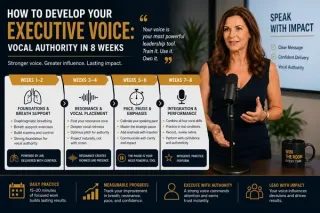
How to Develop Your Executive Voice: Vocal Authority in 8 Weeks
Develop your executive voice with this 8-week vocal authority program. Learn breath support, resonance, pace, pause, and practice routines for senior leaders. ...more
Improve Public Speaking Skills: Expert Tips by Lisa Hugo ,Corporate Communication Tips for CxOs & Executives
July 14, 2026•7 min read
Looking for webinar funnels, digital marketing or a client acquisition system for your coaching or consulting business?
Copyright © 2026 Audacia Marketing Management LLC, All rights reserved.