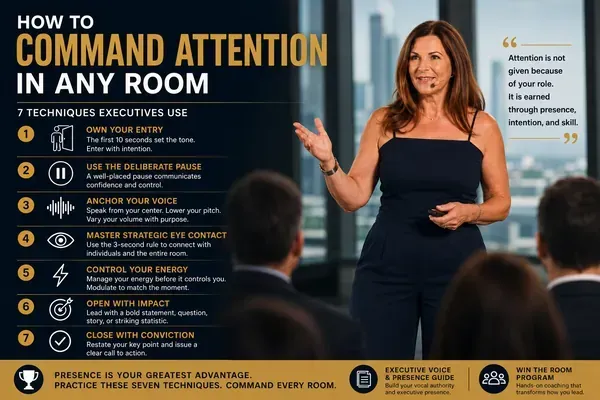
How to Command Attention in Any Room: 7 Techniques Executives Use
Quick Answer: Commanding attention starts before you speak. The most effective executives combine intentional body language, vocal authority, and strategic energy management to hold a room from the moment they enter. These seven techniques, from power positioning to deliberate pause, are used by top leaders worldwide to ensure their message lands every time.
Introduction
Every executive has walked into a room and felt the weight of expectation. Whether it is a boardroom with skeptical investors, a company-wide town hall, or a high-stakes client pitch, the ability to command attention is not optional. It is a leadership requirement.
Yet most leaders rely on title and authority alone to hold a room. That approach fails. Attention is not given because of your role. It is earned through presence, intention, and skill.
After two decades of coaching C-suite executives, entrepreneurs, and senior leaders across industries, I have identified seven techniques that consistently separate leaders who hold a room from those who lose it. These are not abstract theories. They are practical, trainable skills that any leader can develop with focused effort.
The good news: commanding attention is not about personality. Introverts and extroverts alike can master these techniques. It comes down to preparation, awareness, and deliberate practice.
1. Own Your Entry: The First 10 Seconds Matter Most
Research from Princeton University shows that people form judgments about competence and trustworthiness within milliseconds. Your entrance sets the tone for everything that follows.
How to do it:
Pause at the threshold before entering
Stand tall with shoulders back and chin level
Make eye contact with at least three people before sitting or speaking
Move with purpose, not haste
Key Insight: The leaders who command the most attention are rarely the loudest in the room. They are the most deliberate. Every movement signals intention.
Avoid the common mistake of rushing to your seat while checking your phone. That signals to the room that you are not fully present, and the audience will mirror your energy.
2. Use the Power of the Deliberate Pause
Most executives speak too quickly, especially under pressure. The deliberate pause is the single most underused tool in executive communication.
When to pause:
After making a key point (let it land)
Before answering a difficult question (signals confidence)
At the start of your remarks (builds anticipation)
After a transition between sections
A well-placed two-second pause communicates more authority than a perfectly crafted sentence delivered at speed. Silence signals that you are in control. It tells the room: I am not rushing because I do not need to.
Practice tip: Record yourself delivering a three-minute talk. Count your pauses. Most leaders use fewer than two. Aim for six to eight meaningful pauses in that same window.
3. Anchor Your Voice: Speak from Your Center
Your voice is your primary leadership instrument. A thin, nasal, or breathy voice undermines even the most powerful message.
Vocal techniques that command attention:
Speak from your diaphragm, not your throat
Lower your pitch slightly at the end of statements (avoid upspeak)
Vary your volume deliberately: softer for emphasis, stronger for conviction
Warm up your voice before important moments with humming and lip trills
Key Insight: Studies in vocal perception show that listeners associate lower-pitched, steady voices with competence and leadership. This is trainable. You do not need to be born with a commanding voice. You need to develop one.
For a deeper dive into building vocal authority, explore the Executive Voice and Presence Guide.
4. Master Strategic Eye Contact
Eye contact is how you connect with individuals while addressing a group. But most leaders either stare at one person or scan the room like a searchlight, connecting with no one.
The 3-second rule:
Hold eye contact with one person for a full thought or sentence (roughly 3 seconds)
Move to another person for the next thought
Cover all sections of the room over the course of your remarks
This approach makes every listener feel personally addressed. It transforms a presentation into a conversation, even in a room of 200 people.
In virtual settings: Look directly into the camera lens when making key points. This simulates eye contact for remote participants and signals confidence.
5. Control Your Energy Before It Controls You
Energy management is the technique most leaders overlook. The nervous executive who fidgets, paces, or speaks too fast is leaking energy. The disengaged executive who slumps or speaks in monotone is withholding it.
The energy framework:
Before the room: Use a physical reset. Walk briskly, do 10 push-ups, or practice box breathing (inhale 4 counts, hold 4, exhale 4, hold 4)
Entering the room: Set your energy one level above the room's current state
During delivery: Match your energy to the content. Data requires calm authority. Vision requires elevated conviction
Closing: End with energy slightly higher than you started, signaling confidence
Key Insight: The best speakers do not have one energy level. They modulate. The contrast between calm analysis and passionate conviction is what keeps an audience engaged.
6. Open with Impact, Not Pleasantries
"Thank you for having me" is how most executives begin their remarks. It is also how most executives lose the room in the first sentence.
High-impact opening strategies:
Start with a bold statement: "We are leaving $40 million on the table every quarter."
Ask a provocative question: "What would you do if our largest competitor acquired us tomorrow?"
Use a brief, relevant story: A 30-second narrative that frames the problem
Present a striking statistic: "78% of leadership teams cannot articulate their own strategy."
The goal is to create a reason to listen. Your opening should answer the audience's unspoken question: why should I pay attention right now?
For proven frameworks on structuring openings that win the room, sign up for my free Win The Room: Influence, Authority, Impact Masterclass.
7. Close with a Clear Call to Conviction
The way you end determines what people remember. Most executives trail off with "so, yeah, any questions?" This undermines everything that came before it.
Strong closing techniques:
Restate your single most important point in one sentence
Issue a clear call to action: what you want the audience to do next
Circle back to your opening for narrative closure
End on a forward-looking statement that inspires action
Example close: "We started today by asking whether we are ready for what comes next. After reviewing the data, the talent, and the opportunity in front of us, I believe the answer is yes. But only if we commit to the decision we discussed today. I am asking for that commitment now."
Key Takeaways
Your first 10 seconds set the tone. Enter with intention and make eye contact before speaking
The deliberate pause is the most powerful and most underused tool in executive communication
Your voice is trainable. Speak from your diaphragm, lower your pitch at the end of statements, and warm up before key moments
Use the 3-second eye contact rule to connect with individuals while addressing a group
Manage your energy actively. Match your energy to the content and modulate throughout
Open with impact, not pleasantries. Give the audience a reason to listen in your first sentence
Close with conviction. Restate your key point and issue a clear call to action
Ready to Command Every Room You Enter?
These seven techniques are the foundation, but mastery requires practice and personalized feedback. Read the Executive Voice and Presence Guide for a complete training framework, or explore my Win The Room: Influence, Authority, Impact Masterclass.
About the Author: Lisa Hugo is a Dubai-based executive communication coach with over 20 years of experience helping C-suite leaders, entrepreneurs, and senior executives command rooms, cameras, and conversations. She is the creator of the Win The Room program.