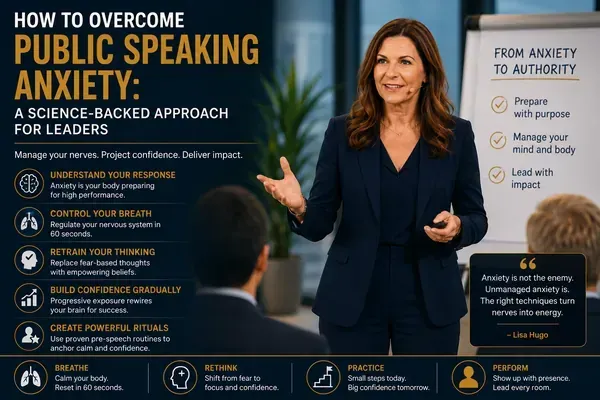
How to Overcome Public Speaking Anxiety: A Science-Backed Approach for Leaders
Quick Answer: Public speaking anxiety is a neurological response, not a character flaw. It can be managed effectively through breath control, cognitive reframing, and progressive exposure. Leaders who learn to work with their anxiety, rather than eliminate it, consistently deliver more authentic, high-impact presentations.
Introduction
Speaking anxiety does not discriminate by title. CEOs, board directors, and seasoned leaders experience it just as frequently as first-time presenters. The difference is that senior leaders rarely talk about it.
Research from the National Institute of Mental Health estimates that up to 75% of people experience some degree of glossophobia, the fear of public speaking. Among executives, the number may be lower in clinical terms, but situational anxiety before high-stakes moments is nearly universal.
The conventional advice to "just relax" or "picture the audience in their underwear" is not only unhelpful; it is counterproductive. Modern neuroscience shows that anxiety is a physiological response managed through specific techniques, not generic reassurance.
This guide presents a science-backed framework for managing speaking anxiety that has been refined through 20 years of coaching senior leaders. These are the same techniques used by executives who regularly present to boards, investors, and global audiences.
Understanding the Anxiety Response
Before you can manage anxiety, you need to understand what is happening in your body.
When you perceive a speaking situation as threatening, your amygdala triggers the fight-or-flight response. This floods your system with adrenaline and cortisol, producing familiar symptoms:
Increased heart rate
Shallow, rapid breathing
Dry mouth and tight throat
Sweating palms
Racing thoughts or mind going blank
Muscle tension, particularly in the shoulders and jaw
Key Insight: These symptoms are not signs of weakness. They are signs that your body is preparing for a high-performance moment. The goal is not to eliminate the response. It is to channel it. Elite athletes, performers, and military leaders all experience the same physiological activation. The difference is how they manage it.
The reframing shift: Research by Alison Wood Brooks at Harvard Business School found that people who reframed their anxiety as excitement ("I am excited") performed significantly better than those who tried to calm down ("I am calm"). This is because anxiety and excitement share the same physiological profile. Relabeling the experience is easier for your brain than suppressing it.
Breathing Techniques That Work in 60 Seconds
Breath is the fastest and most reliable way to regulate your nervous system before and during a presentation. Controlled breathing activates the parasympathetic nervous system, which directly counteracts the fight-or-flight response.
Box Breathing (4-4-4-4)
Used by Navy SEALs and first responders in high-stress situations:
Inhale through your nose for 4 counts
Hold your breath for 4 counts
Exhale through your mouth for 4 counts
Hold empty for 4 counts
Repeat 4 to 6 cycles
Extended Exhale Breathing (4-7-8)
This technique places emphasis on the exhale, which is the phase that activates the calming response:
Inhale through your nose for 4 counts
Hold for 7 counts
Exhale slowly through your mouth for 8 counts
Repeat 3 to 4 cycles
When to use these techniques:
5 minutes before entering the room
During a transition in your presentation while the audience shifts attention
Before answering a difficult question (a 4-count breath fits naturally in a pause)
Anytime you feel your heart rate accelerating
Key Insight: Breathing techniques are not relaxation exercises. They are performance tools. Use them the way an athlete uses a warm-up: strategically, consistently, and without apology.
Cognitive Reframing: Changing Your Relationship with Fear
Anxiety is sustained by the stories you tell yourself about the speaking situation. Cognitive reframing, drawn from cognitive behavioral therapy, involves identifying and replacing unhelpful thought patterns.
Common anxiety-producing thoughts and reframes:
Anxiety ThoughtReframed Thought"I am going to fail.""I have prepared thoroughly and know this material.""They will judge me.""They want me to succeed. My success is their success.""I will forget everything.""I know the key points. If I lose my place, I will pause and regroup.""I am not good enough for this audience.""I was invited because I have value to add.""What if they ask something I cannot answer?""I can say 'I will follow up on that' with complete confidence."
Practice method: Before your next speaking engagement, write down your three biggest fears about the situation. For each, write a reframed version that is realistic, not falsely optimistic. Read the reframed versions aloud the night before and the morning of your presentation.
Progressive Exposure: Building Confidence Through Repetition
The most sustainable way to reduce speaking anxiety is through structured, progressive exposure to increasingly challenging speaking situations.
A progressive exposure ladder for leaders:
Week 1-2: Record yourself delivering a 3-minute talk. Watch the recording and note three things that went well
Week 3-4: Deliver a 5-minute presentation to a trusted colleague and ask for specific feedback
Week 5-6: Present a brief update at a team meeting with deliberate focus on vocal variety and pausing
Week 7-8: Volunteer for a 10-minute presentation to a cross-functional group
Week 9-10: Deliver a presentation in a more formal setting, such as a leadership forum or client meeting
Week 11-12: Take on a high-stakes presentation with a full audience
The principle: Each step should feel slightly uncomfortable but not overwhelming. You are training your nervous system to associate speaking situations with positive outcomes, gradually reducing the fear response.
Key Insight: Avoidance strengthens anxiety. Exposure weakens it. Every time you speak and survive, your brain updates its threat assessment. This is not motivation. It is neuroscience.
For a complete anxiety management program with detailed exercises and tracking tools, see the Overcoming Public Speaking Anxiety Guide.
Pre-Speech Rituals: Anchoring Confidence
The 30 minutes before a speech or presentation are when anxiety is at its peak. A pre-speech ritual gives your mind a structured sequence to follow, replacing anxious anticipation with purposeful preparation.
A sample pre-speech ritual:
T-minus 30 minutes: Review your three key points (not your full script). Confirm your opening and closing lines
T-minus 15 minutes: Physical warm-up. Walk briskly, stretch your shoulders, shake out your hands
T-minus 10 minutes: Vocal warm-up. Hum, do lip trills, speak your opening aloud at performance energy
T-minus 5 minutes: Breathing exercise. Four cycles of box breathing
T-minus 2 minutes: Power stance. Stand with feet apart, shoulders back, chin level. Inhale deeply. Say to yourself: "I know this material. I belong here."
T-minus 0: Enter the room with intention. Make eye contact. Begin
The key principle: Rituals work because they redirect your attention from the outcome (which you cannot control) to the process (which you can). Over time, the ritual itself becomes an anchor for confidence.
Key Takeaways
Speaking anxiety is a physiological response, not a personality flaw. It is manageable with the right techniques
Reframe anxiety as activation, not failure. Research shows that labeling nerves as excitement improves performance
Box breathing and extended exhale breathing can regulate your nervous system in 60 seconds
Cognitive reframing replaces unhelpful thought patterns with realistic, empowering alternatives
Progressive exposure is the most effective long-term strategy. Each successful experience rewires your fear response
Build a pre-speech ritual that anchors confidence through structured, repeatable preparation
Avoidance strengthens anxiety. Exposure, combined with preparation, weakens it
Ready to Transform Your Relationship with Speaking Anxiety?
Anxiety does not have to limit your leadership impact. See the Overcoming Public Speaking Anxiety Guide for a complete program that includes breathing protocols, reframing worksheets, a 12-week progressive exposure plan, and pre-speech ritual templates designed specifically for senior leaders.
About the Author: Lisa Hugo is a Dubai-based executive communication coach with over a decade of experience helping C-suite leaders, entrepreneurs, and senior executives command rooms, cameras, and conversations. She is the creator of the Win The Room program.