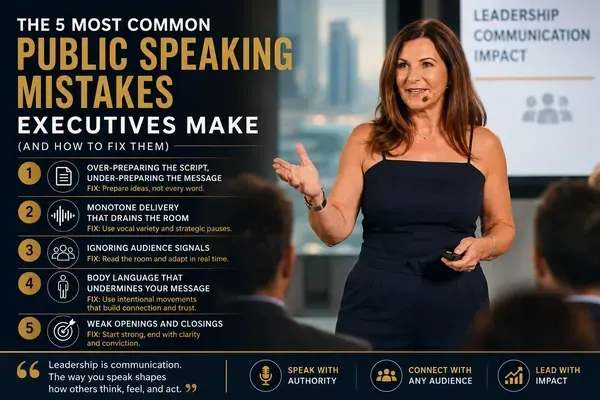
What Are The 5 Most Common Public Speaking Mistakes Executives Make (And How to Fix Them)?
Quick Answer: The five biggest mistakes executives make when speaking are over-preparing scripts instead of ideas, delivering in monotone, ignoring audience signals, relying on weak body language, and failing to craft strong openings and closings. Each is fixable with targeted techniques that prioritize connection over perfection.
Introduction
Here is the paradox of executive communication: the higher you rise, the more your words matter, and the less honest feedback you receive about how you deliver them.
Most C-suite leaders believe they are solid communicators. Many are wrong. Not because they lack intelligence or expertise, but because they have developed habits that quietly undermine their impact. These habits go unchallenged because few people feel comfortable telling a CEO that their presentations are putting the room to sleep.
Over 20 years of coaching executives across industries, I have seen the same five mistakes repeated at every level. The good news is that each has a clear, practical fix. The leaders who address these gaps do not just become better speakers. They become more effective leaders, because leadership is communication.
Let us break down each mistake and how to correct it.
Mistake 1: Over-Preparing the Script, Under-Preparing the Message
Many executives respond to high-stakes speaking situations by scripting every word. This feels safe. It is actually dangerous.
Why it fails:
Scripted delivery sounds rehearsed and disconnected
You lose the ability to adapt in the moment
When you lose your place, you lose your composure
The audience hears a performance, not a conversation
The fix: Prepare frameworks, not scripts.
Identify your three core points and the evidence for each
Create a simple structure: opening hook, three pillars, strong close
Practice the flow of ideas, not the exact words
Use note cards with keywords, not paragraphs
Key Insight: The most compelling executive speakers sound spontaneous because they prepared their thinking, not their phrasing. They know their material deeply enough to express it naturally.
Practice method: Record yourself explaining your key message to a colleague over coffee. That natural, confident delivery is your target. Then build your presentation structure around it.
Mistake 2: Monotone Delivery That Drains the Room
Monotone is the silent killer of executive communication. It is rarely intentional. It develops over years of delivering data-heavy presentations where the focus is on content, not delivery.
Why it fails:
Monotone signals disengagement, even if you are passionate about the topic
The human brain stops processing repetitive auditory patterns within minutes
Your audience literally cannot stay focused, regardless of how important the content is
The fix: Build vocal variety into your delivery.
Pace: Slow down for key points. Speed up slightly for supporting details
Volume: Drop your voice to draw the audience in. Raise it to signal importance
Pitch: Let your natural pitch vary. Avoid the artificial "presentation voice"
Pause: Silence after a key point is more powerful than emphasis
Key Insight: Vocal variety is not about being dramatic. It is about matching your voice to your meaning. When your delivery reflects your conviction, the audience trusts you more.
For a comprehensive vocal development program, explore the Public Speaking Mastery for C-Suite Guide.
Mistake 3: Ignoring Audience Signals
Most executives deliver presentations at the audience rather than with them. They focus on their slides, their notes, or their internal script, and miss the real-time feedback the room is providing.
Common signals executives miss:
Crossed arms and leaning back (disengagement or disagreement)
Phone checking (you have lost them)
Nodding and leaning forward (agreement, keep going)
Furrowed brows (confusion, slow down and clarify)
Side conversations (you have lost the room)
The fix: Build audience checkpoints into your delivery.
After every major point, scan the room for body language
Ask direct questions: "Does this track with what you are seeing in your markets?"
Adjust your pace and depth based on what you observe
If you see disengagement, change something immediately: move, ask a question, tell a story
The 70/30 rule: Spend 70% of your visual attention on the audience and 30% on your materials. Most executives invert this ratio.
Mistake 4: Body Language That Undermines Your Message
Your body communicates before, during, and after your words. When your body language contradicts your message, the audience believes your body.
The most common body language mistakes:
Swaying or rocking: Signals nervousness and distraction
Hands in pockets: Signals discomfort or casualness
Crossing arms: Creates a barrier between you and the audience
Looking at the screen instead of the audience: Signals that you are reading, not leading
Fidgeting with a pen, ring, or clicker: Signals anxiety
The fix: Establish a strong physical baseline.
Stand with feet shoulder-width apart, weight evenly distributed
Keep hands at your sides or use open, purposeful gestures
Move with intention: step toward the audience for emphasis, step to the side for transitions
Plant yourself when making your most important points
Key Insight: Confident body language is not about standing perfectly still. It is about eliminating movements that do not serve your message and adding movements that reinforce it. Every gesture should have a purpose.
Practice method: Deliver your next presentation in front of a full-length mirror. Watch for unconscious movements. Then rehearse with a colleague who will flag every fidget.
Mistake 5: Weak Openings and Closings
Most executive presentations start with "Thanks for having me, let me share a few thoughts on..." and end with "So, any questions?" Both are missed opportunities.
Why this matters:
The primacy effect means your audience remembers your opening disproportionately
The recency effect means your closing is what sticks after you leave the room
A weak opening costs you credibility before you earn it
A weak closing wastes everything you built during the body of your talk
The fix for openings:
Start with a bold claim, a question, or a brief story
Make it relevant to the audience's immediate concerns
Create a reason to listen in your first 15 seconds
The fix for closings:
Summarize your single most important point
Issue a clear call to action
Circle back to your opening for narrative closure
End with energy and conviction, not apology or uncertainty
Example transformation:
Before: "Thanks, I hope that was helpful. Any questions?"
After: "We have the data, we have the team, and we have 90 days to capture this opportunity. I need three things from this room today: alignment on the timeline, budget approval for Phase 1, and your commitment to moving fast. Let us make the decision now."
Key Takeaways
Over-scripting kills authenticity. Prepare your ideas and structure, not your exact words
Monotone delivery causes audiences to disengage regardless of content quality. Build vocal variety through pace, volume, and strategic pauses
Your audience is constantly giving you feedback through body language. Read it and adapt in real time
Eliminate body language that contradicts your message. Every movement should be intentional
Your opening and closing are your highest-leverage moments. Invest disproportionate preparation time in both
These mistakes are habits, not personality traits. Every one of them is fixable with awareness and practice
Ready to Eliminate These Mistakes for Good?
Awareness is the first step. Transformation requires structured practice and expert feedback. Download the Public Speaking Mastery for C-Suite Guide for a complete framework that addresses each of these mistakes with targeted exercises, real-world examples, and a 90-day improvement plan.
About the Author: Lisa Hugo is a Dubai-based executive communication coach with over a decade of experience helping C-suite leaders, entrepreneurs, and senior executives command rooms, cameras, and conversations. She is the creator of the Win The Room program.