
Quick Answer: Executive presence is not a personality trait. It is a set of learnable skills built on three pillars: vocal authority, physical composure, and strategic communication. This 30-day plan dedicates 10 days to each pillar, with daily exercises that take 15-20 minutes. By day 30, you will speak with more authority, hold a room with greater confidence, and communicate with the clarity that senior leaders expect.
What You Will Learn
The three measurable pillars of executive presence and how to develop each one
Daily exercises that build presence skills in 15-20 minutes
How to assess your starting point and track progress
Techniques for maintaining presence under pressure
How to make executive presence feel authentic rather than performative
What You Will Need
A recording device (smartphone camera works well)
A mirror or reflective surface for body language practice
A journal or notes app for daily observations
One trusted colleague for weekly feedback
Time commitment: 15-20 minutes daily for 30 days
Time Required
30 days, 15-20 minutes per day (approximately 8-10 hours total)
Difficulty Level
Beginner to Intermediate
Step-by-Step Instructions
Step 1: Assess Your Starting Point (Day 0)
Before beginning any development plan, you need to understand where you are now. Record yourself in two scenarios: a two-minute introduction of yourself and a brief explanation of a current project you are working on.
Watch the recordings and evaluate yourself honestly across three areas:
Voice: Is your tone confident or uncertain? Do you use filler words (um, uh, like, you know)? Does your pitch rise at the end of statements, making them sound like questions?
Physical Presence: Do you stand tall or slouch? Where do your hands go? Do you make eye contact or look away? Is your movement purposeful or fidgety?
Communication Clarity: Can someone understand your point in the first 30 seconds? Are your sentences concise or do they wander? Do you get to the point quickly?
Rate yourself 1-10 in each area. Write these scores down. You will reassess on Day 30.
Why this matters: You cannot improve what you have not measured. Most executives overestimate their presence in some areas and underestimate it in others. This baseline gives you an honest starting point.
Pro Tip: Ask your trusted colleague to watch the same recordings and give you their scores independently. The gap between your self-assessment and their assessment reveals your blind spots.
Step 2: Vocal Authority Foundation (Days 1-10)
The first ten days focus entirely on your voice, the primary instrument of executive presence. A commanding voice communicates competence and confidence before your words are even processed.
Days 1-3: Breathing and Resonance
Practice diaphragmatic breathing for five minutes each morning. Place one hand on your chest and one on your abdomen. Only your lower hand should move.
Hum for two minutes at a comfortable pitch. Feel the vibration in your chest and face. This activates your resonators and warms your voice.
Read one paragraph aloud, focusing on breathing from your diaphragm. Record it. Listen for depth and steadiness.
Days 4-6: Pace and Pausing
Read a business article aloud at your normal pace. Record it and count the pauses. Most executives pause too rarely.
Practice the same article with a deliberate two-second pause after every key statement. Notice how pauses create emphasis and authority.
In your next meeting, consciously insert one pause before answering a question. Observe the difference in how your response lands.
Days 7-10: Eliminating Vocal Undermines
Record yourself in a real conversation (with permission). Count filler words. Set a daily reduction target.
Practice "downward inflection" on statements. Record yourself saying "We should move forward with this plan" with your pitch dropping at the end. Compare it to the same sentence with rising inflection.
Speak your three most common professional phrases (introductions, opinions, recommendations) with full vocal authority. Repeat until they feel natural.
Why this matters: Studies in vocal perception consistently show that listeners associate lower-pitched, steady, well-paced voices with competence and leadership. This is entirely trainable. You do not need a naturally deep voice. You need a well-controlled one.
Pro Tip: Vocal warm-ups before important meetings take only 90 seconds and make a measurable difference. Humming, lip trills, and speaking your opening line at full projection prime your voice for authority.
Step 3: Physical Composure (Days 11-20)
Physical presence communicates authority before you say a word. These ten days develop the body language that signals confidence and leadership.
Days 11-13: Posture and Stillness
Practice standing with your weight evenly distributed, shoulders back, chin level. Hold this posture for two minutes. Notice where you feel tension and consciously release it.
Sit in your desk chair with both feet flat on the floor, spine straight, hands resting on the table. Practice this "executive seated posture" during calls.
Eliminate one nervous habit each day: pen clicking, hair touching, phone checking, leg bouncing. Replace it with stillness.
Days 14-16: Eye Contact Mastery
In conversations, practice holding eye contact for the full duration of your sentence before shifting. Most people break eye contact mid-sentence, which signals uncertainty.
During virtual meetings, look at the camera (not the screen) when speaking. This creates the impression of direct eye contact for your audience.
Practice the "triangle technique" for group settings: move your gaze between three points in the room (left, center, right) in a slow, deliberate pattern.
Days 17-20: Purposeful Movement
When standing to present, plant your feet and stay still for your opening statement. Resist the urge to pace, rock, or sway.
Practice walking to a new position in the room, stopping, and delivering a key point from that position. Movement should be intentional, not nervous.
Use open hand gestures at waist height to emphasize key points. Avoid crossing arms, putting hands in pockets, or clasping them behind your back.
Why this matters: Research from Princeton and Harvard shows that physical cues account for a significant portion of how leadership capability is perceived. Executives who display composed, purposeful body language are consistently rated as more competent and trustworthy by peers and stakeholders.
Pro Tip: The single most impactful physical change most executives can make is learning to be still. Nervous movement (pacing, fidgeting, swaying) drains your authority faster than any other behavior.
Step 4: Strategic Communication (Days 21-30)
The final ten days integrate your vocal authority and physical presence into how you communicate content, ideas, and decisions.
Days 21-23: Message Discipline
Before every meeting this week, write down your one key message in a single sentence. Practice stating it in under 15 seconds.
Use the "bottom line up front" approach: lead with your conclusion, then support it. Never build to your point.
After each meeting, evaluate: did I communicate my key message clearly? Did people understand my position? Write brief notes.
Days 24-26: Commanding Conversations
Practice the "acknowledge, answer, advance" framework for responding to questions: acknowledge the question, provide a direct answer, then advance the conversation toward your agenda.
In your next three meetings, speak first on at least one topic. Leaders who speak early in discussions are perceived as more confident.
When interrupted, pause, maintain eye contact, and calmly say "I would like to finish this thought." Then continue. Do not apologize for holding your space.
Days 27-30: Integration and Stress-Testing
Record yourself delivering a three-minute briefing on a current project, applying all three pillars: vocal authority, physical composure, and message clarity.
Compare this recording to your Day 0 baseline. Note specific improvements.
Ask your feedback colleague to rate you again across the same three dimensions. Compare scores.
Identify the one area where you made the most progress and the one area that needs continued attention.
Why this matters: Executive presence only matters if it holds under pressure. The final week stress-tests your skills by putting them into real-world situations where the stakes are higher than a practice exercise.
Pro Tip: Do not try to maintain "presence mode" for an entire day. That leads to exhaustion and inauthenticity. Instead, identify three to four key moments each day (an important meeting, a client call, a team briefing) and bring your full presence to those moments deliberately.
Common Mistakes to Avoid
Trying to imitate someone else's presence. Executive presence must be authentic to you. Copying another leader's style looks and feels forced.
Focusing only on big moments. Presence is built in daily interactions, not just keynotes and board meetings. Practice in low-stakes settings first.
Neglecting voice work. Most presence development focuses on body language and overlooks vocal authority, which is arguably the most impactful element.
Expecting overnight transformation. Thirty days creates a strong foundation, but lasting presence requires ongoing practice. Think of this as building a habit, not completing a task.
Confusing presence with dominance. Executive presence is about calm authority and clear communication, not about talking the loudest or longest.
Troubleshooting
Problem: You feel inauthentic when practicing these techniques.
Solution: That feeling is normal and temporary. Any new skill feels awkward at first. Keep practicing. Within two weeks, the techniques will start to feel like natural extensions of your communication rather than performances.
Problem: You revert to old habits under pressure.
Solution: This is expected. Pressure reveals our default patterns. The goal of this 30-day plan is to gradually shift those defaults. When you catch yourself reverting, do not judge. Simply reset and return to the technique. Progress is not linear.
Problem: You are not sure if you are improving.
Solution: Review your recordings from Day 0 and Day 30 back to back. The difference is almost always visible and significant, even when daily progress feels imperceptible.
Expected Results
After 30 days of consistent practice, executives typically report: stronger vocal authority in meetings, reduced filler words by 50-70%, calmer and more composed physical presence, clearer and more concise communication of key messages, and increased confidence in high-stakes situations. Colleagues and stakeholders frequently notice the change before the executive recognizes it themselves.
Next Steps
Continue daily vocal warm-ups as a permanent habit (5 minutes)
Read the companion guide: How to Project Confidence When You Feel Nervous
Explore Lisa Hugo's private executive coaching program for personalized, intensive presence development over six months
Frequently Asked Questions
Can introverts develop executive presence?
Absolutely. Some of the most powerful executive presence belongs to introverts. Presence is not about being the loudest person in the room. It is about speaking with clarity, listening with intention, and communicating calm authority. Introverts often excel at the "stillness" and "listening" components that many extroverts struggle with.
How is executive presence different from charisma?
Charisma is about personal magnetism and likability. Executive presence is about being perceived as a credible, competent, and composed leader. They overlap but are distinct. You can have strong executive presence without being naturally charismatic, and you can be charismatic without having executive presence.
Will this plan work for virtual meetings too?
Yes, with modifications. For virtual presence, camera positioning (at eye level), lighting (face well-lit, no backlight), and audio quality matter enormously. Eye contact means looking at the camera, not the screen. The vocal authority and message clarity techniques apply equally to virtual and in-person settings.
What if my organization does not value "presence" and only cares about results?
Executive presence helps you communicate your results more effectively. The best results in the world are undervalued if they are presented poorly. Presence is not separate from substance. It is how you deliver substance in a way that creates impact and drives action.
How long do the results last?
The skills become permanent habits with continued practice. Most executives find that after 30 days of focused development, maintaining their gains requires only 5-10 minutes of daily awareness and occasional deliberate practice before important situations.
Additional Resources
About the Author: Lisa Hugo is an executive communication coach with more than a decade of experience helping C-suite leaders, entrepreneurs, and senior executives master high-stakes communication. Based in Dubai, she works with leaders across the Middle East and internationally through her private executive coaching program. Her clients include executives from Fortune 500 companies.



She’s helped 1000s of clients around the world to develop their speaking skill with her 1 : 1 coaching and powerful programs, each centered on a different aspect of speaking, including confidence, voice, presentation, and body language.
COMPANY
LEGAL
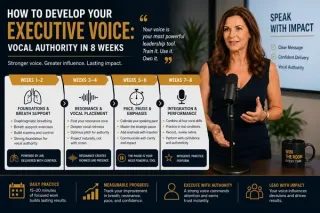
How to Develop Your Executive Voice: Vocal Authority in 8 Weeks
Develop your executive voice with this 8-week vocal authority program. Learn breath support, resonance, pace, pause, and practice routines for senior leaders. ...more
Improve Public Speaking Skills: Expert Tips by Lisa Hugo ,Corporate Communication Tips for CxOs & Executives
July 14, 2026•7 min read
Looking for webinar funnels, digital marketing or a client acquisition system for your coaching or consulting business?
Copyright © 2026 Audacia Marketing Management LLC, All rights reserved.