
Quick Answer: The first 30 seconds of any presentation determine whether your audience leans in or checks out. Command attention by using one of six proven opening techniques: the surprising statistic, the provocative question, the brief story, the bold statement, the "imagine" scenario, or the pattern interrupt. Combine your opening technique with confident body language (stillness, eye contact, deliberate pause) to establish authority before your content even begins.
What You Will Learn
Six proven opening techniques used by top executive speakers
How to choose the right opening for your specific audience and situation
The physical and vocal elements that amplify your first 30 seconds
Common opening mistakes that lose your audience immediately
How to practice and refine your opening for maximum impact
What You Will Need
Your presentation content (at minimum, your core message)
A recording device for practice
Time to rehearse your opening at least ten times out loud
Time commitment: 30-45 minutes of preparation per opening
Time Required
30-45 minutes to craft and rehearse your opening
Difficulty Level
Intermediate
Step-by-Step Instructions
Step 1: Understand Why the First 30 Seconds Matter
Neuroscience research shows that audiences form judgments about a speaker's competence within the first few seconds, often before a single word of content is delivered. These initial impressions create a filter through which everything else is interpreted.
A strong opening does three things:
Captures attention by interrupting the audience's default state (distraction, skepticism, or indifference)
Establishes credibility by demonstrating confidence, preparedness, and relevance
Creates anticipation by signaling that what follows will be worth the audience's time
A weak opening does the opposite: it confirms that this presentation will be like every other forgettable one.
The most common weak opening? "Thank you for having me. I am really excited to be here today. My name is... and I am going to talk about..." This opening communicates nothing of value and wastes the most impactful 30 seconds of your entire presentation.
Why this matters: You cannot recover from a poor opening. If the audience checks out in the first 30 seconds, you spend the rest of your presentation fighting to win back attention that was yours to lose.
Pro Tip: Write your opening last, after you have built the rest of your presentation. You need to know your core message deeply before you can craft the right hook for it.
Step 2: Master the Six Opening Techniques
Technique 1: The Surprising Statistic
Lead with a number that challenges your audience's assumptions or reveals a reality they have not considered.
Example: "Last year, 67% of executives in this region reported that poor communication cost them at least one major deal. Not strategy. Not pricing. Communication."
This technique works because numbers create credibility and surprise creates engagement. The statistic must be relevant to your audience and genuinely unexpected.
When to use it: Data-driven audiences (boards, investors, analysts), presentations about problems or opportunities, topics where the scale is underappreciated.
Technique 2: The Provocative Question
Ask a question that forces the audience to reflect, evaluate, or reconsider something they take for granted.
Example: "When was the last time you left a meeting knowing you had changed someone's mind? Not informed them. Not updated them. Actually changed their mind."
This technique works because questions activate the audience's brain differently than statements. They move from passive listening to active thinking.
When to use it: Leadership audiences, presentations about change or transformation, topics where the audience may be complacent.
Technique 3: The Brief Story
Open with a short, vivid story (60-90 seconds maximum) that illustrates the problem you are solving or the outcome you are proposing.
Example: "Three months ago, I worked with a CEO who had just lost a $40 million deal. Not because the proposal was weak. The proposal was excellent. She lost it because in the final presentation, she could not articulate why her company was the right partner. Forty million dollars, gone in a twenty-minute meeting."
This technique works because stories bypass analytical resistance and create emotional engagement. The audience sees themselves in the story.
When to use it: Any audience, particularly for topics that require emotional buy-in, change management, or when you need to illustrate consequences.
Technique 4: The Bold Statement
Make a declarative statement that takes a clear position or challenges conventional thinking.
Example: "The biggest threat to your career advancement is not your competition. It is your inability to communicate your value in a room of decision-makers."
This technique works because bold statements create a moment of tension. The audience wants to know whether you can support the claim, and they will listen to find out.
When to use it: When you have strong evidence to back your claim, audiences that respect directness, presentations where you want to establish thought leadership.
Technique 5: The "Imagine" Scenario
Invite the audience to visualize a specific future state, either the outcome you are proposing or the consequence of inaction.
Example: "Imagine walking into your next board meeting knowing that every person in that room is leaning forward, engaged, and ready to say yes before you even reach your final slide. That is what happens when your communication matches your competence."
This technique works because visualization activates the same neural pathways as experience. The audience begins to feel the desired outcome.
When to use it: Aspirational presentations, sales conversations, proposals, any situation where you want the audience to emotionally invest in an outcome.
Technique 6: The Pattern Interrupt
Do something the audience does not expect. This could be a moment of deliberate silence, a physical action, a surprising visual, or starting mid-story.
Example: Walk to the front of the room, pause for five full seconds while making eye contact, then say quietly: "What I am about to share will change how you think about every presentation you give for the rest of your career." Then pause again.
This technique works because the human brain is wired to pay attention to novelty. When something breaks the expected pattern, attention spikes automatically.
When to use it: Large audiences where energy may be low, presentations later in the day, situations where you need to differentiate yourself from other speakers.
Step 3: Choose the Right Opening for Your Situation
Match your opening technique to your audience and context:
| Audience Type | Best Opening Techniques |
|---|---|
| Board of Directors | Surprising statistic, Bold statement |
| Investors or Clients | Brief story, Surprising statistic |
| Internal Team | Provocative question, "Imagine" scenario |
| Conference Audience | Pattern interrupt, Brief story |
| Senior Leadership | Bold statement, Provocative question |
| Mixed or Unknown Audience | Brief story, Surprising statistic |
Consider the energy in the room. If the audience is already engaged and attentive, a bold statement or surprising statistic works well. If the energy is low (after lunch, end of a long conference day), a pattern interrupt or vivid story is more effective.
Why this matters: The right technique for the wrong audience falls flat. A pattern interrupt that works brilliantly at a conference may feel inappropriate in a board meeting. Context determines which tool to use.
Step 4: Add Physical and Vocal Authority to Your Opening
Your opening is not just about words. How you deliver those first 30 seconds matters as much as what you say.
Physical elements:
Walk to your speaking position and pause before speaking (2-3 seconds of silence)
Stand with feet shoulder-width apart, weight evenly distributed
Make eye contact with three different sections of the room
Keep your hands relaxed at your sides or on the podium
Stay completely still during your opening line (no swaying, pacing, or fidgeting)
Vocal elements:
Speak your opening line at a slightly lower pitch than your normal voice
Use a deliberate, measured pace (slower than conversational speed)
End your opening statement with downward inflection (authority, not uncertainty)
Insert a 2-second pause after your opening hook before continuing
Why this matters: An audience processes your physical presence and vocal quality before they process your words. If your body signals nervousness while your words signal confidence, the audience believes your body.
Step 5: Rehearse Until Your Opening Is Automatic
Your opening must be memorized completely. Not roughly memorized. Not "I know the gist." Word-for-word memorized.
The first 30 seconds are when nerves peak. If you have to think about what to say during this moment, the cognitive load of remembering words competes with the cognitive load of managing anxiety, and both suffer.
Rehearse your opening at least ten times out loud:
Times 1-3: Focus on memorization and getting the words right
Times 4-6: Focus on delivery (pace, pitch, volume, pauses)
Times 7-8: Focus on physical presence (posture, eye contact, stillness)
Times 9-10: Full integration, deliver as if the audience is present
Record your final two rehearsals and review them. Your opening should feel natural, not performed.
Why this matters: Memorization of your opening eliminates the single biggest point of failure in any presentation. When you know your first 30 seconds cold, confidence flows from the first word.
Common Mistakes to Avoid
Opening with an apology. "Sorry, I am a bit nervous" or "I know this is a lot of information" immediately lowers your credibility.
Starting with logistics. "Before I begin, can everyone see the screen?" Handle logistics before your formal start.
Using a joke unless you are genuinely funny. A failed joke is worse than no joke. If humor is not your strength, use a different technique.
Reading your opening from notes. The first 30 seconds demand eye contact and connection. Notes break both.
Rushing through your opening. Slow down. The instinct to rush is driven by nerves, and it communicates anxiety to the audience.
Troubleshooting
Problem: You cannot find a surprising statistic for your topic.
Solution: Search industry reports, consulting firm publications, or academic research for data that relates to your core message. If statistics are not available, use a brief story or bold statement instead.
Problem: Your opening feels rehearsed and unnatural.
Solution: Rehearse more, not less. The "uncanny valley" of rehearsal happens around practice 4-6, where you know the words but they feel scripted. By practice 8-10, the words become natural again because they are truly internalized.
Expected Results
A well-crafted, well-rehearsed opening creates immediate audience engagement, establishes your credibility in the first 30 seconds, and generates momentum that carries through the rest of your presentation. Executives who master their openings consistently report that the rest of the presentation feels easier because the audience is already invested.
Next Steps
Craft openings for your next three speaking opportunities using different techniques
Read the companion guide: How to Structure a Compelling Executive Presentation
Explore Lisa Hugo's private executive coaching for personalized presentation development
Frequently Asked Questions
Should I introduce myself in the first 30 seconds?
Only if your audience genuinely does not know who you are and that information is essential for your credibility. In most executive settings, you have been introduced or the audience already knows you. Use those precious seconds for your hook, not your biography.
What if the event organizer gives me a long introduction?
Acknowledge the introduction briefly ("Thank you, Sarah") and then launch directly into your opening hook. Do not repeat information the organizer already shared.
Can I use the same opening technique every time?
You can develop a signature style, but vary your technique based on the audience and context. A CEO who always opens with statistics may find that audiences start to predict the approach, reducing its impact.
What if my opening does not land the way I expected?
Continue with confidence. The audience takes their cues from you. If you react to a perceived failure (nervous laugh, apology, visible deflation), the audience notices. If you continue with composure, the moment passes and your content takes over.
Additional Resources
About the Author: Lisa Hugo is an executive communication coach with more than a decade of experience helping C-suite leaders, entrepreneurs, and senior executives master high-stakes communication. Based in Dubai, she works with leaders across the Middle East and internationally through her private executive coaching program. Her clients include executives from Fortune 500 companies.



She’s helped 1000s of clients around the world to develop their speaking skill with her 1 : 1 coaching and powerful programs, each centered on a different aspect of speaking, including confidence, voice, presentation, and body language.
COMPANY
LEGAL
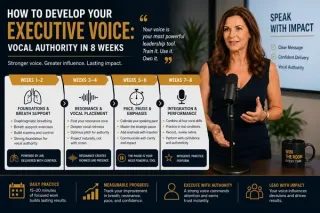
How to Develop Your Executive Voice: Vocal Authority in 8 Weeks
Develop your executive voice with this 8-week vocal authority program. Learn breath support, resonance, pace, pause, and practice routines for senior leaders. ...more
Improve Public Speaking Skills: Expert Tips by Lisa Hugo ,Corporate Communication Tips for CxOs & Executives
July 14, 2026•7 min read
Looking for webinar funnels, digital marketing or a client acquisition system for your coaching or consulting business?
Copyright © 2026 Audacia Marketing Management LLC, All rights reserved.