
Quick Answer: A compelling executive presentation follows a five-part structure: a hook that commands attention in the first 30 seconds, a clear thesis that states your core message, three supporting pillars (each with a claim, evidence, and audience implication), a summary that reinforces your key points, and a call to action that tells the audience exactly what you want them to do next. This structure works for board presentations, investor pitches, keynotes, and strategic recommendations.
What You Will Learn
The five-part presentation structure used by top executive communicators
How to choose the right structure for different audiences and purposes
Techniques for creating smooth transitions between sections
How to determine the right length and depth for executive audiences
Advanced structural techniques for complex topics
What You Will Need
Your core message defined in one sentence
Supporting data, examples, or evidence for your key points
Knowledge of your audience's priorities and decision-making criteria
Time commitment: 1-2 hours to structure a presentation (before slide creation)
Time Required
1-2 hours for structuring (separate from slide design and rehearsal)
Difficulty Level
Intermediate
Step-by-Step Instructions
Step 1: Define Your Core Message Before You Structure Anything
Before thinking about structure, answer one question: what is the single most important thing you want your audience to remember, decide, or do after your presentation?
Write this in one sentence. Not two. Not a paragraph. One sentence.
Examples:
"We should acquire Company X because it gives us market access we cannot build organically."
"Our Q3 results exceeded targets, and we need additional investment in the APAC region to sustain momentum."
"Communication is the most underdeveloped skill in executive leadership, and the cost of ignoring it is measurable."
Everything in your presentation should serve this core message. Any slide, story, data point, or example that does not directly support it should be cut.
Why this matters: Executive audiences are time-constrained and have high expectations for clarity. A presentation without a clear core message feels like a data dump, regardless of how well the individual slides are designed.
Pro tip: If you cannot state your core message in one sentence, you do not yet know what your presentation is about. Keep refining until you can.
Step 2: Build the Five-Part Structure
The most effective executive presentations follow this five-part structure. It works because it mirrors how senior decision-makers process information: they want to know what you want, why they should care, what evidence supports it, and what they need to do next.
Part 1: The Hook (30-60 seconds)
Your opening must command attention immediately. Choose one of these approaches:
A surprising statistic that challenges the audience's assumptions
A brief story that illustrates the problem or opportunity
A bold statement that takes a clear position
A provocative question that creates curiosity
Do not open with "Thank you for your time" or "Today I want to talk about..." These openings waste the most impactful seconds of your presentation.
Part 2: The Thesis (30-60 seconds)
Immediately after your hook, state your core message directly. In executive settings, lead with your conclusion, not your methodology. Senior audiences do not want to follow your thought process. They want to know your position and then evaluate whether your evidence supports it.
"Based on our analysis of the market data and competitive landscape, my recommendation is that we proceed with the acquisition of Company X at the proposed valuation."
This takes courage. Many presenters hide their recommendation at the end because they are afraid of early pushback. But stating your thesis upfront gives the audience a framework for evaluating everything that follows.
Part 3: Three Supporting Pillars (70-80% of your presentation)
Organize your supporting content into exactly three main arguments or evidence blocks. Three is not arbitrary. It is the maximum number of distinct ideas that an audience can retain and evaluate simultaneously.
Each pillar follows its own mini-structure:
Claim: State the supporting argument in one sentence
Evidence: Provide the strongest proof point (data, case study, example, expert reference)
Implication: Explain what this means for the audience specifically
Example pillar: "First, the acquisition gives us immediate access to 2.3 million customers in a market where organic growth would take five years. Our analysis shows a 34% faster path to revenue compared to building from scratch. For this team, that means hitting our 2027 revenue targets without increasing our burn rate."
Part 4: The Summary (30-60 seconds)
Restate your three pillars in one sentence each. Do not add new information. Do not qualify or hedge. Simply remind the audience of the three reasons they should agree with your thesis.
"To summarize: the acquisition accelerates our market access by five years, preserves our capital efficiency, and positions us ahead of our three primary competitors."
Part 5: The Call to Action (30 seconds)
Tell the audience exactly what you want them to do. Be specific and direct:
"I am requesting board approval to proceed with due diligence at the proposed terms."
"I am asking for a $2 million budget increase for APAC operations, effective Q1."
"I want each of you to schedule a 30-minute coaching assessment with your direct reports this month."
A presentation without a clear call to action is a missed opportunity. Every executive presentation should result in a decision, an action, or a commitment.
Why this matters: This structure works because it respects how executive audiences think. They want your position upfront, they want evidence organized clearly, and they want to know what is expected of them.
Step 3: Create Smooth Transitions
Transitions are the connective tissue that turns five separate sections into a cohesive narrative. Poor transitions make a presentation feel like a series of unrelated slides.
Between your hook and thesis:
"That is why I am here today. My recommendation is..."
Between your thesis and first pillar:
"Let me walk you through the three reasons behind this recommendation. First..."
Between pillars:
"That addresses the market access opportunity. The second factor is equally important..."
Between your final pillar and summary:
"Let me bring this together..."
Between your summary and call to action:
"Given these three factors, here is what I am asking for..."
Write your transitions out and memorize them. They are the moments where presenters most commonly stumble or lose momentum.
Why this matters: Smooth transitions create the impression of a speaker who has complete command of their material. They guide the audience through your logic without requiring effort on their part.
Step 4: Calibrate Length and Depth
Executive presentations fail when they are too long or too detailed. Calibrate your content to your time slot and audience:
The 10-minute rule: For most executive presentations, aim for 10-12 minutes of prepared content, even if you have a 30-minute slot. The remaining time is for discussion, questions, and dialogue, which is often where the real value is created.
Depth calibration by audience:
Board of directors: High-level, strategic, focused on risks and returns. Lead with the recommendation. Minimal detail, maximum clarity.
C-suite peers: Strategic with some operational depth. Balance the big picture with one or two levels of supporting detail.
Investors: Narrative-driven with financial credibility. Tell a story backed by data, not a data dump with occasional narrative.
Technical teams: More detail-oriented, but still need a clear structure. Do not let complexity become an excuse for disorganization.
Slide count: One slide per minute is a useful maximum. A 10-minute presentation should have no more than 10-12 slides. Each slide should contain one idea. If a slide requires more than six seconds to comprehend, it is too complex.
Why this matters: Executives who present for their full time slot without leaving room for discussion signal that they value their own talking over the audience's engagement. The best presenters say less and invite more dialogue.
Step 5: Apply Advanced Structural Techniques
Once you have mastered the basic five-part structure, consider these advanced approaches:
The inverted pyramid: Lead with your most important information and progressively add detail. This allows the audience to stop you at any point when they have heard enough, and they will still have received the key message.
The problem-solution-impact structure: When proposing change or addressing challenges. Define the problem (with evidence of its cost), present your solution (with evidence of its effectiveness), and quantify the impact (ROI, risk reduction, competitive advantage).
The past-present-future arc: When presenting strategic plans or transformation proposals. Where were we? Where are we now? Where are we going? This creates a narrative of progress that makes the audience feel part of a journey.
The contrarian structure: When your recommendation challenges conventional thinking. State the conventional view, present evidence that challenges it, and offer your alternative with supporting proof. This works best when you have strong data and a confident delivery.
Why this matters: Different situations call for different structural approaches. Having multiple frameworks in your toolkit allows you to choose the right structure for each specific audience and context.
Common Mistakes to Avoid
Building to a conclusion. Executive audiences want your position upfront. Save the suspense for novels, not board meetings.
Including more than three supporting arguments. If you have five strong points, choose the three strongest. More arguments dilute each one.
Designing slides before structure. Structure determines slides, not the other way around. Build your architecture first.
Skipping the call to action. Every presentation should end with a specific ask. If you are not asking for something, why are you presenting?
Treating Q&A as an afterthought. Q&A is part of your structure. Prepare for it as deliberately as you prepare your content.
Troubleshooting
Problem: Your topic is too complex for three supporting pillars.
Solution: You are likely trying to present too much. Identify the three most important aspects for this specific audience and save the rest for a follow-up document or supplementary materials.
Problem: Your call to action is unclear because the decision is not entirely yours.
Solution: Frame your call to action as a recommendation with a specific next step: "My recommendation is X. The next step I am requesting is Y so that we can move toward a decision by Z date."
Expected Results
Executives who adopt this structure consistently report that their presentations feel more organized, their audiences are more engaged, and their recommendations are more frequently approved. The five-part structure creates clarity for both the speaker and the audience, reducing cognitive load and increasing persuasive impact.
Next Steps
Structure your next presentation using this five-part framework before opening PowerPoint
Read the companion guide: How to Command Attention in the First 30 Seconds of Any Presentation
Explore Lisa Hugo's private executive coaching for personalized presentation development
Frequently Asked Questions
Does this structure work for all types of presentations?
It works for the vast majority of executive presentations: board updates, strategic recommendations, investor pitches, team briefings, and keynotes. The primary exception is purely informational presentations with no persuasive element, and even those benefit from a clear structure.
What if my audience wants more detail than three supporting pillars allow?
Provide an appendix or supplementary document with the detailed data. Your presentation should deliver the strategic narrative. The supplementary materials satisfy the audience members who want to go deeper without burdening the entire group.
Should I share my slides in advance?
This depends on your organization's culture. If pre-reads are expected, send a summary document, not your full deck. You want the audience to hear your narrative, not read ahead and skip to their questions.
How do I handle multiple presenters in the same meeting?
Each presenter should follow the same structural framework. Coordinate your transitions and ensure that each person's segment has its own clear thesis and call to action. The meeting organizer should provide an overarching narrative that ties the individual presentations together.
Additional Resources
About the Author: Lisa Hugo is an executive communication coach with more than a decade of experience helping C-suite leaders, entrepreneurs, and senior executives master high-stakes communication. Based in Dubai, she works with leaders across the Middle East and internationally through her private executive coaching program. Her clients include executives from Fortune 500 companies.



She’s helped 1000s of clients around the world to develop their speaking skill with her 1 : 1 coaching and powerful programs, each centered on a different aspect of speaking, including confidence, voice, presentation, and body language.
COMPANY
LEGAL
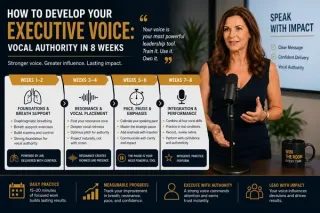
How to Develop Your Executive Voice: Vocal Authority in 8 Weeks
Develop your executive voice with this 8-week vocal authority program. Learn breath support, resonance, pace, pause, and practice routines for senior leaders. ...more
Improve Public Speaking Skills: Expert Tips by Lisa Hugo ,Corporate Communication Tips for CxOs & Executives
July 14, 2026•7 min read
Looking for webinar funnels, digital marketing or a client acquisition system for your coaching or consulting business?
Copyright © 2026 Audacia Marketing Management LLC, All rights reserved.