
Quick Answer: To prepare a high-stakes presentation in 48 hours, focus on three core messages (not twenty slides), build a powerful opening and closing first, rehearse out loud at least five times, prepare for the three toughest questions you could face, and do a full dress rehearsal with someone who will give you honest feedback. Skip the perfectionism. Prioritize clarity, confidence, and connection over comprehensive coverage.
What You Will Learn
How to distill complex content into three core messages that land
A time-blocked 48-hour preparation framework used by C-suite executives
Techniques for building a compelling opening in under 30 minutes
How to rehearse effectively when time is limited
Strategies for managing high-pressure nerves with minimal preparation time
What You Will Need
A quiet space for out-loud rehearsal (non-negotiable)
A recording device (your phone works perfectly)
One trusted colleague willing to listen to a run-through
A timer
Time commitment: 8-10 focused hours across two days
Time Required
8-10 hours of focused preparation across 48 hours
Difficulty Level
Intermediate to Advanced (assumes basic presentation experience)
Step-by-Step Instructions
Step 1: Clarify Your Core Message (Hours 1-2)
Before you open a single slide, answer this question: if the audience remembers only one thing from your presentation, what should it be?
Most executives make the mistake of trying to cover everything. When time is short, comprehensiveness is your enemy. Clarity is your ally.
Write down your single core message in one sentence. Then identify two supporting messages that reinforce it.
These three messages become the backbone of your entire presentation.
Test each message against the "so what" filter. If a busy executive would hear your message and think "so what?", it is not sharp enough. Rewrite it until the relevance is immediately obvious.
Why this matters: Audiences retain three key ideas at most. When you try to communicate twelve points, they remember none. Three focused messages delivered with conviction always outperform twelve scattered talking points.
Pro Tip: Write your three messages on a sticky note and place it where you can see it while building your slides. If a slide does not support one of those three messages, cut it.
Step 2: Build Your Opening and Closing (Hours 2-3)
Your opening and closing are the two highest-impact moments of any presentation. Build them before you touch the middle content.
For your opening, choose one of these proven approaches:
A surprising statistic that challenges assumptions
A brief, relevant story that illustrates the problem you are solving
A provocative question that creates curiosity
A bold statement of your core recommendation
For your closing, do three things: summarize your three core messages in one sentence each, state your specific ask or call to action, and end with a forward-looking statement that paints the outcome.
Memorize both your opening and closing word for word. These are the moments when nerves peak, and having the words locked in eliminates the risk of stumbling when it matters most.
Why this matters: Research shows that audiences form their strongest impressions in the first 30 seconds and the final 60 seconds. Everything in the middle matters less than how you start and finish.
Pro Tip: Your closing should mirror your opening. If you opened with a question, close by answering it. If you told a story, return to it. This creates a narrative arc that feels complete and professional.
Step 3: Structure the Middle Content (Hours 3-5)
With your three core messages defined and your opening and closing built, fill in the middle. Use this structure for each message:
State the message clearly
Provide one piece of evidence (data, example, or case study)
Explain what it means for the audience
Transition to the next message
Resist the urge to add more evidence. One strong proof point per message is more persuasive than five mediocre ones. If your audience wants more detail, they will ask during Q&A.
Build your slides last, not first. Each slide should contain one idea, minimal text, and visuals that reinforce (not repeat) what you are saying. Aim for no more than one slide per minute of speaking time.
Why this matters: Structure creates the perception of preparation and competence, even when time is limited. A well-structured fifteen-minute presentation always outperforms a rambling thirty-minute one.
Pro Tip: For board presentations and investor pitches, lead with the recommendation, then support it. Do not build to a conclusion. Senior audiences want to know where you stand immediately.
Step 4: Prepare for Q&A (Hours 5-6)
The Q&A session often determines whether a presentation is perceived as successful. Identify the three toughest questions you could face and prepare clear, concise answers for each.
Think about who will be in the room. What are their concerns? What might they challenge? What data might they question? Write those questions down and rehearse your answers out loud.
For each tough question, use this framework:
Acknowledge the question directly (no deflecting)
Provide a concise answer (two to three sentences)
Support with one data point or example
Bridge back to your core message
Also prepare a response for the question you hope nobody asks. That is almost always the one that comes up.
Why this matters: Executives who handle Q&A with composure and clarity earn significantly more credibility than those who deliver a polished presentation but stumble under questioning.
Pro Tip: If you do not know the answer, say so directly. "I do not have that data in front of me, but I will follow up by end of day" is always better than a vague, improvised response.
Step 5: Rehearse Out Loud, Multiple Times (Hours 6-8)
This is the step most executives skip, and it is the most important. Silent mental rehearsal does not prepare your voice, your timing, or your body for the real moment.
Follow this rehearsal sequence:
Run 1: Read through your notes out loud. Do not worry about polish. Get familiar with the flow.
Run 2: Practice with notes nearby but try to speak from memory. Time yourself.
Run 3: Stand up. Use gestures. Practice as if the audience is present.
Run 4: Record yourself on video. Watch it back. Identify one thing to improve.
Run 5: Present to a colleague or trusted person. Ask for honest feedback on clarity, pace, and confidence.
After five run-throughs, you will know your material well enough to deliver with confidence, even if nerves hit. Your mouth and brain need to work together, and that only happens through out-loud practice.
Why this matters: Rehearsal is what separates adequate presentations from commanding ones. Every minute of out-loud practice reduces anxiety and increases delivery confidence.
Pro Tip: Pay special attention to transitions between sections. Smooth transitions create the impression of a speaker who knows their material deeply. Rough transitions signal that you assembled the content under pressure.
Step 6: Final Preparation and Day-Of Rituals (Hours 8-10)
The final hours before your presentation are about managing your state, not adding content.
The night before:
Do one final run-through at half speed, focusing on landing key phrases
Lay out your clothes and check your technology
Get adequate sleep (this matters more than one more rehearsal)
Day of:
Arrive early to check the room, the screen, and the technology
Do a five-minute vocal warm-up: humming, lip trills, and speaking your opening at full volume
Stand in a power pose for two minutes before entering the room
Review your three core messages one final time
Put your phone on silent and close your laptop notifications
Why this matters: Your physical and mental state directly impacts your delivery. A calm, prepared speaker commands more authority than a rushed, anxious one, regardless of content quality.
Pro Tip: If you feel nervous, reframe it as excitement. The physiological response is nearly identical. Tell yourself "I am excited about this" rather than "I am nervous about this." Research from Harvard Business School shows this simple reframe measurably improves performance.
Common Mistakes to Avoid
Starting with slides instead of messages. Slides are a visual aid, not a script. Build your message first, slides second.
Trying to cover everything. Comprehensive coverage in 48 hours leads to shallow content. Three deep points beat twelve surface-level ones.
Skipping out-loud rehearsal. Reading silently in your head is not preparation. Your voice needs practice time.
Neglecting Q&A preparation. Many executives spend 90% of prep time on the presentation and 0% on the questions that follow.
Adding content the morning of. Last-minute additions create confusion and undermine your confidence. Lock your content 12 hours before delivery.
Troubleshooting
Problem: You cannot identify your core message because the topic is complex.
Solution: Ask yourself: "If the CEO stopped me in the elevator and asked for a one-sentence summary, what would I say?" That is your core message.
Problem: You feel underprepared despite following the framework.
Solution: Accept that 48 hours will never produce a perfect presentation. Your goal is a confident, clear, well-structured delivery, not perfection. The audience does not know what you planned to include.
Problem: Nerves are overwhelming despite preparation.
Solution: Focus on the first 60 seconds. If you nail your opening (which you have memorized), momentum will carry you. Controlled breathing before you start, four counts in, four counts out, calms the nervous system in under two minutes.
Expected Results
Following this framework, you will deliver a focused, confident presentation that communicates your key messages clearly, handles Q&A with composure, and creates the impression of thorough preparation, even on a tight timeline. Executives who use this approach consistently report feeling 70-80% as prepared as they would with a full week, while spending less than half the time.
Next Steps
Download Lisa Hugo's Presentation Preparation Checklist
Read the companion guide: How to Structure a Compelling Executive Presentation
Consider private executive coaching for ongoing high-stakes presentation support
Frequently Asked Questions
How many slides should I use for a 20-minute presentation?
Aim for 12-15 slides maximum, roughly one per minute of speaking. Each slide should contain one idea with minimal text. If a slide has more than six words, you probably have too much on it.
What if I am presenting on a topic I am not an expert in?
Focus on what you do know and be transparent about the boundaries of your expertise. Audiences respect honesty far more than bluffing. Prepare your three core messages around the aspects you understand well, and have backup resources ready for areas outside your depth.
Should I use notes during the presentation?
For a high-stakes presentation, minimal notes are acceptable, but never read from a script. A single card with your three core messages and key transition phrases is sufficient. The goal is to speak with your audience, not read to them.
What if the technology fails?
Always have a backup plan. Know your presentation well enough to deliver without slides. Carry your file on a USB drive and email it to yourself. Arrive early to test everything. If technology fails during delivery, pause, acknowledge it briefly, and continue without slides. This actually demonstrates remarkable composure.
How do I handle a hostile audience member?
Stay calm, listen to the full question, and respond directly without becoming defensive. Acknowledge the concern, provide your perspective supported by evidence, and offer to discuss further after the session. Never engage in a public debate during your presentation.
Additional Resources
About the Author: Lisa Hugo is an executive communication coach with more than a decade of experience helping C-suite leaders, entrepreneurs, and senior executives master high-stakes communication. Based in Dubai, she works with leaders across the Middle East and internationally through her private executive coaching program. Her clients include executives from Fortune 500 companies.



She’s helped 1000s of clients around the world to develop their speaking skill with her 1 : 1 coaching and powerful programs, each centered on a different aspect of speaking, including confidence, voice, presentation, and body language.
COMPANY
LEGAL
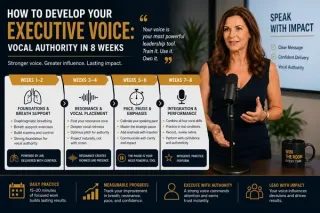
How to Develop Your Executive Voice: Vocal Authority in 8 Weeks
Develop your executive voice with this 8-week vocal authority program. Learn breath support, resonance, pace, pause, and practice routines for senior leaders. ...more
Improve Public Speaking Skills: Expert Tips by Lisa Hugo ,Corporate Communication Tips for CxOs & Executives
July 14, 2026•7 min read
Looking for webinar funnels, digital marketing or a client acquisition system for your coaching or consulting business?
Copyright © 2026 Audacia Marketing Management LLC, All rights reserved.