
Quick Answer: Handling tough questions in Q&A sessions requires three skills: buying thinking time without appearing unprepared (use the pause-acknowledge-respond framework), structuring your answer for clarity (lead with your position, support with one proof point, bridge back to your message), and maintaining composure when challenged (control your body language and vocal tone, not just your words). Preparation is the foundation: anticipate the five hardest questions before every presentation and rehearse concise responses.
What You Will Learn
Seven frameworks for responding to different types of difficult questions
How to buy thinking time without looking unprepared
Techniques for handling hostile or loaded questions
How to respond when you genuinely do not know the answer
Physical and vocal strategies that project confidence during Q&A
What You Will Need
A list of anticipated tough questions for your specific presentation
A colleague willing to practice rapid-fire Q&A with you
A recording device for rehearsal review
Time commitment: 30 minutes of Q&A preparation per presentation
Time Required
30 minutes of Q&A preparation per presentation (ongoing skill)
Difficulty Level
Intermediate to Advanced
Step-by-Step Instructions
Step 1: Prepare Before You Present
The most effective Q&A strategy begins long before anyone asks a question. For every presentation, identify the five toughest questions you could face. These typically fall into predictable categories:
Challenge questions: "Where is your evidence for that claim?"
Hostile questions: "Don't you think this approach is fundamentally flawed?"
Gotcha questions: "How do you reconcile this with what you said last quarter?"
Knowledge-gap questions: Questions about areas outside your expertise
Agenda-driven questions: Questions designed to promote the questioner's viewpoint
Write out concise answers (three to four sentences maximum) for each of your top five anticipated questions. Rehearse them out loud until they feel natural.
Also prepare for the question you hope nobody asks. That is almost always the one that comes up.
Why this matters: Preparation eliminates the panic of being caught off guard. When a tough question arrives and you have already rehearsed a response, your brain retrieves an answer rather than scrambling to construct one under pressure.
Pro Tip: Ask a trusted colleague to play "hostile audience member" during your rehearsal. Have them ask your five tough questions plus two surprises. Practicing under simulated pressure builds the muscle memory of composure.
Step 2: Master the Pause-Acknowledge-Respond Framework
When a tough question lands, your instinct will be to answer immediately. Resist that instinct. The Pause-Acknowledge-Respond (PAR) framework gives you time to think while projecting confidence.
Pause (2-3 seconds): After the question is asked, pause. Take a breath. This brief silence signals that you are considering the question carefully rather than reacting emotionally. It communicates that you are in control.
Acknowledge (1 sentence): Validate the question before answering. "That is an important consideration" or "Thank you for raising that point" or simply "Good question." Acknowledgment creates rapport and buys you additional thinking time.
Respond (2-4 sentences): Deliver your concise, structured answer. Lead with your position, support it briefly, and bridge back to your core message.
Example:
Question: "Your growth projections seem aggressive. What makes you confident in these numbers?"
Pause: (2 seconds of composed silence)
Acknowledge: "That is a fair challenge, and I understand the skepticism."
Respond: "These projections are based on three data points: our 18% growth rate over the past two years, confirmed pipeline commitments from three enterprise clients, and conservative market expansion estimates validated by our advisory board. We have actually reduced our initial projections by 15% to account for market uncertainty."
Why this matters: Immediate responses to tough questions often sound defensive or incomplete. The PAR framework creates space for a measured, credible response.
Step 3: Learn the Seven Response Frameworks
Different types of questions require different response strategies. Master these seven frameworks:
Framework 1: The Direct Answer
For straightforward factual questions, answer directly and concisely.
"Our current margin is 23%, up from 18% last year."
No hedging, no over-explaining. State the fact and stop.
Framework 2: The Bridge
When a question tries to pull you off-message, answer briefly and redirect.
"That is an interesting perspective. What I can tell you is [your key message]."
Acknowledge the question, then return to your agenda.
Framework 3: The Reframe
When a question is based on a false premise, correct the frame before answering.
"I would challenge the assumption behind that question. The data actually shows [corrected frame]. Given that context, [your answer]."
Framework 4: The Honest "I Don't Know"
When you genuinely do not have the answer, say so directly.
"I do not have that specific data point in front of me. I will follow up with you by end of day with the exact figures."
Never bluff. Audiences detect fabrication, and one caught bluff destroys all credibility.
Framework 5: The Deflection (When Appropriate)
When a question is outside your scope or better answered by someone else.
"That is really a question for our CFO, and she would be better positioned to give you a precise answer. I can connect you after this session."
Framework 6: The Disarm
When a question is hostile or loaded, reduce the emotional temperature.
"I can see this is an important concern for you, and I appreciate you raising it directly. Here is how I see it..."
Acknowledge the emotion without matching it. Stay calm and factual.
Framework 7: The Acknowledge and Park
When a question opens a rabbit hole that would derail your presentation.
"That is a substantial topic that deserves its own discussion. I want to give it the attention it warrants. Can we schedule time to explore it in depth after this session?"
Why this matters: Having multiple frameworks gives you options. The right response to a hostile question is different from the right response to a knowledge-gap question. Versatility prevents you from defaulting to a single approach that does not fit every situation.
Step 4: Control Your Physical Response
Your body language during Q&A communicates as much as your words. Under pressure, most executives display physical tells: shifting weight, breaking eye contact, crossing arms, touching their face, or speaking faster.
Physical rules for Q&A:
Maintain eye contact with the questioner while they ask. Then break eye contact and make eye contact with the broader audience while you answer. This prevents the Q&A from becoming a private debate.
Stay open. Hands at your sides or resting on the podium. No crossing arms, no hands in pockets, no fidgeting.
Stay still. Resist the urge to pace or shift weight when a tough question lands. Stillness signals composure.
Lean in slightly when a question is asked. This signals engagement and confidence, not retreat.
Vocal rules for Q&A:
Maintain your pace. Tough questions tempt you to speed up. Slow down instead.
Keep your pitch steady. A rising pitch signals defensiveness.
Use downward inflection on the final sentence of your answer. This signals certainty and completion.
Do not trail off. End your answer decisively. If you are done, stop talking.
Why this matters: An executive who answers a tough question with accurate content but defensive body language still appears unconfident. The audience reads your body first and your words second.
Step 5: Handle the Worst-Case Scenarios
Some Q&A situations require special handling:
When someone is trying to publicly embarrass you:
Stay calm. Respond with facts, not emotion. "I appreciate the directness. Here is what the data shows..." Then move on. Do not engage in a public debate. If the person persists, offer to continue the conversation privately after the session.
When you are asked the same question you already answered:
The questioner either did not understand your answer or did not like it. Rephrase your answer using different words or a new example, but do not change your position. "Let me approach that differently..."
When multiple people want to ask questions simultaneously:
Take control. "I see several hands. Let me take them one at a time." Point to a specific person. This demonstrates leadership and prevents chaos.
When Q&A goes silent (no questions asked):
Have a backup question prepared. "A question I am often asked about this topic is..." This breaks the silence and often prompts others to follow.
When a question reveals a genuine flaw in your argument:
Acknowledge it honestly. "That is a valid point, and it is something we are actively working to address. Currently, our approach is [explanation], and we plan to [next step]." Honesty under pressure builds more credibility than a perfect deflection.
Why this matters: Worst-case scenarios are rare, but when they happen, they define how the audience remembers you. Preparation for these moments is a form of professional insurance.
Step 6: Practice Rapid-Fire Q&A Regularly
Build Q&A skill through regular practice, not just before major presentations.
Weekly exercise (15 minutes):
Ask a colleague to ask you five questions about your current work, including at least two deliberately difficult ones. Practice responding using the PAR framework and your seven response frameworks.
Record these sessions periodically and review your physical composure, response structure, and filler word usage.
Monthly exercise (30 minutes):
Simulate a hostile Q&A session with a group of colleagues. Have them ask aggressive, unexpected, and unfair questions. Practice maintaining composure while delivering clear, structured responses.
Why this matters: Q&A skill degrades without practice, just like any other performance skill. Regular practice keeps your frameworks sharp and your composure reliable.
Common Mistakes to Avoid
Answering a question that was not asked. Listen to the full question before responding. Many executives start answering mid-question based on what they assume is being asked.
Over-answering. A concise, direct response is always more powerful than a lengthy explanation. Say enough, then stop.
Getting defensive. Defensiveness signals that the question hit a nerve. Calm factual responses signal that you are in control.
Engaging in a public debate. If a questioner becomes argumentative, offer to continue offline. You win by maintaining composure, not by winning the argument.
Ignoring hostile subtext. If a question has a hostile undertone, address it calmly rather than pretending it is a neutral question.
Troubleshooting
Problem: You freeze when an unexpected question lands.
Solution: Use the PAR framework. The 2-3 second pause is your safety net. It prevents freezing from becoming visible to the audience while giving your brain time to formulate a response.
Problem: You tend to ramble when answering difficult questions.
Solution: Practice the "3-sentence rule." Force yourself to answer in three sentences maximum: position, support, bridge. If the questioner wants more detail, they will ask a follow-up.
Expected Results
With consistent preparation and practice, executives develop the ability to handle any Q&A question with visible composure and structured clarity. The shift from dreading Q&A to viewing it as an opportunity to demonstrate expertise typically happens within 4-6 weeks of dedicated practice.
Next Steps
Build Q&A preparation into every presentation workflow
Read the companion guide: How to Prepare for a Board Presentation
Explore Lisa Hugo's private executive coaching for intensive Q&A skills development
Frequently Asked Questions
Should I repeat the question before answering?
In large rooms where not everyone may have heard the question, yes. In smaller settings, it is unnecessary and can feel patronizing. Use judgment based on room size and microphone setup.
How long should my answers be?
Aim for 30-60 seconds per answer. Anything longer and you risk losing the audience. If the topic requires a longer explanation, provide a concise answer and offer to discuss in detail after the session.
What if someone asks a question I specifically avoided addressing in my presentation?
Treat it as any other question. The audience does not know what you deliberately excluded. Answer it concisely using one of your seven frameworks.
How do I handle questions in a language I am not fully comfortable in?
Ask for the question to be repeated if needed. Take a moment to formulate your response. It is perfectly acceptable to say "Let me make sure I understand your question correctly" and then paraphrase it. This is a sign of thoroughness, not weakness.
Additional Resources
About the Author: Lisa Hugo is an executive communication coach with more than a decade of experience helping C-suite leaders, entrepreneurs, and senior executives master high-stakes communication. Based in Dubai, she works with leaders across the Middle East and internationally through her private executive coaching program. Her clients include executives from Fortune 500 companies.



She’s helped 1000s of clients around the world to develop their speaking skill with her 1 : 1 coaching and powerful programs, each centered on a different aspect of speaking, including confidence, voice, presentation, and body language.
COMPANY
LEGAL
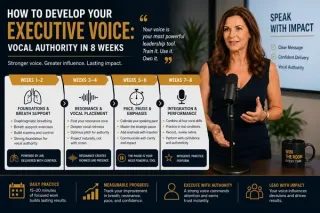
How to Develop Your Executive Voice: Vocal Authority in 8 Weeks
Develop your executive voice with this 8-week vocal authority program. Learn breath support, resonance, pace, pause, and practice routines for senior leaders. ...more
Improve Public Speaking Skills: Expert Tips by Lisa Hugo ,Corporate Communication Tips for CxOs & Executives
July 14, 2026•7 min read
Looking for webinar funnels, digital marketing or a client acquisition system for your coaching or consulting business?
Copyright © 2026 Audacia Marketing Management LLC, All rights reserved.