
Quick Answer
Communication skills training delivers the highest ROI for most executives because communication is the multiplier that determines how effectively you leverage your technical expertise, strategic thinking, and leadership capabilities. While technical skills keep you competent in your function and leadership training develops your approach, communication skills determine whether you can influence decisions, build coalitions, secure resources, and advance to senior leadership roles where impact depends on your ability to persuade, not just perform.
Introduction
You have limited time and budget for professional development. Your organization might offer various training options: technical certifications, strategic thinking workshops, leadership programs, executive education, or communication coaching. How do you decide where to invest?
This is especially critical at the executive level, where every development investment should move you closer to your next career milestone or multiply your current impact. Choosing the wrong focus can mean spending $5,000-$25,000 and three to six months on development that doesn't address your actual bottleneck.
This comparison helps you understand the ROI of communication skills training relative to other executive development options, identify which skills are bottlenecking your advancement, and make strategic investment decisions aligned with your career goals.
If you're trying to prioritize your development budget and time, this framework clarifies what will deliver the most meaningful results at your current stage.
Main Comparison: Communication Training vs Other Development Options
The Unique Nature of Communication Skills
Communication is fundamentally different from other executive development areas because it's a multiplier skill, not an additive skill.
Additive skills (like technical expertise or industry knowledge) increase what you know and can do independently. They add to your personal capability.
Multiplier skills (like communication) determine how effectively you activate your expertise, influence others, and scale your impact through people. They multiply the value of everything else you know.
Think of it this way:
Technical skills: Your ability to analyze data, understand technology, master financial modeling
Strategic thinking: Your ability to identify opportunities, see patterns, develop plans
Leadership approach: Your philosophy, values, and approach to leading people
Communication skills: Your ability to make others understand, believe, and act on your technical knowledge, strategic insights, and leadership vision
Without strong communication, brilliant technical skills, strategic insights, and leadership potential remain trapped inside you, invisible to the people whose support you need to advance.
Communication Training: What It Develops
Focus areas:
Executive presence and gravitas
High-stakes presentation and storytelling
Influence and persuasion across stakeholder groups
Handling difficult conversations and negotiations
Commanding attention in senior forums (boardrooms, executive meetings)
Cross-cultural communication (critical in global or regional roles)
Media and public-facing communication
Primary outcome: Others perceive you as more capable, credible, and leadership-ready. Your existing expertise becomes visible and influential rather than overlooked.
Technical Skills Training: What It Develops
Examples: Data analytics certifications, technology platform expertise, financial modeling, industry-specific technical knowledge, digital transformation capabilities, cybersecurity expertise
Primary outcome: You can perform specialized functions or understand technical domains better. Your individual contribution capacity increases.
Leadership Development Programs: What They Cover
Examples: MBA programs, executive education at business schools, leadership philosophy courses, emotional intelligence training, change management certifications
Primary outcome: You develop frameworks for thinking about leadership, strategy, and organizational dynamics. Your conceptual understanding improves.
Strategic Thinking Training: What It Develops
Focus areas: Business strategy, competitive analysis, market dynamics, strategic planning frameworks, innovation methodologies.
Primary outcome: You can identify opportunities, analyze situations strategically, and develop plans. Your strategic perspective sharpens.
Career Impact Comparison
How Each Type of Development Affects Career Progression
Communication Skills Impact:
Career advancement at the executive level is fundamentally a visibility and influence game. You're promoted not because you're individually brilliant (that's table stakes), but because decision-makers:
Perceive you as leadership-ready (executive presence)
Trust your judgment (credibility built through how you communicate)
Believe you can represent the organization (presentation and public-facing skills)
See you influence outcomes (stakeholder management and persuasion)
Research consistently shows communication skills are the top differentiator between executives who advance to C-suite roles and those who plateau at senior management. Poor communicators, regardless of technical brilliance, rarely make it to the top.
Specific career moments where communication drives outcomes:
Board presentations that determine funding, strategic direction, or your credibility
Executive visibility opportunities (conferences, media, high-profile projects)
Promotion decisions influenced by how you're perceived in senior forums
Securing resources or buy-in for your initiatives from skeptical stakeholders
Navigating organizational politics and building influential coalitions
Technical Skills Impact:
Technical expertise is critical for doing your current job well and maintaining credibility within your function, but it rarely drives executive advancement beyond a certain point.
The higher you rise, the less you personally execute technical work. CEOs don't need to be the best data analysts or engineers; they need to understand enough to make informed decisions and communicate direction. Adding more technical certifications after you've established baseline competence delivers diminishing returns for career advancement.
When technical skills matter most:
Moving from mid-management into senior functional roles (VP Engineering, CFO, CMO)
Maintaining credibility within your technical domain
Industry transitions requiring new technical knowledge
Individual contributor to manager transitions
Leadership Development Impact:
Leadership programs improve how you think about leadership and provide frameworks for decision-making, but they don't directly change how others perceive you as a leader. Perception is shaped by communication.
You can have sophisticated leadership philosophy from an executive MBA, but if you can't articulate your vision compellingly, handle difficult conversations effectively, or command presence in senior forums, others won't see you as a leader.
When leadership development matters most:
First-time leadership roles (manager to director transitions)
Significant organizational challenges requiring new frameworks (leading through crisis, change management)
Supplementing strong communication with deeper strategic and leadership theory
Strategic Thinking Impact:
Strategic thinking skills help you identify what to do, but communication skills determine whether you can convince others to do it with you.
Many brilliant strategists languish in staff roles because they can't persuade operational leaders to execute their insights. Conversely, strong communicators with adequate (not exceptional) strategic thinking often outpace brilliant strategists who can't influence.
ROI Analysis by Career Stage
Early Career to Mid-Management (Individual Contributor to Manager/Director)
Priority ranking:
Technical skills - Establishing functional expertise and credibility
Communication skills - Beginning to influence peers and manage teams
Leadership development - Learning management fundamentals
Strategic thinking - Developing business perspective
Why: Technical competence is the foundation. Communication becomes increasingly important as you start managing.
Senior Management (Director to VP/SVP)
Priority ranking:
Communication skills - Critical bottleneck for most at this level
Strategic thinking - Expected at senior levels
Leadership development - Refining approach to leading larger teams
Technical skills - Maintaining currency, not deepening further
Why: The jump from director to VP is where communication becomes the primary differentiator. Technical skills are table stakes; advancement depends on influence and presence.
Executive Level (VP to C-Suite)
Priority ranking:
Communication skills - THE determining factor for C-suite advancement
Strategic thinking - Required but not sufficient
Leadership development - Ongoing refinement
Technical skills - Largely irrelevant to further advancement
Why: At this level, every interaction is high-stakes. Board presentations, investor relations, public representation, and organizational influence all depend on communication excellence. Technical work is fully delegated.
Side-by-Side Comparison
| Aspect | Communication Training | Technical Skills | Leadership Programs | Strategic Thinking |
|---|---|---|---|---|
| Type of Skill | Multiplier — amplifies other skills | Additive — increases personal capability | Framework — shapes your thinking approach | Framework — strengthens your analysis approach |
| Career Impact at Senior Levels | Highest — determines advancement | Moderate — maintains credibility | Moderate — improves leadership approach | High — informs decisions |
| Visibility Impact | Highest — directly shapes perception | Low — invisible unless communicated | Low — primarily an internal philosophy | Moderate — visible when communicated well |
| Influence on Others | Highest — directly improves persuasion | None — does not help convince others | Low — does not directly improve influence | Moderate — good ideas still require good communication |
| Time to ROI | Fast — 8–12 weeks for measurable change | Moderate — 3–6 months to apply | Slow — 6–12 months to integrate | Moderate — 3–6 months to apply |
| Urgency for Executives | Highest — immediate need for influence | Lower — likely already competent | Moderate — refinement rather than foundation | High — expected at senior levels |
| Cost of Poor Performance | Career-limiting — blocks advancement | Functional limitation — affects the current role | Limits team effectiveness | Limits decision quality |
| Typical Investment | $5,000–$50,000 for focused programs | $2,000–$10,000 for certifications | $50,000–$150,000+ for MBA or executive education | $5,000–$25,000 for workshops or executive education |
| Measurement Ease | High — stakeholder feedback and outcomes | High — certifications and performance | Difficult — subjective improvement | Difficult — decision quality measured over time |
| Transferability | Highest — applies across all contexts | Low — function-specific | High — universal frameworks | High — universal thinking tools |
| Shelf Life | Permanent — a core human skill | 2–5 years — affected by technical evolution | Permanent — evergreen concepts | Permanent — durable thinking frameworks |
| Best For | Plateaued executives who need greater visibility | Functional transitions | First-time leaders and major MBA-related career pivots | Senior leaders making complex decisions |
The Cost of Poor Communication
While development investments are visible costs, the hidden costs of poor communication are often far greater:
Measurable Career Costs:
Missed promotions: The VP role goes to someone with better presence, not necessarily better performance (cost: $50K-$200K+ annual compensation difference)
Limited visibility opportunities: You're not selected for board presentations, investor meetings, or conference speaking (cost: career trajectory impact)
Stakeholder frustration: Leaders stop inviting you to strategic conversations because you're difficult to understand or lack presence (cost: influence and access)
Failed initiatives: Brilliant ideas die because you can't build coalitions or secure buy-in (cost: organizational impact and your reputation)
Hidden Organizational Costs:
Poor communication from leaders costs organizations an average of $420,000 per year per company according to research on leadership communication failures
Unclear communication is cited as the #1 reason projects fail (cost: project budgets, team time, opportunity cost)
Executive communication failures damage stakeholder confidence, whether with boards, investors, clients, or internal teams (cost: organizational reputation and trust)
Personal Professional Costs:
Diminished confidence: Knowing your ideas aren't landing or you're not perceived as leadership-ready affects your professional confidence
Stress and frustration: Working harder without the influence to match your effort creates burnout
Isolation: When communication is difficult, leaders avoid you, limiting your network and opportunities
Decision Framework: Where Should You Invest First?
Invest in Communication Training First If:
You've been told you need more "executive presence" or gravitas
Your ideas are solid but you struggle to influence stakeholders or secure buy-in
You avoid high-stakes presentations or feel they don't go well
You're technically excellent but passed over for promotions
You work in culturally complex environments and need to navigate different communication norms
You're preparing for or in a role requiring board-level interaction, investor relations, or public representation
Feedback suggests you're "smart but not strategic" (often code for poor communication of your thinking)
You plateau at senior management and can't break into executive leadership
Invest in Technical Skills First If:
You're transitioning industries and lack fundamental domain knowledge
Your current technical skills are outdated and affecting job performance
You're early in your career and building foundational expertise
You're moving from one function to another (e.g., operations to finance)
Invest in Leadership Development First If:
You're a first-time people manager struggling with fundamental leadership questions
You're considering an MBA for career transition or network (leadership development is part of this)
You're facing major leadership challenges (crisis, change management) and need new frameworks
Invest in Strategic Thinking First If:
You're highly tactical and struggle to think beyond execution
You're moving into roles requiring business strategy (not just functional execution)
You have strong communication and technical skills but need strategic frameworks
The Integrated Approach:
For most senior executives, the optimal strategy is:
Communication training to remove the bottleneck limiting your influence and visibility
Strategic thinking development to deepen your decision-making frameworks (often part of executive communication programs anyway)
Ongoing leadership refinement through reading, mentorship, and experience
Technical skills as needed for specific transitions or critical gaps
Key Takeaways
Communication is the multiplier skill - It determines how effectively you activate everything else you know. Without it, technical brilliance, strategic insights, and leadership potential remain invisible.
Career advancement at senior levels is primarily determined by communication - Executives are promoted based on presence, influence, and how they're perceived, not just performance in current roles.
The cost of poor communication exceeds development investment - One missed promotion, failed initiative, or damaged stakeholder relationship costs far more than investing in communication excellence.
ROI timelines favor communication training for executives - You see measurable impact in 8-12 weeks, while most other development takes 6-12+ months to show results.
Technical skills have diminishing returns at executive levels - Beyond baseline competence, additional technical certifications rarely drive career advancement. Communication skills remain critical through C-suite.
Strategic thinking requires communication to create impact - Brilliant strategies that can't be articulated and sold to stakeholders deliver zero value. Communication turns strategic thinking into organizational action.
Different career stages require different priorities - Early career focuses on technical competence; senior management transitions require communication excellence; C-suite depends almost entirely on influence and presence.
Transform how you communicate and multiply your impact:
If communication is your bottleneck, every month you delay addressing it costs you influence, opportunities, and advancement potential. Lisa Hugo's Win The Room program and private executive coaching are designed specifically to transform how senior leaders communicate, present, and influence at the highest levels.
Frequently Asked Questions
I'm already a decent communicator. Should I still prioritize communication training?
"Decent" communication is table stakes for survival at senior levels, but excellence is what drives advancement. The difference between adequate and exceptional communication is the difference between staying at VP and reaching C-suite. If you're not getting feedback that your communication is a standout strength, there's room for transformation.
Won't an MBA or executive education program improve my communication along with other skills?
MBA programs touch on communication but rarely provide the intensive practice and feedback required for transformation. You'll improve your strategic thinking and gain frameworks, but graduates often still need focused communication coaching. If communication is your primary bottleneck, dedicated training delivers results faster than hoping an MBA improves it as a side benefit.
My organization offers free leadership training. Should I do that instead of paying for communication coaching?
Free organizational training is valuable and you should participate, but it's typically designed for broad audiences and covers general topics. If communication is specifically limiting your advancement, investing in specialized executive communication coaching supplements (not replaces) organizational programs and accelerates results.
How do I know if communication is really my bottleneck vs. something else?
Ask yourself these diagnostic questions:
Do people frequently misunderstand your points or ask for clarification?
Do your presentations feel less impactful than you'd like?
Do you struggle to influence stakeholders who should logically support your ideas?
Have you received feedback about needing more "presence," "gravitas," or "executive polish"?
Do you avoid certain high-stakes communication situations?
Are others with similar technical skills advancing while you plateau?
If you answered yes to several, communication is likely your bottleneck.
What if I invest in communication training but my organization doesn't value communication skills?
Organizations always value communication skills at senior levels, even if they don't explicitly name it. Decision-makers promote people they trust to represent the organization, influence stakeholders, and command respect. If you're in a highly technical organization that claims to prioritize technical skills over communication, notice who actually gets promoted to senior leadership. It's consistently the people who combine technical credibility with communication effectiveness, not the most technically brilliant but poor communicators.



She’s helped 1000s of clients around the world to develop their speaking skill with her 1 : 1 coaching and powerful programs, each centered on a different aspect of speaking, including confidence, voice, presentation, and body language.
COMPANY
LEGAL
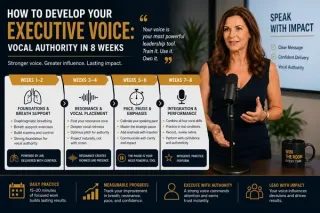
How to Develop Your Executive Voice: Vocal Authority in 8 Weeks
Develop your executive voice with this 8-week vocal authority program. Learn breath support, resonance, pace, pause, and practice routines for senior leaders. ...more
Improve Public Speaking Skills: Expert Tips by Lisa Hugo ,Corporate Communication Tips for CxOs & Executives
July 14, 2026•7 min read
Looking for webinar funnels, digital marketing or a client acquisition system for your coaching or consulting business?
Copyright © 2026 Audacia Marketing Management LLC, All rights reserved.