
Quick Answer
Win The Room is an 8-week live cohort program designed specifically for executives and senior leaders, featuring personalized coaching, peer learning, and real-world application. Traditional public speaking courses are typically self-paced or classroom-style programs for general audiences with recorded content and generic examples. Win The Room delivers measurable executive presence transformation, while traditional courses teach basic presentation fundamentals.
Introduction
You've decided to invest in improving your communication and presentation skills. Now you're faced with countless options: online courses promising to make you a confident speaker, university programs teaching presentation basics, and specialized executive programs like Win The Room.
The price differences are significant. A Udemy course costs $50, a university extension program runs $500-$2,000, while Win The Room is a premium investment. What are you actually getting for the difference?
This comparison breaks down the fundamental differences in approach, outcomes, and value so you can choose the right program for your career level and goals. If you're a senior leader, executive, or high-potential professional, understanding these distinctions will save you time, money, and frustration.
Main Comparison: Executive Cohort vs Traditional Courses
Program Structure and Delivery
Win The Room (8-Week Executive Cohort):
Win The Room brings together 8-12 senior leaders for an intensive, live 8-week transformation program. You meet weekly for structured sessions combining instruction, practice, and peer feedback. The cohort model creates accountability, diverse perspectives, and a professional network. Sessions are scheduled at consistent times with live coaching from Lisa Hugo, adapted in real-time to the group's needs and individual challenges.
Between sessions, you complete focused assignments applying concepts to your real work situations (actual upcoming presentations, negotiations, or stakeholder meetings). The program culminates in a capstone presentation with detailed feedback.
Traditional Public Speaking Courses:
Most public speaking courses follow one of these models:
Self-paced online courses: Pre-recorded video modules you watch on your own schedule, with limited or no instructor interaction
University/community programs: 6-12 week classroom courses meeting weekly, often with 20-40 students and a single instructor
Toastmasters-style clubs: Peer-led practice groups using standardized speech formats
Corporate training workshops: 1-2 day intensive sessions covering presentation basics for mixed-level audiences
These courses typically teach presentation fundamentals: structure, body language, vocal variety, and managing nervousness. Content is designed for general audiences, from entry-level professionals to experienced speakers.
Target Audience and Customization
Win The Room:
Exclusively for executives, senior leaders, and C-suite professionals
Small cohort size (8-12) allows deep personalization
Examples, scenarios, and challenges reflect executive-level situations
Addresses cultural nuances critical in GCC/Middle East business contexts
Assumes participants already have business expertise and focuses on executive-level influence
Traditional Courses:
General audience from students to mid-level professionals
Large class sizes (often 20-40+) limit individual attention
Generic examples (wedding speeches, informational presentations, persuasive talks)
Western-centric communication norms without regional adaptation
Starts from foundational basics, appropriate for beginners
Coaching and Feedback Quality
Win The Room:
Lisa Hugo personally coaches every participant with 20+ years of executive communication expertise. Feedback is:
Specific and actionable ("When you paused before the financial data, you lost the CFO's attention - here's how to maintain engagement through numbers")
Culturally informed ("In GCC boardrooms, that direct challenge approach will backfire - try this instead")
Career-level appropriate (addressing executive presence, gravitas, strategic influence)
Delivered live with immediate application and adjustment
You also receive peer feedback from other senior leaders who understand your challenges and can offer relevant insights.
Traditional Courses:
Instructors range from experienced speakers to generalist teachers. Feedback tends to be:
Generic ("Make more eye contact, slow down, use gestures")
Based on Western public speaking conventions without cultural context
Limited by class size (5-10 minutes of individual attention per session at most)
Often provided by peers with less relevant experience
Delivered on practice speeches rather than real work situations
Content Focus and Methodology
Win The Room:
The curriculum targets high-stakes executive communication:
Commanding attention in boardrooms and with senior stakeholders
Executive storytelling and data-driven persuasion
Handling challenging questions and skeptical audiences
Cross-cultural influence strategies
Executive presence and gravitas
Strategic framing for different decision-maker types
Methodology emphasizes real-world application. You don't give practice speeches on random topics; you prepare for actual upcoming high-stakes situations.
Traditional Public Speaking Courses:
Content covers presentation fundamentals:
Speech organization (intro, body, conclusion)
Managing nervousness and building confidence
Vocal delivery and body language basics
Visual aid design (PowerPoint tips)
General persuasion principles
Methodology relies on practice speeches with assigned topics, developing skills in a safe learning environment before applying to real situations.
Side-by-Side Comparison
| Aspect | Win The Room | Traditional Public Speaking Courses |
|---|---|---|
| Format | 8-week live cohort | Self-paced online or weekly classes lasting 6–12 weeks |
| Delivery | Live coaching sessions | Pre-recorded videos or large classroom lectures |
| Group Size | 8–12 senior leaders | Self-paced with no group, or 20–40+ students |
| Target Audience | Executives, senior leaders and C-suite professionals | General audience across all career levels |
| Instructor Expertise | 20+ years as an executive communication specialist | Varies from generalist instructors to experienced speakers |
| Content Level | Executive-level influence, presence and high-stakes communication | Foundational presentation skills |
| Customization | High — real work situations and individual challenges | Low — generic topics and examples |
| Cultural Context | Specialized for the Middle East and GCC | Western-centric, with limited regional adaptation |
| Feedback Quality | Detailed, expert and career-appropriate | Generic and limited by class size |
| Peer Learning | From other executives facing similar challenges | Mixed-level peers or no peer interaction |
| Real-World Application | Integrated — work on actual upcoming presentations | Practice speeches that are later applied to work |
| Network Value | High — connections with other senior leaders | Low to moderate |
| Typical Investment | $5,000–$8,000 | $50–$2,000 |
| Time Commitment | 8 weeks, 2–3 hours per week, plus assignments | Self-paced or 6–12 weeks at 1–2 hours per week |
| Measurable Outcomes | Executive presence transformation and stakeholder impact | Basic presentation confidence |
| ROI Timeline | 8–12 weeks | 6–12 months when self-applied to executive-level situations |
Investment Comparison and ROI
Traditional Public Speaking Courses:
Self-paced online: $50-$200 (lifetime access to videos)
University extension: $500-$2,000 (6-12 week programs)
Corporate workshops: $1,000-$3,000 (1-2 day intensives)
Toastmasters clubs: $100-$200 per year (membership)
ROI Consideration: These are appropriate investments if you're building foundational skills or early in your career. However, if you're a senior leader earning $150K-$500K+, the time spent in programs not tailored to your level is an opportunity cost. Six months practicing in a general-audience environment delays the executive-level transformation you need.
Win The Room:
Investment: $5,000-$6,000 for 8-week cohort program
Time commitment: 16-25 total hours over 8 weeks
ROI Consideration: For executives and senior leaders, the ROI calculation is different:
Career advancement: One promotion influenced by improved executive presence can mean $20K-$100K+ in additional compensation
Stakeholder influence: Successfully influencing a board decision, securing executive buy-in, or winning a major client through better communication delivers immediate business value
Time efficiency: Eight weeks of focused executive-level training vs. 12-18 months trying to extract executive insights from general-audience programs
Network value: Connections with 8-12 other senior leaders can lead to opportunities, partnerships, and peer support worth far more than the program investment
If communication is your bottleneck to the next level, the investment pays for itself with one successful outcome.
Decision Framework: Which Should You Choose?
Choose Win The Room If:
You're a senior leader, executive, or C-suite professional
You need executive presence and high-stakes communication skills, not basic presentation fundamentals
You have important upcoming situations (board presentations, investor pitches, organizational change leadership)
You value peer learning from others at your career level
You operate in culturally complex environments (especially Middle East/GCC region)
You want measurable transformation in 8 weeks, not incremental improvement over a year
The investment aligns with your career level and income
You're committed to active participation and real-world application
Choose Traditional Public Speaking Courses If:
You're early in your career and building foundational skills
You've never done formal presentation training and need the basics
Your speaking situations are primarily internal team meetings or informational presentations
Budget is a primary constraint
You prefer learning at your own pace without group commitments
You're not yet in high-stakes executive communication situations
Questions to Ask Before Deciding:
What's the actual problem I'm solving? Basic nervousness and structure, or executive-level influence and presence?
What's the cost of not solving this? If it's holding you back from promotions or board-level credibility, invest accordingly.
What's my timeline? If you have high-stakes situations in the next 3-6 months, you need focused executive training now.
Who else will be in the program? Will peer learning be valuable or distracting based on their career levels?
Key Takeaways
Executive-level training is fundamentally different - Win The Room addresses influence, presence, and high-stakes communication; traditional courses teach presentation basics appropriate for general audiences.
Live cohort creates acceleration - Real-time coaching, peer learning, and accountability deliver faster results than self-paced videos or large classroom settings.
Specialization matters for ROI - Executive-focused programs cost more upfront but deliver measurable career impact faster than extracting executive insights from general programs over many months.
Cultural context is critical - In regions like the Middle East, GCC-specialized coaching (like Lisa's Dubai-based expertise) provides advantages generic Western-focused programs cannot match.
Investment should match career level - A $50 course may be perfect for a junior professional; an executive earning $300K should invest proportionally in development that moves the needle at their level.
Application timing differs - Traditional courses teach skills you later apply to work; Win The Room integrates real work situations into the learning, delivering immediate applicability.
Consider your actual starting point - If you already present regularly and need refinement for executive impact, you'll be frustrated in a course teaching how to structure a basic speech.
Ready for Executive Level Transformation?
Win The Room is designed for senior leaders who are done with generic presentation training and ready for the influence, presence, and cultural expertise their roles demand. Lisa Hugo's 8-week cohort brings together executives committed to transforming how they show up in high-stakes situations.
Frequently Asked Questions
I've already taken public speaking courses. Will Win The Room be redundant?
Win The Room assumes you already know presentation basics and focuses exclusively on executive-level skills: commanding boardrooms, influencing skeptical senior stakeholders, executive presence, and culturally-informed communication. If you've done foundational training, Win The Room is the next-level specialization you need.
Can I get similar results from a $200 online course if I'm disciplined?
The content difference is significant (basic skills vs. executive-level influence), but equally important is the methodology. Self-paced courses lack real-time expert feedback, peer learning from other executives, and integration of your actual work situations. Most people who buy online courses never complete them, and those who do rarely achieve transformation without personalized coaching.
How much time per week does Win The Room require?
Plan for 2-3 hours of live session time weekly, plus 1-2 hours for focused assignments. The assignments aren't busywork, they're preparation for your actual upcoming high-stakes situations, so the time is directly valuable to your work.
What if I can't attend one of the live sessions?
Sessions are recorded for cohort members who miss a week due to unavoidable conflicts, but live participation is essential for full value. The real-time coaching, practice, and peer interaction can't be replicated by watching a recording.
Is Win The Room only about presentations, or does it cover other communication?
The program covers all high-stakes executive communication: presentations, yes, but also one-on-one influence conversations, handling difficult questions, negotiations, executive presence in various settings, and strategic communication with different stakeholder types. If you communicate to influence outcomes at the senior level, Win The Room addresses it.



She’s helped 1000s of clients around the world to develop their speaking skill with her 1 : 1 coaching and powerful programs, each centered on a different aspect of speaking, including confidence, voice, presentation, and body language.
COMPANY
LEGAL
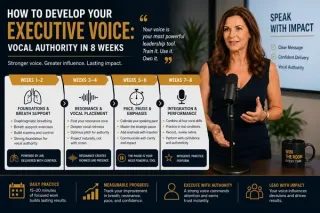
How to Develop Your Executive Voice: Vocal Authority in 8 Weeks
Develop your executive voice with this 8-week vocal authority program. Learn breath support, resonance, pace, pause, and practice routines for senior leaders. ...more
Improve Public Speaking Skills: Expert Tips by Lisa Hugo ,Corporate Communication Tips for CxOs & Executives
July 14, 2026•7 min read
Looking for webinar funnels, digital marketing or a client acquisition system for your coaching or consulting business?
Copyright © 2026 Audacia Marketing Management LLC, All rights reserved.