
Quick Answer
An executive communication coach specializes exclusively in high-stakes communication, presentation skills, and executive presence, while a generic business coach covers broad business topics like strategy, productivity, and leadership. If your primary challenge is communicating effectively at the executive level, commanding rooms, or influencing stakeholders, a specialist delivers faster, more measurable results than a generalist.
Introduction
You've reached a point in your career where how you communicate matters as much as what you know. Maybe you struggle to command attention in boardrooms, your presentations lack impact, or you need to influence skeptical stakeholders across cultures. The question is: should you work with a specialized executive communication coach or a general business coach?
This comparison helps senior leaders, executives, and high-potential professionals understand when specialization matters and when a generalist approach is sufficient. You'll discover the key differences in methodology, outcomes, and investment, so you can choose the right support for your specific goals.
If you're investing time and resources in professional development, this decision significantly impacts your results and career trajectory.
Main Comparison: Specialist vs Generalist
What Each Type of Coach Does
Executive Communication Coaches focus exclusively on how you communicate, present, and show up as a leader. They work on:
High-stakes presentation skills and storytelling
Executive presence and gravitas
Influence and persuasion techniques
Cross-cultural communication (especially valuable in global roles)
Media training and thought leadership
Handling difficult conversations and negotiations
Generic Business Coaches cover a broader range of business and leadership topics:
Goal setting and accountability
Time management and productivity
Leadership philosophy and style
Career transitions and strategy
Work-life balance
General confidence building
Why Specialization Matters at the Executive Level
Communication at the C-suite and senior leadership level is fundamentally different from mid-level management communication. You're dealing with:
Higher stakes: A single presentation can influence millions in investment, strategic direction, or organizational change
Sophisticated audiences: Board members, investors, and senior stakeholders who evaluate not just your content but your presence
Cultural complexity: In regions like the Middle East, communication nuances can make or break relationships
Media and public visibility: Executive roles often require external-facing communication skills
A specialist has spent thousands of hours mastering these specific challenges. A generalist may touch on communication as one of many topics but lacks the depth to transform how you show up in critical moments.
The Methodology Difference
Executive Communication Specialists:
Use evidence-based frameworks specifically for executive-level impact
Provide detailed feedback on vocal delivery, body language, and presence
Offer industry-specific scenarios and role-playing
Often have backgrounds in theatre, communications, or executive leadership
Work with video analysis and real-time coaching
Generic Business Coaches:
Focus on mindset, strategy, and accountability across multiple areas
May discuss communication conceptually but rarely practice delivery
Use general coaching questions rather than technical skill-building
Typically lack specialized training in presentation or communication techniques
Side-by-Side Comparison
Side-by-Side Comparison
| Aspect | Executive Communication Coach | Generic Business Coach |
|---|---|---|
| Primary Focus | Communication, presentation, executive presence | Broad business skills, strategy, leadership mindset |
| Depth of Expertise | Deep specialization in one critical area | Surface-level coverage of many areas |
| Typical Background | Communications, theatre, executive speaking | Business, HR, general coaching certification |
| Session Structure | Practice, feedback, skill-building exercises | Discussion, questioning, goal-setting |
| Measurable Outcomes | Improved presentation scores, stakeholder feedback, promotion to visible roles | General confidence, clarity on goals, accountability |
| Cultural Expertise | Often specialized, such as Middle East business culture | Usually Western-focused, with limited regional depth |
| Best For | Leaders who need to influence, present, and command rooms | Professionals seeking general business guidance |
| Typical Investment | Higher per session, but faster results in a specific area | Lower per session, but requires more sessions for communication gains |
| ROI Timeline | 8–12 weeks for noticeable transformation | 6–12 months for general development |
Decision Framework: Which Should You Choose?
Choose an Executive Communication Specialist Like Lisa Hugo If:
Your primary challenge is communication-related (presentations, influence, presence)
You have high-stakes speaking situations (board meetings, investor pitches, conferences)
You need to command attention and credibility in senior-level rooms
You operate in culturally complex environments (especially Middle East/GCC region)
You want rapid, measurable improvement in a specific skill area
Your career advancement depends on visibility and impact
You've been told you need more "executive presence" or gravitas
Consider a Generic Business Coach If:
You're early in your career and need broad professional development
Your challenges span multiple areas (time management, career strategy, work-life balance)
Communication is not your primary obstacle
You prefer exploratory, discussion-based coaching over skill-building
You're looking for ongoing accountability across general business goals
Budget is limited and you need basic guidance
The Hybrid Approach
Many successful executives work with both: a communication specialist for targeted skill transformation and a business coach for ongoing strategic guidance. The key is timing and prioritization based on your most pressing challenges.
Key Takeaways
Specialization accelerates results - An executive communication coach delivers faster, more measurable improvements in how you present and influence than a generalist covering many topics.
Executive-level communication is distinct - The skills needed to influence boards, lead organizations, and navigate cultural complexity require specialized expertise, not general coaching approaches.
ROI depends on your challenge - If communication is your bottleneck to advancement, investing in a specialist pays off faster than broad-based coaching.
Cultural context matters - In regions like the Middle East, a coach with GCC-specific expertise (like Dubai-based specialists) provides advantages no international generalist can match.
Methodology is different - Communication coaching involves practice, feedback, and skill-building; business coaching focuses on discussion, questioning, and accountability.
Both have value - The right choice depends on your specific goals, career stage, and primary challenges, not which type of coaching is "better" overall.
Consider your timeline - If you have an important presentation, negotiation, or visibility opportunity in the next 3-6 months, a specialist delivers results when you need them.
Ready to Transform How You Communicate at the Executive Level?
Lisa Hugo's Win The Room program is designed specifically for senior leaders and executives who need to command attention, influence stakeholders, and elevate their executive presence. As the Middle East's premier executive communication specialist, Lisa combines international expertise with deep GCC cultural knowledge.
Frequently Asked Questions
Can a business coach help me improve my presentations?
A business coach can provide general encouragement and accountability, but they typically lack the specialized training to give technical feedback on delivery, presence, body language, or executive-level storytelling. If presentations are a serious concern, a communication specialist provides the depth you need.
How long does it take to see results with a communication specialist?
Most executives notice measurable improvements within 8-12 weeks of focused work with a communication specialist. You'll see changes in stakeholder feedback, presentation confidence, and your ability to influence outcomes. Generic business coaching often takes 6-12 months to impact communication skills because it's not the primary focus.
Is communication coaching only about public speaking?
No. Executive communication coaching covers all high-stakes communication: one-on-one influence conversations, negotiations, board presentations, media interviews, team leadership, and cross-cultural business communication. It's about how you show up and influence in every professional interaction, not just formal presentations.
What if I need help with both communication and other business areas?
Consider starting with your biggest bottleneck. If communication is holding you back from promotions, visibility opportunities, or influence, address that first with a specialist. Once you've transformed that area, you can work with a business coach on broader strategic goals, or work with both simultaneously if budget allows.
Why does cultural expertise matter in executive communication?
Business communication norms vary significantly across regions. In the Middle East, for example, relationship-building protocols, hierarchical communication, indirect vs direct feedback, and cultural sensitivity around certain topics are critical. A coach with regional expertise helps you navigate these nuances, while a generic international coach may inadvertently recommend approaches that don't work in your specific context.



She’s helped 1000s of clients around the world to develop their speaking skill with her 1 : 1 coaching and powerful programs, each centered on a different aspect of speaking, including confidence, voice, presentation, and body language.
COMPANY
LEGAL
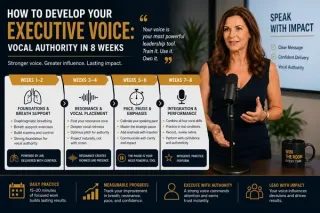
How to Develop Your Executive Voice: Vocal Authority in 8 Weeks
Develop your executive voice with this 8-week vocal authority program. Learn breath support, resonance, pace, pause, and practice routines for senior leaders. ...more
Improve Public Speaking Skills: Expert Tips by Lisa Hugo ,Corporate Communication Tips for CxOs & Executives
July 14, 2026•7 min read
Looking for webinar funnels, digital marketing or a client acquisition system for your coaching or consulting business?
Copyright © 2026 Audacia Marketing Management LLC, All rights reserved.