
Quick Answer: Successful communication in the Middle East business environment requires understanding three cultural foundations: the primacy of relationships over transactions (invest time in connection before business), the importance of indirect communication in sensitive situations (directness is valued, but context and delivery matter enormously), and the role of hierarchy and respect in professional interactions. Executives who adapt their communication style to these foundations consistently outperform those who apply Western-only frameworks in the GCC.
What You Will Learn
The five key communication principles that drive business success in the Middle East
How to adapt your presentation style for GCC audiences
Relationship-building protocols that accelerate trust and deal-making
Common communication mistakes that damage credibility in the region
Practical techniques for navigating hierarchy, hospitality, and indirect feedback
What You Will Need
Openness to cultural adaptation (not cultural imitation)
Research on specific cultural norms of the country you are engaging with (UAE, Saudi Arabia, Qatar, Bahrain, Kuwait, and Oman each have nuances)
Patience and a long-term relationship mindset
Time commitment: This is an ongoing practice, not a one-time adjustment
Time Required
Ongoing (cultural communication is a continuous development area)
Difficulty Level
Intermediate
Step-by-Step Instructions
Step 1: Understand the Relationship-First Framework
In Western business culture, relationships often develop as a byproduct of successful transactions. In the Middle East, the sequence is reversed: relationships are the foundation upon which transactions are built.
Before your first business presentation or negotiation in the GCC, invest time in relationship building. This means:
Accept hospitality graciously. When offered coffee, tea, or refreshments before a meeting, accept. Declining can be perceived as distancing yourself. The hospitality ritual is not a formality. It is the beginning of the business relationship.
Engage in personal conversation. Asking about family, health, and well-being before business discussions is expected and valued. This is not small talk. It is a genuine expression of interest in the person, not just the deal.
Be patient with timelines. Business decisions in the Middle East often take longer than Western executives expect because decision-makers want to ensure the relationship is solid before committing. Pushing for a fast decision can damage trust.
Why this matters: Executives who skip the relationship-building phase and jump directly to business proposals are frequently perceived as transactional and untrustworthy. The relationship is not separate from the business. It is the business.
Pro Tip: Remember names, personal details, and follow up on previous conversations. An executive who asks "How was your son's graduation?" at the next meeting demonstrates the personal investment that accelerates trust in the GCC.
Step 2: Navigate Direct and Indirect Communication
Communication in the Middle East operates on a spectrum between direct and indirect, and the appropriate approach depends on context, hierarchy, and the sensitivity of the topic.
When directness is valued:
Stating your credentials and expertise (modesty can be misread as lack of competence)
Expressing commitment to a partnership or project
Sharing positive results or achievements
Making clear offers or proposals
When indirect communication is essential:
Delivering negative feedback or criticism (always in private, never in front of others)
Disagreeing with a senior person (frame disagreements as questions or alternative perspectives)
Discussing pricing or financial concerns (approach gradually, not bluntly)
Raising problems or challenges (present alongside solutions)
The concept of "saving face" is critical. Public criticism, contradiction, or embarrassment damages relationships irreparably. Always provide negative feedback privately, frame it constructively, and preserve the other person's dignity.
Why this matters: Western executives often default to a direct, "straight to the point" approach that works well in New York or London but can create friction in Dubai, Riyadh, or Doha. Adapting your directness level to the context is a sign of cultural intelligence, not weakness.
Pro Tip: When you need to deliver a difficult message, use "softening" language: "I wonder if we might consider..." or "One perspective that may be worth exploring is..." These phrases feel indirect to Western ears but communicate clearly in Middle Eastern contexts while preserving respect.
Step 3: Adapt Your Presentation Style
Presentations in the Middle East require adjustments from standard Western presentation practices:
Pacing and patience:
Allow more time for questions and discussion during your presentation, not just at the end
Be prepared for interruptions, which are not considered rude but rather a sign of engagement and interest
Do not rush. A measured, unhurried pace signals confidence and respect for the audience's time
Hierarchy awareness:
Address the most senior person in the room first and most frequently
Make eye contact with decision-makers during your key points
If a senior person asks a question, give it full attention even if it seems tangential to your topic
Titles matter. Use "Sheikh," "Your Excellency," or professional titles until invited to use first names
Content adjustments:
Include references to the region's economic vision (Saudi Vision 2030, UAE Centennial 2071) when relevant
Use case studies from the region or similar markets rather than exclusively Western examples
Emphasize long-term partnership and mutual benefit rather than short-term gains
Include visual elements and data that demonstrate respect for the audience's sophistication
Language considerations:
If presenting in English to an audience where English is a second language, speak clearly and at a moderate pace
Avoid idioms, slang, and culture-specific references that may not translate
Provide materials in Arabic when possible, even if the presentation itself is in English
If working with an interpreter, pause after each key point to allow complete translation
Why this matters: A presentation that feels efficient and well-paced to a Western audience may feel rushed and impersonal to a GCC audience. Adapting your style shows cultural respect and increases the likelihood that your message will be received positively.
Step 4: Master the Art of Business Hospitality and Reciprocity
Hospitality is a cornerstone of Middle Eastern business culture. Understanding and participating in hospitality rituals builds trust faster than any slide deck.
Key practices:
Accept invitations. Dinner invitations, coffee meetings, and social events are business-building opportunities. Declining repeatedly signals lack of interest in the relationship.
Reciprocate appropriately. If a business partner hosts you for dinner, reciprocate with an invitation of your own at your next visit. The exchange of hospitality creates bonds of mutual obligation and respect.
Gift-giving etiquette. In many Middle Eastern contexts, thoughtful gifts are appreciated. Choose quality items that reflect your home country or culture. Avoid alcohol and items that conflict with Islamic values.
Dining protocols. Follow your host's lead on seating, food service, and conversation topics. Showing appreciation for the food and hospitality is always valued.
Why this matters: Business hospitality in the Middle East is not a social nicety. It is a business strategy. The relationships built over shared meals and hospitality often determine which partners are chosen for major projects.
Step 5: Understand Regional Variations
The Middle East is not a monolith. Each country has distinct business communication norms:
UAE (Dubai, Abu Dhabi): The most internationally oriented market in the GCC. Business culture blends Western efficiency with regional relationship values. English is widely spoken. Meetings often start on time (closer to Western expectations), but relationship-building remains essential.
Saudi Arabia: Rapid modernization under Vision 2030 is creating a new business culture that blends tradition with innovation. Hierarchy and respect for seniority remain central. Business moves at its own pace, and patience is critical.
Qatar: Small market with significant influence. Personal connections are paramount. Qatari business leaders value deep, long-term partnerships over transactional relationships.
Bahrain: More relaxed business culture with strong British influence. English is widely used. Business pace tends to be faster than Saudi Arabia but retains strong relationship orientation.
Kuwait: Conservative business environment with emphasis on family business networks. Access to decision-makers often comes through personal introductions and relationship chains.
Oman: Quiet, relationship-focused business culture. Omani business partners value sincerity, humility, and long-term commitment. Hard-sell approaches are particularly ineffective here.
Why this matters: An approach that succeeds in Dubai may not translate directly to Riyadh or Muscat. Research specific cultural norms before each engagement.
Step 6: Build Long-Term Cultural Communication Habits
Cultural communication competence is not a checkbox. It is a continuous practice. Build these habits into your professional development:
Read regional media. Follow Gulf Business, Arabian Business, and local news sources to understand current priorities and sensitivities.
Learn basic Arabic phrases. "As-salamu alaikum" (peace be upon you), "shukran" (thank you), and "inshallah" (God willing) demonstrate respect and effort.
Seek feedback. Ask regional colleagues or partners for honest feedback on your communication style. Most will appreciate the question.
Attend cultural events. Participate in Ramadan iftars, National Day celebrations, and cultural events when invited. These experiences deepen your understanding beyond what any guide can provide.
Why this matters: Executives who treat cultural adaptation as an ongoing practice rather than a one-time adjustment build the deepest and most productive relationships in the region.
Common Mistakes to Avoid
Assuming the Middle East is one culture. The UAE, Saudi Arabia, Qatar, Bahrain, Kuwait, and Oman each have distinct business norms. Research each market specifically.
Being too informal too quickly. Use titles and formal address until explicitly invited to use first names.
Publicly disagreeing with a senior person. This causes loss of face and can permanently damage a relationship.
Showing impatience with relationship-building. Attempting to skip the personal connection and jump to business signals that you are transactional.
Ignoring religious and cultural observances. Schedule meetings around prayer times. Be sensitive to Ramadan. Show awareness of Islamic holidays.
Troubleshooting
Problem: You are unsure how formal or informal to be in a specific meeting.
Solution: Default to more formal. It is always easier to become less formal when the other party signals comfort with informality than to recover from being perceived as too casual too soon.
Problem: A business deal is progressing much slower than expected.
Solution: This is likely normal, not a sign of disinterest. Continue investing in the relationship. Send occasional check-in messages that are personal, not transactional. Patience is a competitive advantage in the GCC.
Expected Results
Executives who adapt their communication style for the Middle East business environment consistently build stronger relationships, close deals more effectively, and earn reputations as culturally intelligent leaders. The investment in cultural communication competence pays dividends across every professional interaction in the region.
Next Steps
Research specific cultural norms for the country you are engaging with next
Read the companion guide: How to Structure a Compelling Executive Presentation
Explore Lisa Hugo's private executive coaching for culturally intelligent communication development
Frequently Asked Questions
I have worked in the Middle East for years. Do I still need to adapt?
Long-term residents sometimes develop blind spots. Periodically reassessing your communication habits and seeking feedback from local colleagues ensures you remain culturally attuned as the region evolves.
How do I balance cultural adaptation with authenticity?
Cultural adaptation is not about pretending to be someone you are not. It is about expanding your communication repertoire. You remain yourself. You simply become more effective by understanding how your audience receives information.
Should I learn Arabic for business in the Middle East?
While English is widely used in GCC business environments, learning conversational Arabic demonstrates extraordinary respect and commitment. Even basic phrases create warmth and goodwill that English-only communication cannot.
How do I handle business during Ramadan?
Business continues during Ramadan, but the pace changes. Schedule meetings in the morning when energy is highest. Be mindful of fasting hours. If invited to an iftar (the meal that breaks the fast), accept, as this is a significant hospitality gesture.
Additional Resources
About the Author: Lisa Hugo is an executive communication coach with more than a decade of experience helping C-suite leaders, entrepreneurs, and senior executives master high-stakes communication. Based in Dubai, she works with leaders across the Middle East and internationally through her private executive coaching program. Her clients include executives from Fortune 500 companies.



She’s helped 1000s of clients around the world to develop their speaking skill with her 1 : 1 coaching and powerful programs, each centered on a different aspect of speaking, including confidence, voice, presentation, and body language.
COMPANY
LEGAL
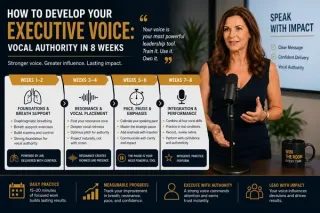
How to Develop Your Executive Voice: Vocal Authority in 8 Weeks
Develop your executive voice with this 8-week vocal authority program. Learn breath support, resonance, pace, pause, and practice routines for senior leaders. ...more
Improve Public Speaking Skills: Expert Tips by Lisa Hugo ,Corporate Communication Tips for CxOs & Executives
July 14, 2026•7 min read
Looking for webinar funnels, digital marketing or a client acquisition system for your coaching or consulting business?
Copyright © 2026 Audacia Marketing Management LLC, All rights reserved.