
Quick Answer: Projecting confidence when you feel nervous is a skill, not a personality trait. The key is controlling the three channels your audience reads: your voice (steady pace, downward inflection, deliberate pauses), your body (stillness, open posture, eye contact), and your words (concise statements, no qualifiers, direct language). Your audience cannot feel your nerves. They can only see and hear what you choose to show them. Master these three channels, and nervousness becomes invisible.
What You Will Learn
Why confidence is a performance skill, not an emotional state
How to control the three channels that project confidence (voice, body, language)
Pre-performance rituals that shift your internal state
How to recover when nervousness becomes visible
The difference between projecting confidence and being inauthentic
What You Will Need
A recording device for self-assessment
A mirror for body language practice
Willingness to practice these techniques in low-stakes settings first
Time commitment: 10-15 minutes of daily practice
Time Required
1-2 weeks of conscious practice for noticeable improvement
Difficulty Level
Beginner to Intermediate
Step-by-Step Instructions
Step 1: Understand the Confidence Gap
There is an important distinction between feeling confident and appearing confident. Many of the most effective executives in the world feel nervous before high-stakes moments. The difference is that they have learned to project confidence regardless of their internal state.
Your audience has no access to your heartbeat, your sweating palms, or the thoughts racing through your mind. They only have access to three things: what they see (your body), what they hear (your voice), and what they process (your words). Control these three channels, and your nervousness remains your private experience.
This is not about being fake. It is about being professional. A surgeon does not share their anxiety with a patient before operating. An executive does not broadcast their nervousness to stakeholders before recommending a strategy. Professional confidence means managing your external presentation so that your audience can focus on your message rather than your emotional state.
Why this matters: Nervousness is normal and even beneficial (it means you care about the outcome). But visible nervousness shifts the audience's attention from your content to your discomfort, which undermines your message and your credibility.
Pro tip: Reframe confidence as a skill you deploy, not a feeling you wait for. You do not need to feel confident to project confidence. They are independent of each other.
Step 2: Control Your Voice (Channel 1)
Your voice is the most immediate indicator of confidence or anxiety. Nervous speakers speak faster, higher, and with more filler words. Confident speakers are slower, lower, and more deliberate.
Technique 1: Slow down by 20%
When you feel nervous, your pace accelerates automatically. Consciously slow your speaking pace by about 20%. This feels unnaturally slow to you but sounds calm and authoritative to your audience.
Technique 2: Lower your pitch slightly
Nervousness raises vocal pitch. Before speaking, hum at a comfortable low pitch for 10 seconds. This sets your voice at a lower starting point. Maintain awareness of your pitch throughout your presentation, especially during Q&A when stress spikes.
Technique 3: Use deliberate pauses
Pauses are the most powerful confidence signal in speaking. A speaker who can pause for two seconds mid-presentation is a speaker who is in control. Replace filler words (um, uh, so) with silence. Every pause says: "I am not rushing because I do not need to."
Technique 4: End sentences with downward inflection
Nervous speakers often end statements with rising pitch, turning assertions into questions. Practice ending every declarative statement with your pitch going down. "We should move forward with this plan." (pitch drops on "plan"). This single change dramatically increases perceived confidence.
Why this matters: Your audience decides whether you are confident within the first few seconds of hearing you speak. Vocal control creates the impression of confidence before your content is even processed.
Step 3: Control Your Body (Channel 2)
Body language communicates confidence or anxiety more powerfully than words. When nervous, your body instinctively tries to protect itself: arms cross, shoulders rise, weight shifts, hands fidget. Overriding these instincts is essential.
Technique 1: Plant and stay
When you reach your speaking position, plant your feet shoulder-width apart and stay still. Do not pace, sway, rock, or shift weight. Stillness is the physical equivalent of a vocal pause. It signals: "I am grounded. I am in control."
Technique 2: Open your body
Keep your hands at your sides, on the table, or using open gestures. Never cross your arms, grip the podium with white knuckles, or put your hands in your pockets. Open body language signals openness and confidence. Closed body language signals self-protection and anxiety.
Technique 3: Make eye contact
Nervous speakers look at their slides, their notes, the floor, or the back wall. Confident speakers make direct eye contact with individuals in the audience. Hold eye contact with one person for a full sentence, then move to another person. This creates connection and demonstrates that you are not hiding.
Technique 4: Slow your movements
Every physical action should be deliberate. Walk to the podium slowly. Pick up your clicker purposefully. Turn to face a new section of the audience with intention. Quick, jerky movements broadcast nervousness. Slow, purposeful movements broadcast control.
Why this matters: When your body looks calm, your brain begins to believe it. This is not just projection. It is self-regulation. Calm body language actually reduces the internal experience of anxiety through a feedback loop between your body and your brain.
Step 4: Control Your Words (Channel 3)
Nervous speakers use language patterns that undermine their authority: qualifiers, hedges, apologies, and excessive disclaimers. Confident speakers use direct, concise language.
Eliminate confidence killers:
Instead of "I think we should probably consider..." say "We should..."
Instead of "I am not sure, but maybe..." say "Here is my perspective..."
Instead of "Sorry, this might not be relevant, but..." say "One important factor is..."
Instead of "Does that make sense?" say nothing. Let your statement stand.
Use decisive language:
"My recommendation is..."
"The data supports..."
"We will proceed with..."
"The best approach is..."
Keep sentences short. Long, winding sentences are a symptom of nervous over-explaining. State your point. Support it briefly. Stop. If the audience needs more, they will ask.
Why this matters: Tentative language tells your audience that you are not sure about your own message. Even if you feel uncertain, using decisive language signals that you have considered the options and reached a conclusion.
Step 5: Build Pre-Performance Rituals
The 15 minutes before you speak determine much of your confidence level during the presentation. Build a consistent pre-performance ritual:
10 minutes before:
Find a private space (hallway, restroom, empty room)
Do box breathing: inhale 4 counts, hold 4, exhale 4, hold 4. Repeat 4-6 cycles
Stand in an expansive posture (feet wide, hands on hips) for 2 minutes
Say out loud: "I am excited about this. I am prepared. I know my material."
5 minutes before:
Vocal warm-up: hum for 30 seconds, do lip trills for 30 seconds, speak your opening line at full volume once
Review your three core messages (not your slides, your messages)
Visualize yourself delivering your opening with calm authority
1 minute before:
Take one deep breath
Relax your jaw, drop your shoulders
Walk to your position with purpose
Why this matters: Rituals create predictability, and predictability reduces anxiety. When you follow the same routine before every speaking engagement, your brain begins to associate the ritual with the performance state rather than the anxiety state.
Step 6: Recover When Nervousness Shows
Despite your best efforts, there will be moments when nervousness becomes visible: a shaking voice, a lost train of thought, a visible tremor. The key is recovery, not prevention.
If your voice shakes: Pause. Take a breath. Lower your pitch slightly. Resume at a deliberately slower pace. The audience will interpret the pause as emphasis, not panic.
If you lose your train of thought: Pause. Do not fill the silence with "um" or apologies. Glance at your notes or your key message card. Say "Let me return to..." and continue. This happens to every speaker at every level. Your recovery determines whether anyone remembers it.
If your hands shake: Place them on the podium, the table, or clasp them gently in front of you. Do not hold papers (which amplify trembling). Use a clicker rather than a pointer.
If you blush or sweat: Ignore it. Your audience notices far less than you think. Drawing attention to physical symptoms ("Sorry, it is warm in here") makes them more visible, not less.
Why this matters: Perfect composure is not required. Effective recovery is. An executive who stumbles, pauses, and continues with composure earns more respect than one who never stumbles, because the audience recognizes the strength required to recover gracefully.
Common Mistakes to Avoid
Telling the audience you are nervous. This shifts their focus from your message to your emotional state. Keep your nerves private.
Over-rehearsing to the point of rigidity. You want to know your material, not recite a script. Leave room for natural delivery.
Relying on alcohol or beta-blockers as a primary strategy. These mask symptoms without building real skills.
Comparing yourself to speakers who appear naturally confident. Many of them are projecting confidence exactly the way you will learn to.
Avoiding high-stakes situations. Avoidance prevents you from building the skills that only come through experience.
Troubleshooting
Problem: You feel confident during practice but nervous during the real event.
Solution: Practice under conditions that more closely simulate the real event: stand up, use the actual slides, present to a live audience (even one person). The gap between practice and performance narrows when practice conditions match performance conditions.
Problem: You project confidence initially but lose composure during Q&A.
Solution: Q&A is a different skill from presenting. Prepare for Q&A separately. Anticipate tough questions and rehearse responses. The PAR framework (Pause, Acknowledge, Respond) gives you a structure that maintains composure under questioning.
Expected Results
Within 1-2 weeks of consistent practice, executives typically report that their visible nervousness decreases significantly, even while their internal experience of anxiety remains. Over 4-6 weeks, many executives find that the internal anxiety also decreases as their brain learns from repeated experience that speaking situations are manageable.
Next Steps
Practice these techniques in your next three meetings before using them in a high-stakes presentation
Read the companion guide: How to Overcome Public Speaking Anxiety: 10 Evidence-Based Techniques
Explore Lisa Hugo's private executive coaching for intensive confidence development
Frequently Asked Questions
Is projecting confidence when I feel nervous the same as being fake?
No. It is the same as being professional. You manage your external presentation so that your audience can focus on your message. Every leader does this. Projecting confidence is not dishonesty. It is a communication skill.
Will the nervousness ever go away completely?
For most executives, some degree of arousal before high-stakes situations is permanent, and desirable. The arousal keeps you sharp and engaged. What changes is your ability to manage it and your trust in your own capacity to perform despite it.
Can I be confident without being arrogant?
Absolutely. Confidence is about clarity, composure, and decisiveness. Arrogance is about dismissing others and overestimating your own importance. You can be confident and humble simultaneously.
How long does it take to become a naturally confident speaker?
Most executives reach a point of "comfortable confidence" within 3-6 months of regular practice and speaking experience. "Natural" confidence is really just well-practiced projected confidence that has become habitual.
Additional Resources
How to Overcome Public Speaking Anxiety: 10 Evidence-Based Techniques
How to Command Attention in the First 30 Seconds of Any Presentation
About the Author: Lisa Hugo is an executive communication coach with more than a decade of experience helping C-suite leaders, entrepreneurs, and senior executives master high-stakes communication. Based in Dubai, she works with leaders across the Middle East and internationally through her private executive coaching program. Her clients include executives from Fortune 500 companies.



She’s helped 1000s of clients around the world to develop their speaking skill with her 1 : 1 coaching and powerful programs, each centered on a different aspect of speaking, including confidence, voice, presentation, and body language.
COMPANY
LEGAL
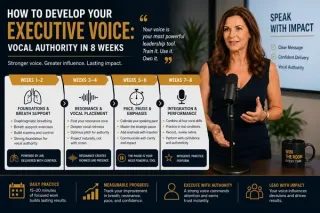
How to Develop Your Executive Voice: Vocal Authority in 8 Weeks
Develop your executive voice with this 8-week vocal authority program. Learn breath support, resonance, pace, pause, and practice routines for senior leaders. ...more
Improve Public Speaking Skills: Expert Tips by Lisa Hugo ,Corporate Communication Tips for CxOs & Executives
July 14, 2026•7 min read
Looking for webinar funnels, digital marketing or a client acquisition system for your coaching or consulting business?
Copyright © 2026 Audacia Marketing Management LLC, All rights reserved.