
Quick Answer: Public speaking anxiety is a physiological response, not a character flaw. The most effective approach combines cognitive reframing (changing how you interpret nervousness), physical regulation (controlling your body's stress response), and systematic desensitization (gradual, repeated exposure). These ten evidence-based techniques, drawn from cognitive behavioral therapy, performance psychology, and neuroscience, can reduce speaking anxiety by 40-60% within weeks of consistent practice.
What You Will Learn
Why your brain treats public speaking as a threat and how to override that response
Ten specific, research-backed techniques for managing speaking anxiety
How to use anxiety as performance fuel rather than a barrier
Pre-presentation routines that calm your nervous system in minutes
Long-term strategies for building lasting confidence at the podium
What You Will Need
Willingness to practice techniques consistently (not just read about them)
A recording device for self-observation
Access to low-stakes speaking opportunities for practice
Time commitment: 10-15 minutes daily for technique practice
Time Required
2-4 weeks of consistent practice for meaningful reduction in anxiety
Difficulty Level
Beginner (techniques are accessible regardless of current anxiety level)
Step-by-Step Instructions
Step 1: Understand the Science Behind Your Fear
Before applying any technique, understand what is actually happening in your body. Public speaking anxiety is a survival response. Your amygdala, the brain's threat detection center, interprets standing in front of a group as a social threat. It triggers the fight-or-flight response: elevated heart rate, shallow breathing, dry mouth, sweating, and muscle tension.
This response is not a sign of weakness. It is your nervous system doing exactly what it evolved to do. The problem is not the response itself. The problem is that your brain has miscategorized "giving a presentation" as a life-threatening event.
Every technique in this guide works by either interrupting this threat response, retraining your brain's categorization of speaking situations, or channeling the physiological arousal into performance energy.
Why this matters: Understanding the mechanism removes shame. You are not "bad at public speaking." Your nervous system is overreacting to a perceived threat. That overreaction can be recalibrated.
Pro Tip: The physiological symptoms of anxiety (racing heart, sweating, heightened alertness) are nearly identical to excitement. The difference is entirely in your interpretation.
Step 2: Technique 1, Cognitive Reappraisal
Research from Harvard Business School by Alison Wood Brooks demonstrated that reframing anxiety as excitement significantly improves speaking performance. Instead of telling yourself "I am calm" (which your body knows is a lie), say "I am excited."
Before your next speaking situation, say out loud: "I am excited about this opportunity." Repeat it three times. This simple reframe redirects the same physiological arousal toward a positive performance state.
The study found that participants who reappraised anxiety as excitement performed measurably better in public speaking tasks than those who tried to calm down.
Why this matters: Trying to suppress anxiety intensifies it. Reframing it leverages the energy your body is already producing.
Step 3: Technique 2, Box Breathing
Box breathing is used by Navy SEALs, first responders, and elite athletes to regulate the nervous system under extreme stress. It works by activating the parasympathetic nervous system, which counteracts the fight-or-flight response.
The technique:
Inhale through your nose for 4 counts
Hold your breath for 4 counts
Exhale through your mouth for 4 counts
Hold empty for 4 counts
Repeat 4-6 cycles
Practice this daily for one week so it becomes automatic. Then use it in the five minutes before any speaking situation. Three cycles are usually enough to noticeably lower your heart rate and reduce the sensation of panic.
Why this matters: Controlled breathing is the fastest way to shift your nervous system from sympathetic (fight-or-flight) to parasympathetic (calm and focused). It works within 60-90 seconds.
Step 4: Technique 3, Progressive Muscle Relaxation
Anxiety creates muscle tension, often in the jaw, shoulders, and hands. Progressive muscle relaxation (PMR) systematically releases this tension.
Starting from your feet and moving upward, tense each muscle group for five seconds, then release for ten seconds. Pay special attention to your jaw (clench and release), shoulders (raise toward ears and drop), and hands (make tight fists and open).
Practice the full sequence daily for one week. Before speaking situations, use a shortened version focusing only on jaw, shoulders, and hands. The entire shortened version takes 60 seconds.
Why this matters: Physical tension restricts your breathing, tightens your voice, and signals anxiety to your audience. Releasing tension before you speak allows your voice and body to function naturally.
Step 5: Technique 4, Visualization and Mental Rehearsal
Elite athletes have used visualization for decades. The same technique applies to speaking. Your brain does not fully distinguish between vividly imagined experiences and real ones, which means mental rehearsal builds confidence similar to actual rehearsal.
Close your eyes and visualize your upcoming speaking situation in detail: the room, the audience, the lighting, the sounds. See yourself walking to the front of the room with calm confidence. Hear yourself delivering your opening with a steady, authoritative voice. Watch the audience responding positively. Feel the sense of control and competence.
Practice this visualization daily for five minutes in the week before an important speaking engagement.
Why this matters: Visualization creates neural pathways associated with successful performance. When the real moment arrives, your brain has already "practiced" success, reducing the novelty that triggers anxiety.
Step 6: Technique 5, Exposure Hierarchy
Cognitive behavioral therapy uses systematic desensitization, gradually exposing yourself to feared situations in increasing levels of intensity, to reduce phobic responses. Create your own exposure hierarchy for speaking:
Level 1: Speak up in a small team meeting with familiar colleagues
Level 2: Present a brief update in a larger meeting
Level 3: Lead a discussion or training session for your team
Level 4: Present to a cross-functional group or unfamiliar audience
Level 5: Deliver a formal presentation to senior leadership
Level 6: Speak at an external event or conference
Start at whatever level produces mild anxiety (not panic) and stay there until it feels manageable. Then move to the next level. Do not skip levels. Each successful experience at one level reduces anxiety at the next.
Why this matters: Avoidance maintains and strengthens anxiety. Gradual, repeated exposure teaches your brain that speaking situations are not dangerous, permanently recalibrating your threat response.
Step 7: Technique 6, The Power Pose Reset
Research on embodied cognition shows that your posture influences your psychological state, not just the other way around. Standing in an expansive, open posture for two minutes before a speaking situation increases feelings of confidence and reduces cortisol (the stress hormone).
Find a private space before your presentation. Stand with your feet shoulder-width apart, hands on your hips or arms raised in a V-shape. Hold for two minutes. Breathe deeply. This is not about fooling your audience. It is about priming your own nervous system for confidence.
Why this matters: Physical posture sends signals to your brain about your emotional state. An expansive posture tells your brain "I am confident and in control," which reduces the anxiety response.
Step 8: Technique 7, Audience Reframing
Much of speaking anxiety comes from perceiving the audience as judges or critics. Reframe your audience as allies who want you to succeed.
Before speaking, remind yourself: "These people are here because my topic matters to them. They want useful information. They are not evaluating me as a person. They are hoping to learn something valuable."
Identify two or three friendly faces in the audience before you begin. Make eye contact with them during your opening. Their positive reactions will reinforce your confidence.
Why this matters: The brain's threat response is triggered by perceived social evaluation. When you reframe the audience from "evaluators" to "allies," the threat level drops significantly.
Step 9: Technique 8, Preparation as Anxiety Reduction
The single most effective anxiety reducer is thorough preparation. Anxiety thrives on uncertainty. Preparation eliminates uncertainty.
For every speaking opportunity, prepare at a level that exceeds what you think is necessary:
Know your material well enough to present without slides
Anticipate the five most likely questions and prepare answers
Rehearse your opening and closing until they are memorized
Visit the room in advance if possible
Test all technology before your audience arrives
Overprepare your opening. The first 60 seconds are when anxiety peaks. If you have those words locked in, momentum will carry you forward.
Why this matters: Preparation converts unknown variables into known ones. Each unknown you eliminate reduces your brain's perception of threat.
Step 10: Technique 9, The Pre-Performance Routine
Elite performers in every field use consistent pre-performance routines to enter an optimal state. Create yours and use it before every speaking engagement.
A sample routine (15 minutes before speaking):
3 minutes of box breathing
2 minutes of power posing
2 minutes of visualization
3 minutes reviewing your three core messages
2 minutes of vocal warm-up (humming, lip trills)
3 minutes of light movement (walking, stretching)
Consistency is key. Using the same routine every time creates a Pavlovian association between the routine and a calm, focused performance state.
Why this matters: Routines reduce decision-making, create a sense of control, and prime your body and mind for optimal performance.
Step 11: Technique 10, Post-Performance Analysis (Without Self-Criticism)
After each speaking engagement, conduct a brief, structured review. Answer three questions:
What went well? (Identify at least three positives)
What would I do differently next time? (Identify one specific improvement)
What did I learn about my anxiety patterns? (Observe without judging)
Do not replay the presentation in your mind looking for mistakes. This reinforces anxiety. Instead, focus on evidence that you survived, that the audience responded positively, and that your preparation paid off.
Why this matters: Anxious speakers tend to engage in post-event rumination, replaying every perceived mistake. Structured positive review breaks this cycle and builds a track record of evidence that speaking situations are manageable.
Common Mistakes to Avoid
Trying to eliminate anxiety entirely. The goal is management, not elimination. Some arousal improves performance.
Using alcohol or beta-blockers as a primary strategy. These mask symptoms without building real skills. Use techniques that create lasting change.
Avoiding speaking opportunities. Avoidance is the single biggest factor that maintains speaking anxiety long-term.
Comparing yourself to naturally confident speakers. Everyone's starting point is different. Compare yourself only to your own baseline.
Expecting instant results. These techniques work through consistent practice over weeks, not through one-time application.
Troubleshooting
Problem: Box breathing makes you feel more anxious.
Solution: Start with a shorter cycle (3 counts instead of 4) and practice when you are already calm. Build up to the full 4-count cycle gradually. Some people find exhaling for 6 counts while inhaling for 4 more effective.
Problem: Visualization feels impossible because you cannot stop imagining worst-case scenarios.
Solution: Start by visualizing a past speaking experience that went well. Replay that memory in detail. Once you can sustain a positive visualization from memory, begin visualizing future scenarios.
Expected Results
With consistent practice over 2-4 weeks, most executives experience a 40-60% reduction in subjective anxiety levels. Physical symptoms (shaking, sweating, racing heart) become noticeably milder. The critical shift is moving from "I cannot do this" to "I can manage this." Full confidence typically develops over 3-6 months of regular speaking practice combined with these techniques.
Next Steps
Read the companion guide: How to Project Confidence When You Feel Nervous
Explore Lisa Hugo's private executive coaching for personalized anxiety management
Sign up for Lisa Hugo's free masterclass Win The Room: Influence, Authority, Imapct
Frequently Asked Questions
Is public speaking anxiety a sign that I am not leadership material?
No. Many of the most effective leaders experience speaking anxiety. The difference is that they have learned to manage it rather than avoid it. Some of the executives Lisa coaches hold C-suite positions at Fortune 500 companies and still feel nervous before major presentations. Their skill is in managing the anxiety, not in being immune to it.
Can medication help with public speaking anxiety?
Beta-blockers and anti-anxiety medications can reduce physical symptoms, and some executives use them for specific high-stakes situations. However, they do not build the underlying skills that create lasting confidence. The most effective long-term approach combines behavioral techniques with gradual exposure.
How long until I feel completely comfortable speaking?
Complete comfort is not a realistic or even desirable goal. A degree of arousal improves performance. Most executives reach a point of "comfortable discomfort," where they feel the nervousness but it no longer controls their performance, within 3-6 months of consistent practice.
Will these techniques work for virtual presentations too?
Yes. Virtual presentations create a different type of anxiety (the discomfort of speaking to a camera without audience feedback), but the same techniques apply. Box breathing, cognitive reappraisal, and thorough preparation are equally effective regardless of format.
Additional Resources
About the Author: Lisa Hugo is an executive communication coach with more than a decade of experience helping C-suite leaders, entrepreneurs, and senior executives master high-stakes communication. Based in Dubai, she works with leaders across the Middle East and internationally through her private executive coaching program. Her clients include executives from Fortune 500 companies.



She’s helped 1000s of clients around the world to develop their speaking skill with her 1 : 1 coaching and powerful programs, each centered on a different aspect of speaking, including confidence, voice, presentation, and body language.
COMPANY
LEGAL
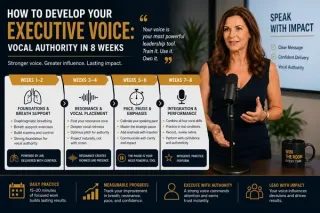
How to Develop Your Executive Voice: Vocal Authority in 8 Weeks
Develop your executive voice with this 8-week vocal authority program. Learn breath support, resonance, pace, pause, and practice routines for senior leaders. ...more
Improve Public Speaking Skills: Expert Tips by Lisa Hugo ,Corporate Communication Tips for CxOs & Executives
July 14, 2026•7 min read
Looking for webinar funnels, digital marketing or a client acquisition system for your coaching or consulting business?
Copyright © 2026 Audacia Marketing Management LLC, All rights reserved.