
Table of Contents
Executive Summary
Introduction: Every Room Is Your Stage
Chapter 1: The Win The Room Framework
Chapter 2: Before You Begin - The Executive Influence Kickoff
Chapter 3: Weeks 1-2 - Authority and Confidence Under Pressure
Chapter 4: Weeks 3-4 - Voice and Visual Impact
Chapter 5: Weeks 5-6 - Message Mastery and Strategic Storytelling
Chapter 6: Weeks 7-8 - Strategic Influence and Integration
Chapter 7: Daily Practices and Routines
Chapter 8: Measuring Your Transformation
Chapter 9: Beyond the 8 Weeks - Sustaining Excellence
Conclusion: Your Win The Room Journey
Key Takeaways: The 8 Principles of Winning The Room
8-Week Quick Reference Guide
About the Author and Win The Room
Executive Summary
This guide is the definitive companion to Win The Room: Influence, Authority, Impact, an intensive 8-week coaching program designed for leaders, executives, and business owners who are ready to fundamentally elevate how they communicate, influence, and lead. Whether you sit in the C-suite, manage cross-functional teams, or own a growing business, the ability to "win the room" is the single most powerful differentiator between leaders who are competent and those who are truly exceptional.
Over eight focused weeks, you will build mastery across three interconnected pillars: Presence, Structure, and Connection. Each pillar is developed through live coaching sessions, private video reviews, personalized feedback, and real-world practice scenarios. This is not a theoretical overview or a collection of tips. It is a rigorous, week-by-week program that produces lasting behavioral change.
This guide is for you if you have deep expertise but struggle to communicate it with the clarity and confidence it deserves. It is for you if you lead important meetings but leave wondering whether your message truly landed. It is for you if you know that the gap between where you are and where you want to be is not about what you know, but about how you show up.
Win The Room operates on a rolling monthly cohort model, with new groups starting every month. The program requires approximately 2-4 hours per week, with coaching sessions running one hour each on Tuesdays and Thursdays. This structure ensures consistent engagement without overwhelming your executive schedule.
What makes this program different is its focus on influence rather than public speaking, its tailored approach to leadership scenarios, and its foundation in direct, personalized coaching from Lisa Hugo. The result is not simply knowing how to communicate more effectively. It is having rewired how you think about, prepare for, and deliver every high-stakes interaction.
Introduction: Every Room Is Your Stage
Every room you enter represents an opportunity. A boardroom, a virtual meeting, a hallway conversation, a keynote stage, a negotiation table. Each of these environments is a moment where your leadership is either amplified or diminished by how you communicate. The leaders who rise fastest, earn the most trust, and drive the greatest results are not always the smartest people in the room. They are the ones who know how to win the room.
Winning the room does not mean dominating it. It means shaping the energy, directing the conversation, and leaving every person in that space feeling heard, aligned, and compelled to act. It is the intersection of three critical pillars that, when developed together, create a communication presence that is genuinely transformational.
The Three Pillars form the architecture of Win The Room:
Presence is how you show up: your confidence, composure, energy, voice, and physical presence. People form impressions quickly, and those impressions are shaped long before you deliver your first data point.
Structure is how you communicate ideas: simplifying complexity, achieving clarity, and creating memorable messages. Even strong ideas lose impact when poorly delivered.
Connection is how you influence people: building trust, driving engagement, earning buy-in, and inspiring action. Communication is about outcomes, not just being understood.
When these three pillars align, you consistently win the room.
Over the next 8 weeks, you will develop each pillar through targeted coaching, real-world application, and personalized feedback. The program is structured in four phases: Authority Foundations (Weeks 1-2), Vocal and Visual Impact (Weeks 3-4), Message and Story Mastery (Weeks 5-6), and Strategic Influence and Integration (Weeks 7-8).
To get the most from this guide, commit to the practices outlined in each chapter. Record yourself regularly. Seek honest feedback. Treat every meeting, presentation, and conversation as a practice opportunity. The leaders who transform fastest are those who bring intentionality to every interaction, not just the high-stakes ones.
Key Insight: Leadership communication is not a soft skill. It is the skill that determines whether all your other skills get noticed, valued, and acted upon. this objective. If it does not, remove it.
Chapter 1: The Win The Room Framework
What It Means to "Win the Room"
Winning the room is the ability to enter any communication environment and achieve three things simultaneously: capture attention, earn trust, and inspire action. It is not about charisma as an innate trait. It is a learnable system of behaviors, habits, and strategies that any committed leader can develop.
The most common misconception about powerful communicators is that they were born that way. The best communicators are the most disciplined practitioners. They prepare more thoroughly, reflect more honestly, and practice more consistently than their peers.
The Three Pillars in Depth
Presence is the foundation of authority. It encompasses your confidence, composure, energy, voice quality, and physical bearing. People form impressions within seconds of encountering you, and those impressions are shaped primarily by nonverbal signals. When your presence is strong, people stop scrolling, stop multitasking, and pay attention. Presence is not aggression. It is the quiet certainty that comes from preparation, competence, and a deep connection to your message. You command the room without demanding it.
Structure is what transforms expertise into influence. Many brilliant leaders struggle not because their ideas lack merit, but because those ideas are buried under complexity, jargon, or disorganized delivery. Structure is your ability to simplify the complex, to distill a ten-minute explanation into a sixty-second message that resonates. It includes frameworks for organizing your thoughts, techniques for creating memorable messages, and methods for delivering information in a sequence that builds understanding and momentum. When your structure is strong, your ideas land the first time you share them.
Connection is the ultimate measure of communication effectiveness. A brilliant presentation that changes nothing has no connection. A difficult conversation that shifts a relationship, a meeting that produces clear decisions, a pitch that earns buy-in, these are the markers of genuine connection. Connection is built through trust, engagement, emotional intelligence, and the ability to adapt to your audience in real time. When your connection is strong, your communication produces results that outlast the moment.
Why This Differs from Public Speaking Training
Win The Room is not a public speaking course. It is a leadership communication program designed for real-world scenarios: boardroom presentations, stakeholder negotiations, team leadership conversations, investor pitches, media interactions, and high-stakes discussions where outcomes matter. The frameworks work equally well for introverts and extroverts, for native English speakers and those speaking English as a second language.
Quick Tip: Your competitive advantage is not what you know. It is your ability to make what you know matter to others.
Assessing Your Current State
Before beginning the program, conduct an honest self-assessment across all three pillars. Rate yourself from 1 to 10 on each:
Presence: Do people pay attention when you speak? Do you project confidence? Is your voice strong and clear? Do you maintain composure under pressure?
Structure: Are your messages clear and concise? Can you simplify complex ideas? Do people remember your key points?
Connection: Do your meetings produce clear outcomes? Do your presentations drive action? Do people trust you and feel engaged?
Record these scores. You will revisit them at the midpoint (Week 4) and at the conclusion (Week 8) to measure your transformation.
Chapter 2: Before You Begin - The Executive Influence Kickoff
Your Private Onboarding Session
Before the 8-week journey begins, every participant completes an Executive Influence Kickoff, a private one-on-one session with Lisa Hugo. This session is the foundation upon which your entire transformation is built.
Setting Expectations and Goals:
During the kickoff, you will clarify your specific communication goals. Are you preparing for a board presentation? Seeking a promotion that requires greater executive presence? Building credibility with a new team? Leading through a period of organizational change? Your goals shape how each week's content is applied to your specific context.
The Communication Assessment:
You will complete a comprehensive communication assessment that evaluates your current strengths and growth areas across all three pillars. This assessment includes a baseline recording, where you deliver a short presentation on camera. This recording becomes the "before" snapshot against which all future progress is measured.
Personalized Development Map:
Based on your assessment, Lisa creates a personalized development map that identifies your highest-leverage areas for improvement. Some leaders need to focus primarily on vocal authority. Others need to sharpen message structure. Still others need to develop their ability to connect and influence in real time. Your map ensures that the 8-week program delivers maximum impact for your specific needs.
Quick Tip: Come to your kickoff session with three specific communication scenarios where you want to perform at a higher level. The more specific your goals, the faster your transformation.
Chapter 3: Weeks 1-2 - Authority and Confidence Under Pressure
Week 1: Authority Audit and Executive Positioning
The first week focuses on understanding how others currently perceive your communication and identifying the specific habits that may be weakening your impact.
Understanding Current Perceptions:
How do stakeholders, colleagues, and direct reports experience your communication? This week, you will develop awareness of the gap between your intention (what you mean to convey) and your impact (what others actually receive). Common gaps include: intending to project confidence but appearing tentative, intending to be thorough but coming across as unfocused, or intending to be collaborative but seeming indecisive.
Identifying Habits That Weaken Impact:
Every leader has communication habits, some helpful, some limiting. Common patterns include upspeak (raising pitch at the end of statements, making them sound like questions), hedging language ("I just think," "maybe we could"), rushing through key points, avoiding eye contact, and trailing off at the end of sentences. This week, your job is to identify your top three limiting patterns through recording review and coaching feedback.
Executive Positioning:
How you position yourself in conversations determines whether people see you as an expert, a peer, or someone who lacks authority. Learn to enter conversations with intention, to frame your contributions with confidence, and to hold your ground without aggression.
Week 1 Practice:
Record yourself speaking for three minutes on a topic you know well. Watch without judgment and note three observations about your delivery.
Identify your default speaking patterns across three contexts: explaining an idea, presenting a recommendation, and handling a question.
Begin tracking your filler words, hedging phrases, and upspeak instances.
Key Insight: You cannot change what you do not see. The authority audit is not about criticism. It is about creating the self-awareness that makes all future growth possible.
Week 2: Confidence Under Pressure
Week 2 builds the tools to stay calm, clear, and connected when the stakes are highest.
Managing High-Stakes Anxiety:
Pressure does not create poor communication. It reveals untrained communication. Learn specific techniques for managing physiological stress responses: diaphragmatic breathing to lower your pitch and steady your nerves, grounding exercises to maintain physical composure, and cognitive reframing to transform anxiety into focused energy.
Maintaining Clarity Under Questioning:
When challenged or questioned, most leaders either become defensive or lose their train of thought. Learn the "Pause, Process, Respond" technique: pause for a beat (this signals confidence, not uncertainty), process the question to ensure you address what was actually asked, and respond with a clear, concise answer. If you do not know the answer, say so directly and commit to a follow-up timeline.
Staying Connected When It Matters Most:
Under pressure, most communicators retreat inward, losing connection with their audience. Practice maintaining eye contact, reading audience reactions, and adjusting your approach in real time, even when you feel stressed.
Week 2 Practice:
Practice diaphragmatic breathing before every meeting this week: four counts in through the nose, six counts out through the mouth. Repeat three times.
Have a colleague ask you five challenging questions on camera. Review your responses for composure, clarity, and connection.
Identify one high-stakes situation this week and consciously apply the Pause, Process, Respond technique.
Quick Tip: Confidence is not the absence of nerves. It is the ability to perform at your best despite them.
Chapter 4: Weeks 3-4 - Voice and Visual Impact
Week 3: The Voice of Authority
Your voice is the primary instrument of your authority. Week 3 develops vocal control and impact through mastery of pitch, pace, and tone.
Pitch Control:
A lower, resonant pitch conveys authority and calm. Practice humming exercises: hum a comfortable note, feeling the vibration in your chest. Gradually open your mouth into an "ahhh" while maintaining that chest vibration. This trains your voice to resonate from your chest rather than your throat, creating a fuller, more authoritative sound. Avoid the common trap of pitching up at the end of statements, which undermines authority.
Pace Mastery:
Most leaders speak too quickly, especially under pressure. Your target pace is 130-150 words per minute for presentations and 100-120 for high-stakes conversations. The strategic pause is your most powerful vocal tool. Pause before a key point to create anticipation. Pause after a key point to let it land. Practice speaking a sentence, pausing for a full two seconds, then continuing.
Tone and Emotional Range:
A monotone voice loses audiences within minutes, regardless of how strong the content is. Develop your tonal range by reading passages aloud with deliberate variation, emphasizing key words, softening for emotional moments, and sharpening for calls to action.
Week 3 Practice:
Perform the morning vocal warm-up daily: diaphragmatic breathing (1 minute), humming (1 minute), articulation drills (1 minute), pitch variation reading (1 minute), power statement delivery (1 minute).
Record yourself daily and listen specifically for pace variation, pitch range, and vocal power.
Count filler words in each recording and track your reduction over the week.
Week 4: Presence and Visual Impact
Authority is communicated visually before a single word is spoken. Week 4 strengthens body language, eye contact, camera presence, and professional presentation for meetings and events.
Body Language and Posture:
Stand with your feet hip-width apart, shoulders back and down, chin parallel to the floor. This is your "power position." When seated, sit at the front edge of your chair, spine straight, both feet on the floor. Avoid crossing your arms, leaning back, or angling your body away from your audience. Practice the "three-second entrance": when you enter a room or begin speaking, pause for three seconds, make eye contact, take a breath, then begin.
Gesture Mastery:
Effective gestures are purposeful and visible. Keep your hands in the "gesture zone" between your waist and shoulders. Use open palms to signal honesty and controlled hand movements to emphasize key points. Stay natural with your gestures. Do NOT use steepled fingers. You might have been taught this in other courses or seen other leaders do this, but let me tell you, it does not contribute to your expertise, but rather appears stiff, unnatural and like you are trying too hard. Eliminate fidgeting, face-touching, and hand-clasping.
Camera and Virtual Presence:
On camera, your face is your stage. Position your camera at eye level. Look directly into the lens when speaking. Frame yourself so as much of your torso is visible as possible. Ideally your head, chest and shoulders visible with enough space to fit an apple above your head. Use facial expressions deliberately. What feels slightly exaggerated to you will appear natural on screen. Virtual environments demand the same amount of energy as in person, maybe even more. Increase your vocal variety by 20 percent and use your hands within the camera frame.
Wardrobe and Professional Presentation:
Your visual presentation is part of your executive presence. Receive guidance through the Executive Presence Toolkit on wardrobe choices, virtual setup optimization, and preparation for in-person events and speaking engagements.
Week 4 Midpoint Assessment:
Repeat your three-pillar self-assessment from Chapter 1. Compare your scores to your baseline. Record a five-minute presentation and compare it to your kickoff baseline recording. You should see measurable improvement in posture, vocal variety, and overall presence.
Key Insight: Your body speaks before your mouth opens. Make sure it is saying what you intend.
Chapter 5: Weeks 5-6 - Message Mastery and Strategic
Week 5: The Million Dollar Message
The ability to communicate value clearly, concisely, and compellingly is what separates leaders who inform from leaders who influence. Week 5 provides frameworks to simplify complexity and communicate your value effectively.
Simplifying Complexity:
Most experts overcommunicate. They share everything they know rather than the specific information their audience needs. Learn the "One Message" framework: for any interaction, identify the single most important message you need to land. Everything else is supporting evidence. If your audience remembers only one thing, what must it be?
The Headline-First Approach:
Lead with your conclusion or recommendation, then provide supporting details. This respects your audience's time and ensures your most important message is heard even if attention wanders. Practice restructuring your natural communication pattern from "background, analysis, conclusion" to "conclusion, key evidence, call to action."
Communicating Value to Different Audiences:
The same idea requires different framing for different audiences. A technical team needs specifics and methodology. A board needs outcomes and strategic implications. A client needs benefits and results. Learn to adapt your message architecture without changing your core message.
Creating Memorable Messages:
Memorable messages share common characteristics: they are specific rather than generic, they use concrete language rather than abstractions, and they connect to something the audience already cares about. Develop three core messages this week: your leadership philosophy (one sentence), your team or business mission (two sentences), and your strategic vision (three sentences).
Week 5 Practice:
Rewrite your most important current business message using the One Message framework.
Practice the headline-first approach in every meeting this week.
Deliver your three core messages aloud three times daily until they feel natural and powerful.
Quick Tip: If you cannot explain your idea in 60 seconds, you do not yet understand it well enough. Simplify until it is effortless.
Week 6: Strategic Storytelling
Stories are the most powerful tool in a leader's communication arsenal. Week 6 teaches you to build trust and credibility through strategic storytelling and to create a reusable Story Bank.
Why Stories Outperform Data:
Neuroscience confirms that stories activate more regions of the brain than data alone. When you share a story, your audience's brain synchronizes with yours, a phenomenon called neural coupling. This creates deeper understanding, stronger emotional connection, and better retention. Data informs. Stories persuade.
Building Your Story Bank:
Develop a personal library of stories organized by purpose. You need stories that establish credibility (your origin or expertise story), stories that demonstrate resilience (how you overcame a challenge), stories that paint the future (your vision for what is possible), and stories that build connection (moments of vulnerability or humor). Each story should be deliverable in 60-90 seconds.
Story Structure for Leaders:
Every effective leadership story follows a simple arc: Situation (set the scene briefly), Complication (introduce the challenge or tension), Resolution (describe the outcome), and Lesson (connect the story to the point you are making). Practice this structure until it becomes second nature.
Using Stories in High-Stakes Contexts:
Stories are not just for keynotes. Use a brief story to open a board presentation and establish context. Use a client success story to overcome objections in a sales conversation. Use a personal story to build trust with a new team. The strategic deployment of stories separates leaders who are forgettable from those who are unforgettable.
Week 6 Practice:
Write and rehearse four stories for your Story Bank: credibility, resilience, vision, and connection.
Tell one story per day to a real person in a real business context.
Record yourself delivering each story and refine for timing, emotional impact, and clarity.
Key Insight: The leaders who are remembered are the ones who make you feel something. Data creates understanding. Stories create action.
Chapter 6: Weeks 7-8 - Strategic Influence and Integration
Week 7: Strategic Influence and High-Stakes Buy-In
Week 7 develops the advanced skills of adapting to audiences, handling objections, and influencing decisions in high-stakes environments.
Reading and Adapting to Your Audience:
Before you speak, scan the room. Are people engaged or distracted? Anxious or relaxed? Skeptical or receptive? Practice reading three cues: body posture (open vs. closed), eye contact (direct vs. averted), and energy level (leaning in vs. leaning back). When you notice disengagement, shift strategies. Ask a question. Change your pace. Share an unexpected story.
Handling Objections with Grace:
Objections are not attacks. They are opportunities to deepen understanding and build trust. Use the "Acknowledge, Address, Advance" technique: acknowledge the concern genuinely, address it with evidence or reframing, and advance the conversation toward alignment. Never become defensive or dismissive.
Influencing Without Authority:
Many of the most important communication moments happen when you have no formal authority over your audience: pitching to investors, persuading peers, presenting to a board, or negotiating with clients. Learn ethical influence techniques grounded in reciprocity (give value before asking for commitment), social proof (reference others who have taken similar action), and consistency (connect your request to values the other person has already expressed).
Navigating Difficult Conversations:
Difficult conversations become manageable with structure. Use the "Fact-Feel-Future" method: state the facts without interpretation, acknowledge the feelings involved (yours and theirs), and propose a future-focused solution. This approach reduces defensiveness and keeps the conversation productive.
Week 7 Practice:
Before every meeting this week, identify the decision-maker's primary concern and tailor your approach accordingly.
Practice the Acknowledge, Address, Advance technique in at least two real conversations.
Role-play a difficult conversation scenario with a colleague and record it for review.
Quick Tip: The leader who asks the best questions influences the room more than the leader who gives the longest answers.
Week 8: Integration and Winning The Room
The final week brings all three pillars together. You will apply every skill learned across the program in real-world scenarios and create a personal growth roadmap for continued development.
Applying All Skills in Real-World Scenarios:
This week, practice activating Presence, Structure, and Connection in every interaction. Before each conversation or meeting, identify which pillar needs the most emphasis and consciously lean into it. After each interaction, reflect on how all three pillars showed up.
Real-World Pressure Testing:
Deliver a comprehensive presentation that integrates all eight weeks of development. This is your opportunity to demonstrate the full range of your transformation: vocal authority, physical presence, structured messaging, strategic storytelling, audience adaptation, and confident influence.
Your Personal Style Signature:
By Week 8, you have developed skills across every dimension of leadership communication. Now refine them into your signature style. What makes you distinctive? Perhaps it is your storytelling ability, your calm authority under pressure, or your gift for making complex ideas simple. Amplify what is uniquely yours.
Creating Your Growth Roadmap:
Working with Lisa, develop a personalized growth roadmap that extends beyond the 8-week program. This roadmap identifies your ongoing development priorities, practice routines, and milestones for the next 90 days. Excellence is not a destination. It is a discipline.
Final Transformation Assessment:
Complete your final three-pillar self-assessment. Record a presentation and compare it to your kickoff baseline recording. Gather feedback from stakeholders who have observed your communication over the past 8 weeks. Document your transformation.
Key Insight: The goal is not to become a different communicator. It is to become the most powerful version of who you already are.
Chapter 7: Advanced Performance Skills
Transformation is built in the daily moments, not the occasional big performances. These routines are the non-negotiable foundation of your 8-week program.
Morning Vocal Warm-Up (5 Minutes)
Perform this sequence every morning before your first meeting or call:
Diaphragmatic Breathing (1 minute): Four counts in through the nose, six counts out through the mouth. Repeat five times.
Humming (1 minute): Hum a comfortable note, feeling the vibration in your chest. Slowly move the pitch up and down.
Articulation Drills (1 minute): Repeat tongue twisters slowly, then at speed. Focus on crisp consonants and open vowels. Examples: "Red leather, yellow leather" and "Unique New York, you know you need unique New York."
Pitch Range (1 minute): Read a paragraph aloud, deliberately exaggerating your pitch variation.
Power Statement (1 minute): Deliver your core leadership message aloud with full vocal power, confident posture, and deliberate eye contact with yourself in a mirror.
Pre-Meeting Preparation Ritual (3 Minutes)
Before every significant interaction:
Intention (1 minute): What is the one outcome I must achieve? How do I want people to feel when this interaction ends?
Physical Reset (1 minute): Stand in your power position. Take three deep breaths. Roll your shoulders back. Lift your chin.
Mental Rehearsal (1 minute): Visualize yourself delivering your key message with confidence, clarity, and connection.
Post-Interaction Reflection (2 Minutes)
After every significant interaction, ask yourself:
What worked well? (Identify one specific moment you want to repeat.)
What would I change? (Identify one specific adjustment for next time.)
What did I learn about my audience? (Capture one insight about how they responded.)
Quick Tip: Keep a small notebook or use the notes app on your phone to capture these reflections. Patterns will emerge within weeks.
Weekly Review Process (15 Minutes)
Every Friday afternoon:
Watch one recording from the week and assess progress.
Review your daily reflection notes for patterns.
Identify the skill area that needs the most attention next week.
Set one specific practice goal for the coming week.
Celebrate one communication win from the week.
Chapter 8: Measuring Your Transformation
What gets measured gets improved. This chapter provides a framework for tracking your progress from the Executive Influence Kickoff through Week 8 and beyond.
Baseline to Final Comparison
Your transformation begins with honest measurement during the kickoff. At the midpoint (Week 4) and conclusion (Week 8), you repeat these assessments. Track the numerical change, but also pay attention to the qualitative shifts, the moments where you notice yourself responding differently.
Quantitative Metrics
Recording Comparisons: Compare your kickoff baseline recording directly to your Week 4 and Week 8 recordings. Measure specific variables: words per minute, filler word frequency, pause length and frequency, vocal pitch range, and gesture frequency.
Feedback Scores: At three points (Week 2, Week 4, Week 8), ask five colleagues to rate your communication on a scale of 1-10 across three dimensions: clarity, confidence, and impact.
Engagement Indicators: Monitor concrete outcomes: Are more people accepting your meeting invitations? Are your emails receiving faster responses? Are your proposals being approved more frequently?
Qualitative Indicators
Pay attention to shifts that are harder to quantify:
Internal confidence: Do you approach high-stakes interactions with less anxiety and more anticipation?
Opportunities: Are you being invited to more visible platforms or included in more strategic conversations?
Feedback quality: Are people commenting spontaneously on your communication?
Relationship depth: Are your professional relationships becoming more trusting and productive?
Stakeholder Feedback Gathering
At Week 8, ask five to seven stakeholders who interact with you regularly to answer: "How has my communication changed over the past two months?" "What is the most noticeable improvement?" "What one area should I continue to develop?"
Video Assessment Comparisons
Watch your kickoff, Week 4, and Week 8 recordings side by side. The changes that felt gradual from the inside are often dramatic when viewed in comparison. Pay particular attention to posture, facial expression, vocal energy, and overall confidence.
Key Insight: The leaders who measure their communication growth are the ones who sustain it. What you track, you improve. What you ignore, you lose.
Chapter 9: Beyond the 8 Weeks - Sustaining Excellence
Completing Win The Room is a significant achievement, but it is the starting line for a lifetime of exceptional leadership communication.
Maintaining Momentum
The most critical period in any transformation is the 30 days immediately following completion. This is when old habits exert the strongest pull. Maintain your daily practices, continue your weekly reviews, and keep recording yourself. The discipline that built these skills is the same discipline that sustains them.
Your Growth Roadmap in Action
The personalized growth roadmap you created in Week 8 is your guide for continued development. Follow the practice routines, hit the milestones, and check in with yourself regularly. At Day 30 after completion, conduct a formal self-review to ensure your new habits are holding strong.
Advanced Skill Development
With a strong foundation in all three pillars, you are ready for advanced development. Consider specializing in areas that align with your career trajectory: executive storytelling for board presentations, media training for public-facing roles, cross-cultural communication for global leadership, or persuasive negotiation for deal-making environments.
Becoming a Communication Leader
As your skills grow, you become a resource for others. Model the practices you have learned in every interaction. Create a communication culture within your team where clarity, confidence, and connection are valued.
Building Your Speaking Brand
You now have the skills to position yourself as a thought leader. Seek opportunities to speak at conferences, contribute to industry publications, participate in panel discussions, and share your expertise on professional platforms. Each public appearance reinforces your authority and expands your influence.
Continued Support Through the Strategic Support Hub
Win The Room graduates retain access to the Strategic Support Hub, a portal with resources, session recordings, and ongoing support materials. Use this hub to revisit frameworks, review coaching session recordings, and continue refining your skills long after the program concludes.
Conclusion: Your Win The Room Journey
You began this program as a leader with expertise, experience, and ambition. Over 8 intensive weeks, you have developed something that amplifies all of those assets: the ability to communicate with Presence, Structure, and Connection in every room you enter.
The transformation you have experienced is not superficial. You have rewired how you prepare for, deliver, and reflect on every interaction. You have built habits that will continue to compound, creating a leadership presence that grows stronger with every conversation, meeting, and presentation.
From this point forward, you are not simply a competent communicator. You are an exceptional one. You have the tools to command a boardroom, inspire a team, navigate a crisis, and deliver a keynote with equal confidence and clarity. You know how to read a room and adapt in real time. You know how to turn complex ideas into memorable messages. You know how to make your expertise visible, valued, and actionable.
Your path forward is clear: maintain the daily practices that built these skills, continue seeking feedback and growth, and use your growth roadmap to keep pushing forward.
Communication is not about being the loudest voice. It is about becoming the trusted voice others naturally follow.
The room is yours. Go win it.
Key Takeaways: The 8 Principles of Winning The Room
Presence is your first impression. How you show up, your confidence, composure, and energy, determines whether people lean in or tune out.
Structure turns expertise into influence. The message that is understood is the message that moves people. Simplify relentlessly.
Connection drives results. Communication is not about being understood. It is about inspiring action, earning trust, and creating buy-in.
Authority is built, not born. The leaders who seem naturally commanding are the ones who practice most deliberately.
Stories persuade where data informs. Build a Story Bank and deploy stories strategically to make your expertise memorable and human.
Your voice is your instrument. Invest in pitch, pace, and tone to command attention and convey gravitas.
Adapt to every audience and context. One-on-one, small group, virtual, and large audience communication each require different strategies.
Transformation is a daily discipline. The 8-week program builds the foundation, but daily practice sustains it for a lifetime.
About the Author and Win The Room
Lisa Hugo is an internationally recognized executive communication coach who helps leaders, executives, and business owners communicate with power, clarity, and authentic presence. Based in Dubai and working with clients globally, Lisa has coached hundreds of leaders across industries including finance, technology, healthcare, energy, and professional services.
Win The Room: Influence, Authority, Impact is Lisa's signature 8-week coaching program, designed for professionals who want to consistently command attention, communicate with clarity, and influence outcomes when the stakes are high. The program combines live coaching sessions, private video reviews, personalized feedback, and a comprehensive resource vault to create lasting behavioral change.
The program is built around three interconnected pillars, Presence, Structure, and Connection, and is suitable for executives, entrepreneurs, consultants, subject experts, business owners, and any professional who needs to influence through communication. New cohorts begin monthly, and applications are accepted on a rolling basis to ensure each group is cohesive and well-matched.
Graduates of Win The Room consistently report increased confidence in high-stakes communication, greater influence with stakeholders, stronger professional relationships, and a measurable improvement in their ability to drive decisions and results.
Copyright © 2026 Lisa Hugo/Audacia Marketing Management LLC, All rights reserved.
Ready to transform Your Leadership Communication?



She’s helped 1000s of clients around the world to develop their speaking skill with her 1 : 1 coaching and powerful programs, each centered on a different aspect of speaking, including confidence, voice, presentation, and body language.
COMPANY
LEGAL
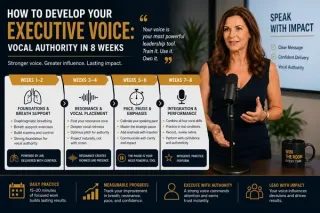
How to Develop Your Executive Voice: Vocal Authority in 8 Weeks
Develop your executive voice with this 8-week vocal authority program. Learn breath support, resonance, pace, pause, and practice routines for senior leaders. ...more
Improve Public Speaking Skills: Expert Tips by Lisa Hugo ,Corporate Communication Tips for CxOs & Executives
July 14, 2026•7 min read
Looking for webinar funnels, digital marketing or a client acquisition system for your coaching or consulting business?
Copyright © 2026 Audacia Marketing Management LLC, All rights reserved.